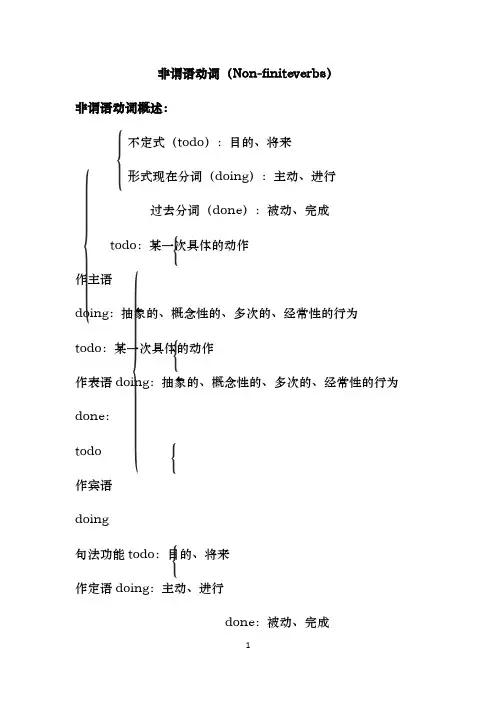
非谓语动词
- 格式:doc
- 大小:47.00 KB
- 文档页数:5
非谓语动词在英语中,动词不定式、动名词和分词(包括现在分词和过去分词)可以出现在句子中除谓语以外的任何一个位置上.Ⅰ).1 作主语Smoking is bad for health. 吸烟对人身体有害。
(笼统地谈吸烟问题)2 it用形式主语于句首常用不定式置于句尾* It is /was + adj./ n. /-ed +to do* It is no use/good/a waste of time + doing sth.It is impossible to finish the job in two days.It is no good/ use having a car if you can’t drive.如果你不会开车,有车也没用。
It is a waste of time watching TV. 看电视是浪费时间。
3 There is no…句型中,常用doing作主语。
There is no saying what will happen. 无法估计将会发生什么事。
There is no use making an excuse for this.为这事编造借口没用。
Ⅱ). 作宾语-------doing/ to do:⒈有些及物动词后面只能接doing作宾语,不能接不定式,常见的有:miss错过// suggest 建议/ finish 完成/ practise练习/ enjoy 喜欢/ imagine 想象/ can’t help禁不住/ admit 承认/ deny 否认/ envy 嫉妒/escape 逃脱/ risk 冒险/ forgive 原谅/ stand 忍受/ keep保持/ mind 介意/ appreciate 感激,赞赏/ consider 认为/ delay 耽误/ miss 想念/ understand 理解/ feel like想要I’m sorry I missed seeing you while in Shanghai.很遗憾,我在上海时没看到你。
⒉有些动词后面只能跟to do作宾语,不能接动名词,如:wish, hope, expect, offer, manage, decide, refuse, agree, pretend, promise, seem, failI don’t wish to be disturbed in my work.我不愿在工作中被打搅。
⒊有些动词后面既可以接动名词,也可以接不定式作宾语,其意义基本一样,如:begin, start, like, love, dislike, hate, prefer, can’t stand, 但like, love 和would 或should 连用时,接不定式作宾语。
⒋有些动词后面既可接动名词又可接不定式作宾语,但意义不同。
如:⑴mean to do sth. 打算干某事mean doing 意味着…I didn’t mean to hurt you.我没打算伤害你。
Missing the bus means waiting for an hour.误了车就意味着等一个小时。
⑵stop to do sth.停下来去做某事stop doing sth. 停止做某事I was lost and had to stop to ask the way.我迷路了只好停下来问路。
They stopped talking.他们停止了谈话。
⑶go on to do sth. (做完一件事之后)接着做(另一件事)go on doing sth.继续做某事After learning history, we went on to learn geography.学完历史之后,我们接着学地理。
You shouldn’t go on living this way.你不应当继续过这样的生活了。
⑷try to do sth. 试图做某事try doing sth.试试做某事(往往表示某种方法或方式)Let’s try knocking at the back door.咱们敲敲后边的门试试。
We tried to solve the problem.我们努力想解决这个问题。
⑸forget, regret, remember后接to do表示尚未发生的动作,接doing表示已经发生动作。
I forgot to write him a letter.我忘了给他写信。
(以前没写信)I forgot writing him a letter.我忘了以前曾写信给他。
(曾写过信)⑹be used to do sth. 被用来做…be used to doing sth. 习惯于做…We are used to going to bed early.我们习惯于早睡。
Wood can be used to make paper.木材可以用来造纸。
⑺can’t help(to)do sth. 不能帮助做某事can’t help doing sth. 不禁…We can’t help to solve the problem.我们不能帮助解决这个问题。
On hearing the news, we couldn’t help laughing. 一听到这个消息,我们忍不住大笑起来。
⑻allow, permit, advise, forbid, consider + doing /+ sb to doWe don’t allow smoking here.我们这里不允许吸烟。
We don’t allow them to smoke.我们不允许他们吸烟。
He advised having a rest.他建议休息。
He advised me to have a rest.他建议我休息。
I considered going to Canada.我考虑去加拿大。
I consider him to be honest.我认为他诚实。
⑼need, require, want + to be done/ doing “需要(被作某种处置)”The bridge needs/ requires/ wants repairing.=The bridge needs/ requires/ wants to be repaired. 这个桥梁需要修一修了。
⒌介词(除but以外)后面的动词宾语一律用doing形式。
They are interested in singing.他们爱好唱歌。
(动名词singing作介词in的宾语)* but 与no, not any, all 等词连用时为介词,但其后面的动词用to do,如果but前面有实义动词do 的任何形式,则but 后面用动词原形doHe did nothing but cry.他什么也没做,只是哭。
(but 前面有实义动词did, 所以but后面要接动词原形)I had no choice but to cry.我别无办法,只好哭。
(but前面没有实义动词do,所以but后面要跟不定式形式)⒍“wh- + to do,这一结构可转换成该疑问词引导的从句。
It hasn’t been decided where to go. 还没决定到哪里去。
(主语)I found out where to buy fruit cheaper.我找到了廉价买水果的地方。
(宾语)The question is what to write about.问题是应写什么。
(表语)Ⅳ. 作定语----to do/ doing/ done:⒈to do 做后置定语,与中心词构成逻辑上的动宾关系,表示将要发生的动作或状态I have something important to tell you. (something important 是tell you的逻辑宾语)⒉动名词作定语表示该名词的用途,现在分词作定语表示该名词正在进行的动作或存在的状态。
a reading room (=a room for reading ) 阅览室(动名词)a swimming pool (=a pool for swimming)游泳池(动名词)a swimming girl (=a girl who is swimming)在游泳的女孩(现在分词)a sleeping car (=a car for sleeping)一节卧车(动名词)a sleeping girl (=a girl who is sleeping)在睡觉的女孩(现在分词)⒊doing作定语,多表示动作正在进行/与谓语动词同时进行/经常性的动作或状态;done作定语,则多表示分词动作“先于谓语动词表示的动作”,表“被动”There were 50 children returning from school.= 50 children who were returning from school(表正在进行)Ⅴ. 作状语---- to do/ doing/ done:⒈doing作状语往往和逻辑主语之间存在主动关系,表示时间、原因、方式、结果、条件、伴随情况Walking down the street, I met an old friend of mine.(时间状语,walk 和meet 同时发生) Hearing the cry for help, they all rushed out.(原因状语,hear 和rush out 几乎同时发生)We sat by the window, talking about what had happened.(伴随状语,talk 和sit同时发生) Having brushed my teeth, I came downstairs for breakfast.(时间状语,brush teeth 在come downstairs 之前发生)`Thinking it over, you will not take the job.= If you think it over (条件状语)Having been there many times, he offered to be our guide.(原因状语,be there在offer之前发生)⒉done作状语表示被动(了解)⒊to do/ in order to do /so as to do(不于句首)用不定式作目的状语I studied hard to pass the exam.为了通过这次考试我努力读书。