
【名师精品】unit 8 Is there a post office near here Section A(2d-3c)课件
- 格式:pptx
- 大小:508.28 KB
- 文档页数:7


人教版unit8_Is_there_a_post_office_near_here_全英文说课稿Unit 8 Is there a post office near here?Section A (1a-2c)Good morning, everyone one! It’s my great honor to stand here and talk about my teaching idea. My topic today is Unit 8 Is there a post office near here? And I’ll talk about it from the following parts:the analysis of teaching material、the analysis of students、the teaching and learning method、the teaching procedures and the blackboard design.Now, please allow me to show you the first part—The analysis of teaching material.Part 1 The analysis of teaching materialStatus and functionsThis lesson is from the second book of GO FOR IT for Grade 7.It is the first period of this unit. This textbook is designed to cultivate students’overall abilities including linguistic, culture and social ones. And it is also designed with the aim of making Ss use English to exchange ideas, fulfill certain tasks and solve practical problems.This topic is about how to ask and give directions on the street. Students will be certainly interested in it because it is closed to their daily life.Now I’ll talk about the teaching aims and demands in this lesson.Teaching aims and demandsAccording to the new curriculum standard, teaching aims are composed of three aspects:Knowledge aims, Ability aims and Emotion aims.Knowledge aims:1. Ask Ss to learn the words of different buildings. Such as,post office, bank, supermarket, hotel, restaurant, cinema, etc.2. Ask Ss to learn the prepositions of places:next to, across from, between, near, behind, in front of…etc.3. Ask Ss to learn the sentence pattern:Is there a/an…? Yes, there is. / No, there isn’t.Where is…? It’s +prepositional phrases.Ability aims:1. To help Ss talk about the places and locations with the target language.2. To enable students to ask and give directions using the sentence pattern.Emotion aims:1. To help Ss increase their ability of communication, cooperation and exploration by expressing their own opinions with the target language.2. To make Ss get happiness by giving help to others.Next, I’ll talk about the teaching important and difficult points.Teaching important and difficult pointsThe important points of this unit are the prepositions of places, the names of different places, and making conversations with the target language.The difficult point is asking and giving directions with the prepositions and the sentences.Part 2 The analysis of studentsThis lesson is for the students of Grade 7, they have leant about “Where is ......? It’s on/ in/ under ......”before. And they can use the structures when they practice asking and givingdirections in this lesson.The students have learned English for more than half a year so far. They can understand each other well. They have showed great interest in English. This topic is closed to the daily life, so they will be interested in it as usual.After this I’ll talk about teaching and learning methods.Part 3 Teaching and learning methodsFor teaching methods, the new curriculum standard advocates that language is for communication, English teaching should lay special emphasis on development of Ss. For this purpose, I’ll mainly adopt task-based teaching method、communication teaching method. H ere I’ll mainly talk about Task-based teaching method, that is to say, in my class I’ll design different activities and get Ss to fulfill the tasks. In that way, Ss will learn to experience and explore to improve their overall abilities.For learning metho ds, I’ll adopt cooperative learning method and autonomous learning method. Ss in grade 7 have mastered a certain basic knowledge of English, and they still keep their curiosity on something new. According to this situation, in this unit I will design some activities to help Ss to develop their learning strategies. Now I’ll deal with the most important part, teaching procedure.Part 4 Teaching procedureIn this part, I’ll arrange 7 steps:Step1 Warm-upIn this step, we’ll first give each other greetings, then I’ll guide students to review what we’ve learnt in last class, and then I’ll lead in the new lesson. I’ll ask them questions like“Where are my books? /Where are your pens...”. to reviewthe prepositions they have learned and lead in There is a…. Is there a……?Now I’ll go to step 2.Step2 presentationFirst, I’ll present pictures of buildings on the street. The students are interested in the new knowledge and I will teach them all about these words.Next, I’ll ask them to imagine a real situation. I’ll say, “Now, you are in a new city, you don’t know the places here. And you want to go to a library, how can you ask people about it?Then I’ll help students to ask, “Is there a library near here?” . and let them answer , “Yes, there is./ No, there isn’t. ”.No w, I’ll ask students to practice the sentences.Step3 practiceI’ll ask students to look at the pictures in activity 1a on page 43.First, ask them to match the right places with the words.Next, ask them to talk about the places with the sentence pattern:-Is there a……near here? I’ll help them to look at the map and answer:-Yes, there is. It is on______ Street.Now, students work in pairs.Then, we will go on listening practice. I’ll ask students to listen to the tapeand circle the places in 1a they hear. Check the answers.After that I’ll enter into step 4.Step4 listening and practiceBefore listening, I’ll first present the prepositions of placeswith some pictures. I’ll lead students to review and learn the prepositions. Then, let them talk about the different places and make conversations using these words.After this, I’ll ask students to finish activity 2a, and then check answers by asking question:“Where is the pay phone?”This can also make Ss describe the places with the prepositions.Now, let Ss listen to the conversations and fill in the blanks. After finishing 2b, ask Ss to read the sentences to check answers.Step5 consolidationI’ll go on 2c .First, ask Ss to ask and answer questions about the places in 1a on page43. They can talk like this:Where is the post office? The post office is across from the hotel.Then, I’ll ask students to make their own conversations. Ask them to look at the picture in 1a, tell them, “Imagine you will find a place, make a simple conversation to ask and give directio ns according to the picture”.As they do this, I’ll walk around and give them help if necessary. Then, as they have done, ask them to perform their conversations.Step 6 SummaryAsk students to read the grammar focus. And then I’ll let students do some exercises and check if they have got the knowledge.Then, we will come to the last step.Step7 homeworkWrite some sentences to talk about your bedroom using different prepositions of places.After talking about the teaching procedure, I’d like to go to the next part—Part 5 Blackboard designUnit8 Is there a post office near here?-Is there a ___________ near here?-Yes, there is. It’s on __________ Street.the post office across fromthe bank in front ofWhere is the restaurant ? It’s next to the park. the pay phone behindthe hotel between the hotel and。

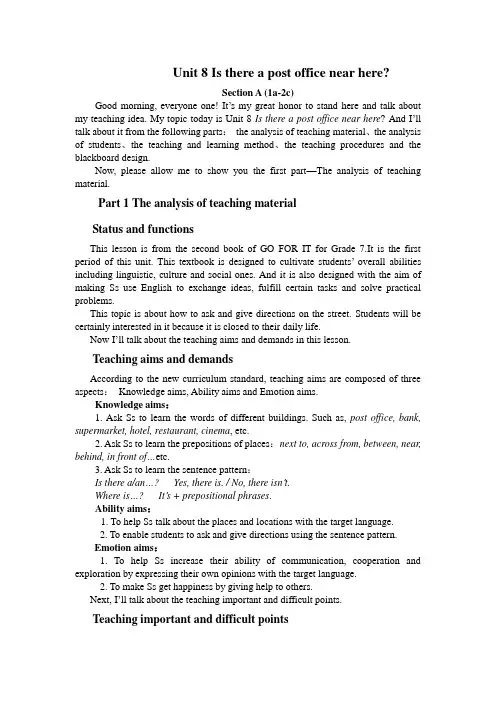
Unit 8 Is there a post office near here?Section A (1a-2c)Good morning, everyone one! It’s my great honor to stand here and talk about my teaching idea. My topic today is Unit 8 Is there a post office near here? And I’ll talk about it from the following parts:the analysis of teaching material、the analysis of students、the teaching and learning method、the teaching procedures and the blackboard design.Now, please allow me to show you the first part—The analysis of teaching material.Part 1 The analysis of teaching materialStatus and functionsThis lesson is from the second book of GO FOR IT for Grade 7.It is the first period of this unit. This textbook is designed to cultivate students’overall abilities including linguistic, culture and social ones. And it is also designed with the aim of making Ss use English to exchange ideas, fulfill certain tasks and solve practical problems.This topic is about how to ask and give directions on the street. Students will be certainly interested in it because it is closed to their daily life.Now I’ll talk about the teaching aims and demands in this lesson.Teaching aims and demandsAccording to the new curriculum standard, teaching aims are composed of three aspects:Knowledge aims, Ability aims and Emotion aims.Knowledge aims:1. Ask Ss to learn the words of different buildings. Such as,post office, bank, supermarket, hotel, restaurant, cinema, etc.2. Ask Ss to learn the prepositions of places:next to, across from, between, near, behind, in front of…etc.3. Ask Ss to learn the sentence pattern:Is there a/an…? Yes, there is. / No, there isn’t.Where is…? It’s +prepositional phrases.Ability aims:1. To help Ss talk about the places and locations with the target language.2. To enable students to ask and give directions using the sentence pattern.Emotion aims:1. To help Ss increase their ability of communication, cooperation and exploration by expressing their own opinions with the target language.2. To make Ss get happiness by giving help to others.Next, I’ll talk about the teaching important and difficult points.Teaching important and difficult pointsThe important points of this unit are the prepositions of places, the names of different places, and making conversations with the target language.The difficult point is asking and giving directions with the prepositions and the sentences.Part 2 The analysis of studentsThis lesson is for the students of Grade 7, they have leant about “Where is ......? It’s on/ in/ under ......”before. And they can use the structures when they practice asking and giving directions in this lesson.The students have learned English for more than half a year so far. They can understand each other well. They have showed great interest in English. This topic is closed to the daily life, so they will be interested in it as usual.After this I’ll talk about teaching and learning methods.Part 3 Teaching and learning methodsFor teaching methods, the new curriculum standard advocates that language is for communication, English teaching should lay special emphasis on development of Ss. For this purpose, I’ll mainly adopt task-based teaching method、communication teaching method. Here I’ll mainly talk about Task-based teaching method, that is to say, in my class I’ll design different activities and get Ss to fulfill the tasks. In that way, Ss will learn to experience and explore to improve their overall abilities.For learning methods, I’ll adopt cooperative learning method and autonomous learning method. Ss in grade 7 have mastered a certain basic knowledge of English, and they still keep their curiosity on something new. According to this situation, in this unit I will design some activities to help Ss to develop their learning strategies. Now I’ll deal with the most important part, teaching procedure.Part 4 Teaching procedureIn this part, I’ll arrange 7 steps:Step1 Warm-upIn this step, we’ll first give each other greetings, then I’ll guide students to review what we’ve learnt in last class, and then I’ll lead in the new lesson. I’ll ask them questions like“Where are my books? /Where are your pens...”. to review the prepositions they have learned and lead in There is a…. Is there a……?Now I’ll go to step 2.Step2 presentationFirst, I’ll present pictures of buildings on the street. The students are interested in the new knowledge and I will teach them all about these words.Next, I’ll ask them to imagine a real situation. I’ll say, “Now, you are in a new city, you don’t know the places here. And you want to go to a library, how can you ask people about it?Then I’ll help students to ask, “Is there a library near here?” . and let them answer , “Yes, there is./ No, there isn’t. ”.Now, I’ll ask students to practice the sentences.Step3 practiceI’ll ask students to look at the pictures in activity 1a on page 43.First, ask them to match the right places with the words.Next, ask them to talk about the places with the sentence pattern:-Is there a……near here? I’ll help them to look at the map and answer:-Yes, there is. It is on______ Street.Now, students work in pairs.Then, we will go on listening practice. I’ll ask students to listen to the tapeand circle the places in 1a they hear. Check the answers.After that I’ll enter into step 4.Step4 listening and practiceBefore listening, I’ll first present the prepositions of places with some pictures. I’ll lead students to review and learn the prepositions. Then, let them talk about the different places and make conversations using these words.After this, I’ll ask students to finish activity 2a, and then check answers by asking question:“Where is the pay phone?”This can also make Ss describe the places with the prepositions.Now, let Ss listen to the conversations and fill in the blanks. After finishing 2b, ask Ss to read the sentences to check answers.Step5 consolidationI’ll go on 2c .First, ask Ss to ask and answer questions about the places in 1a on page43. They can talk like this:Where is the post office? The post office is across from the hotel.Then, I’ll ask students to make their own conversations. Ask them to look at the picture in 1a, tell them, “Imagine you will find a place, make a simple conversation to ask and give directions according to the picture”.As they do this, I’ll walk around and give them help if necessary. Then, as they have done, ask them to perform their conversations.Step 6 SummaryAsk students to read the grammar focus. And then I’ll let students do some exercises and check if they have got the knowledge.Then, we will come to the last step.Step7 homeworkWrite some sentences to talk about your bedroom using different prepositions of places.After talking about the teaching procedure, I’d like to go to the next part—Part 5 Blackboard designUnit8 Is there a post office near here?-Is there a ___________ near here?-Yes, there is. It’s on __________ Street.the post office across fromthe bank in front ofWhere is the restaurant ? It’s next to the park.the pay phone behindthe hotel between the hotel and。