c语言 运算符表达式
- 格式:doc
- 大小:16.38 KB
- 文档页数:8
c语言 运算符表达式
English Answer:
What are Operators in C Programming?
Operators are symbols that perform specific operations
on variables and constants. They are used to combine,
compare, increment, decrement, and perform various other
operations on data. Operators can be classified into
different types based on their functionality.
Types of Operators in C:
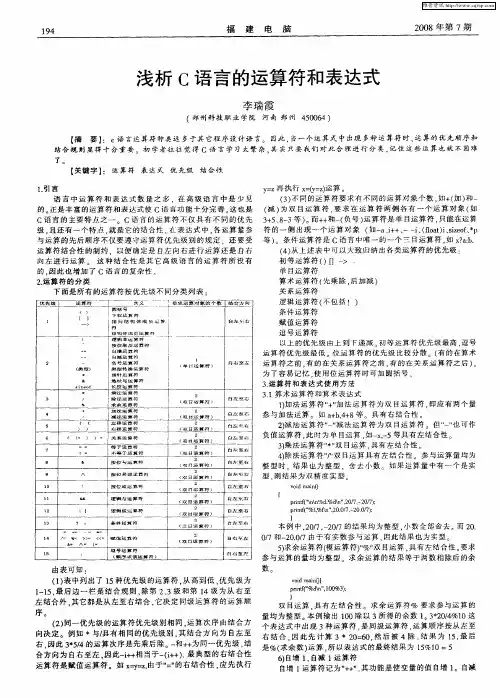
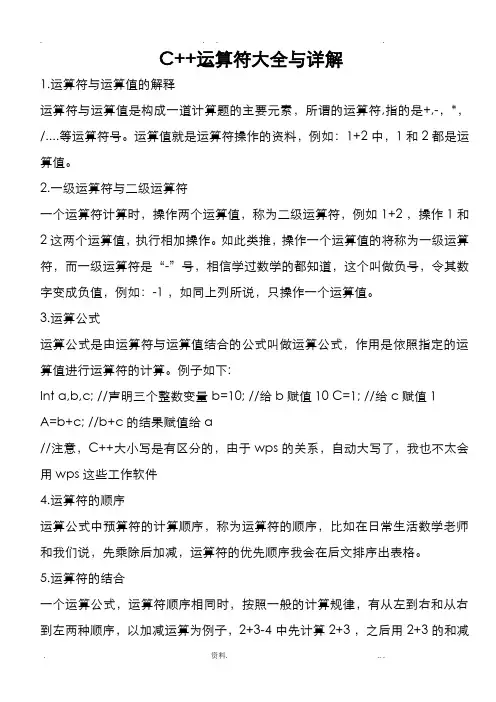
Arithmetic Operators: (+, -, , /, %)。
Used to perform mathematical operations on numeric
values.
Relational Operators: (==, !=, <, >, <=, >=)。
Used to compare two values and return a Boolean
result (true or false).
Logical Operators: (&&, ||, !)。
Used to perform logical operations on Boolean
values.
Assignment Operators: (=, +=, -=, =, /=)。
Used to assign values to variables.
Increment/Decrement Operators: (++,--,++i,i++)。
Used to increment or decrement the value of a
variable by 1.
Conditional (Ternary) Operator: (?)。
Used as a shorthand for an if-else statement.
Bitwise Operators: (&, |, ^, ~, <<, >>)。
Used to perform bitwise operations on binary
values.
Special Operators: (, ), [], &。
Used for grouping expressions, indexing arrays,
and accessing memory addresses.
Syntax of Operator Expressions:
An operator expression typically consists of operands
(variables or constants) and operators. The operands are
the entities on which the operator operates, and the result
of the expression is determined by the specified operator.
Operator Precedence and Associativity:
Operators have different precedence levels, which
determine the order in which they are evaluated. Operators
with higher precedence are evaluated before those with
lower precedence. Operators with the same precedence are evaluated based on their associativity (left-to-right or
right-to-left).
Common Operator Expressions:
`a + b`: Addition of two variables 'a' and 'b'.
`x y`: Subtraction of 'y' from 'x'.
`c d`: Multiplication of 'c' and 'd'.
`e / f`: Division of 'e' by 'f' (returns a floating-point result).
`x == y`: Comparison of 'x' and 'y' to check if they
are equal.
`a && b`: Logical AND operation, returns true if both
'a' and 'b' are true.
`i++`: Increment the value of 'i' by 1.
`(x > 0) ? a : b`: Ternary operator, assigns 'a' to
the result if 'x' is greater than 0, otherwise assigns 'b'.
中文回答:
C语言中的运算符。
运算符是执行变量和常量特定运算的符号。它们用于组合、比较、递增、递减以及对数据执行各种其他运算。运算符可以根据其功能划分为不同类型。
C语言中的运算符类型:
算术运算符, (+, -, , /, %)。
用于对数值执行数学运算。
关系运算符, (==, !=, <, >, <=, >=)。
用于比较两个值并返回布尔结果(真或假)。
逻辑运算符, (&&, ||, !)。
用于对布尔值执行逻辑运算。
赋值运算符, (=, +=, -=, =, /=)。
用于为变量赋值。
自增/自减运算符, (++,--,++i,i++)。
用于将变量的值增加或减少 1。
条件(三元)运算符, (?)。
用作 if-else 语句的简写。
位运算符, (&, |, ^, ~, <<, >>)。
用于对二进制值执行位运算。
特殊运算符, (, ), [], &。
用于对表达式进行分组、对数组进行索引和访问内存地址。
运算符表达式的语法:
运算符表达式通常由操作数(变量或常量)和运算符组成。操作数是运算符操作的实体,表达式的结果由指定的运算符确定。
运算符优先级和结合性:
运算符有不同的优先级,这决定了它们被评估的顺序。优先级较高的运算符优先于优先级较低的运算符进行评估。具有相同优先级的运算符根据它们的结合性(从左到右或从右到左)进行评估。
常见的运算符表达式:
`a + b`,变量 'a' 和 'b' 的加法。
`x y`,从 'x' 中减去 'y'。
`c d`,'c' 和 'd' 的乘法。
`e / f`,'e' 除以 'f'(返回浮点结果)。
`x == y`,比较 'x' 和 'y' 以检查它们是否相等。
`a && b`,逻辑 AND 运算,如果 'a' 和 'b' 都为真,则返回真。
`i++`,将 'i' 的值增加 1。
`(x > 0) ? a : b`,三元运算符,如果 'x' 大于 0 则将
'a' 分配给结果,否则将 'b' 分配给结果。