Hellen Keller
- 格式:doc
- 大小:54.00 KB
- 文档页数:3
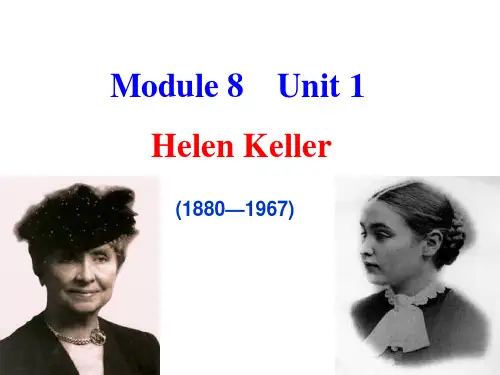
Helen Adams Keller(June 27, 1880 –June 1, 1968) was an American author, political activist, and lecturer. She was the first deafblind person to earn a Bachelor of Arts degree.[1][2]The story of how Keller's teacher, Anne Sullivan, broke through the isolation imposed by a near complete lack of language, allowing the girl to blossom as she learned to communicate, has become widely known through the dramatic depictions of the play and film The Miracle Worker.A prolific author, Keller was well-traveled, and was outspoken in her opposition to war. A member of the Socialist Party of America and the Wobblies, she campaigned for women's suffrage, workers' rights, and socialism, as well as many other leftist causes.Helen Adams Keller was born on June 27, 1880, in Tuscumbia, Alabama. Her family lived on a homestead, Ivy Green,[3] that Helen's grandfather had built decades earlier.[4] Helen's father, Arthur H. Keller,[5] spent many years as an editor for the Tuscumbia North Alabamian and had served as a captain for the Confederate Army.[4] Helen's paternal grandmother was the second cousin of Robert E. Lee.[6] Helen's mother, Kate Adams,[7] was the daughter of Charles Adams.[8] Though originally from Massachusetts, Charles Adams also fought for the Confederate Army during the American Civil War, earning the rank of brigadier-general.[6]Helen's father's lineage can be traced to Casper Keller, a native of Switzerland.[6][9] Coincidentally, one of Helen's Swiss ancestors was the first teacher for the deaf in Zurich.[6] Helen reflects upon this coincidence in her first autobiography, stating "that there is no king who has not had a slave among his ancestors, and no slave who has not had a king among his."[6]Helen Keller was not born blind and deaf; it was not until she was 19 months old that she contracted an illness described by doctors as "an acute congestion of the stomach and the brain", which might have been scarlet fever or meningitis. The illness did not last for a particularly long time, but it left her deaf and blind. At that time, she was able to communicate somewhat with Martha Washington,[10] the six-year-old daughter of the family cook, who understood her signs; by the age of seven, she had over 60 home signs to communicate with her family.In 1886, her mother, inspired by an account in Charles Dickens' American Notes of the successful education of another deaf and blind child, Laura Bridgman, dispatched young Helen, accompanied by her father, to seek out Dr. J. Julian Chisolm, an eye, ear, nose, and throat specialist in Baltimore, for advice.[11]He subsequently put them in touch with Alexander Graham Bell, who was working with deaf children at the time. Bell advisedthe couple to contact the Perkins Institute for the Blind, the school where Bridgman had been educated, which was then located in South Boston. Michael Anaganos, the school's director, asked former student Anne Sullivan, herself visually impaired and only 20 years old, to become Keller's instructor. It was the beginning of a 49-year-long relationship, Sullivan evolving into governess and then eventual companion.Anne Sullivan arrived at Keller's house in March 1887, and immediately began to teach Helen to communicate by spelling words into her hand, beginning with "d-o-l-l" for the doll that she had brought Keller as a present. Keller was frustrated, at first, because she did not understand that every object had a word uniquely identifying it. In fact, when Sullivan was trying to teach Keller the word for "mug", Keller became so frustrated she broke the doll. [12] Keller's big breakthrough in communication came the next month, when she realized that the motions her teacher was making on the palm of her hand, while running cool water over her other hand, symbolized the idea of "water"; she then nearly exhausted Sullivan demanding the names of all the other familiar objects in her world.Due to a protruding left eye, Keller was usually photographed in profile. Both her eyes were replaced in adulthood with glass replicas for "medical and cosmetic reasons".[13Starting in May, 1888, Keller attended the Perkins Institute for the Blind. In 1894, Helen Keller and Anne Sullivan moved to New York to attend the Wright-Humason School for the Deaf, and to learn from Sarah Fuller at the Horace Mann School for the Deaf. In 1896, they returned to Massachusetts and Keller entered The Cambridge School for Young Ladies before gaining admittance, in 1900, to Radcliffe College, where she lived in Briggs Hall, South House. Her admirer, Mark Twain, had introduced her to Standard Oil magnate Henry Huttleston Rogers, who, with his wife, paid for her education. In 1904, at the age of 24, Keller graduated from Radcliffe, becoming the first deaf blind person to earn a Bachelor of Arts degree. She maintained a correspondence with the Austrian philosopher and pedagogue Wilhelm Jerusalem, who was one of the first to discover her literary talent.[14]Anne Sullivan stayed as a companion to Helen Keller long after she taught her. Anne married John Macy in 1905, and her health started failing around 1914. Polly Thompson was hired to keep house. She was a young woman from Scotland who didn't have experience with deaf or blind people. Sheprogressed to working as a secretary as well, and eventually became a constant companion to Keller.[15]Keller moved to Forest Hills, Queens together with Anne and John, and used the house as a base for her efforts on behalf of American Foundation for the Blind.[16]After Anne died in 1936, Keller and Thompson moved to Connecticut. They traveled worldwide and raised funding for the blind. Thompson had a stroke in 1957 from which she never fully recovered, and died in 1960.[1]Winnie Corbally, a nurse who was originally brought in to care for Polly Thompson in 1957, stayed on after Thompson's death and was Keller's companion for the rest of her life.[1]Keller suffered a series of strokes in 1961 and spent the last years of her life at her home.[1]On September 14, 1964, President Lyndon B. Johnson awarded her the Presidential Medal of Freedom, one of the United States' highest two civilian honors.[27] In 1965 she was elected to the National Women's Hall of Fame at the New York World's Fair.[1]Keller devoted much of her later life to raising funds for the American Foundation for the Blind. She died in her sleep on June 1, 1968, at her home, Arcan Ridge, located in Easton, Connecticut. A service was held in her honor at the National Cathedral in Washington, D.C., and her ashes were placed there next to her constant companions, Anne Sullivan and Polly Thompson.。