
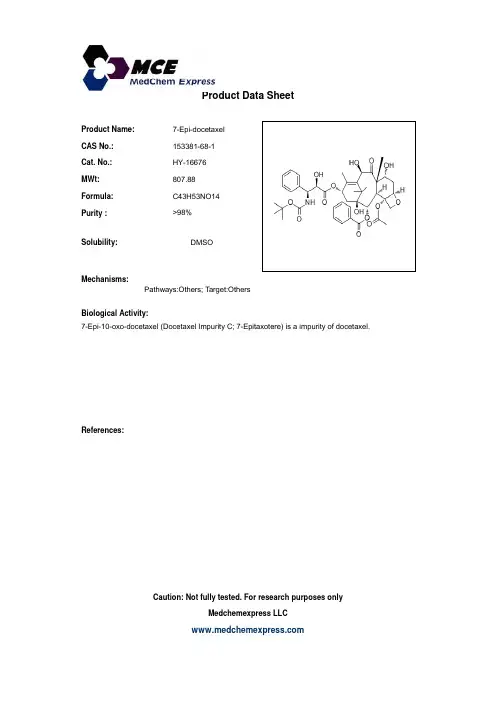
7-Epi-docetaxel_153381-68-1_DataSheet_MedChemExpress
- 格式:pdf
- 大小:63.98 KB
- 文档页数:1

FRA 5310Sweep Frequency Response Analyser for Power Transformer DiagnosisThe FRA 5310 Sweep Frequency Response Analyser detects transformer winding movements and mechanical failures due to mechanical shock, transportation or short circuits.APPLICATIONMany dielectric and mechanical failures in large power transformers are preceded by mechanical changes in the winding structure. These changes, or displacements in the winding, may be the result of:⏹Transportation damage occurring between themanufacturer and the final location⏹Short circuit forces imposed on the windingsresulting from a low impedance fault occurring close to the transformer⏹Natural effects of aging on the insulatingstructures used to support the windingsDetection of these displacements ahead of a dielectric failure can reduce unplanned maintenance costs, and provide the possibility to improve system reliability by preventing outages. Additionally, when damage is discovered, repairs may be targeted to a specific phase winding. METHODThe corresponding HF circuit of a transformer winding is a complex R-L-C-network. The measured frequency response (transfer function) of this network is unique like a fingerprint. Changes in the winding geometry will be reflected by deviations between repeated measurements. Even small winding movements or distortions will cause legible changes in the measured transfer function, which is clearly detectable. Deviations can be caused by short-circuited turns, open windings, mechanical damage to windings or core, loose turns, faulty clamps, etc.DESIGNThe FRA 5310 software and the large touch-screen interface guarantee a very easy-to-use instrument. Load measurements, set configurations, obtain connecting information, repeat previous measurements and do comparisons just on a fingertip. Integrated analysis tools, reporting capability and additional PC software complete this advanced Sweep Frequency Response Analyser.FEATURES AND BENEFITS⏹High measurement reliability and reproducibilitydue to active probes design and a clear definedconnection and grounding technique⏹High signal-to-noise ratio due to output voltage up to12 Vpeak-peak at 50 Ω (24 Vpeak-peak at 1 MΩ)⏹Automatic Interpretation according to ChineseStandard DL / T 911 - 2004⏹Ease of use due to automated Windows test softwareand large color touch screen interface and remote startbutton⏹Rugged, lightweight and small all-in-one field design ⏹Measuring modes (amplitude & phase):▪Transfer Voltage Function U1/U2 (f)▪Impedance Function U1/I2 (f) 1981Previously stored curves are accessed using the History tab sheet, where information can be edited and updated at a later date.Automatic Test Setting (Sequence)Analysis page with limits set according to the standards A complete transformer test measurement list (sequence) can be predefined and executed automatically when required, making it simple to repeat a previous fingerprint measurement, even if the operator has no previous knowledge of the setup.ANALYSIS TOOLSThe analysis system allows multiple stored measurements to be loaded for detailed analysis, comparison, verification, reporting, etc.The measured transfer function curves can be displayed as Magnitude [dB], Phase [°], Impedance [ ] , Admittance [S] and Ratio.Additional comments can be stored with the single analysis displays so expert interpretation andassessments, further test instructions, etc can be included. Various display tools are easily accessible from the touch screen to allow simple analysis: Zoom-in and -out, auto scaling, linear and logarithmic scaling, curve shifting, measuring point labels, save as meta-file, printout, title editing, setup information editing, frequency band display,etc.Two frequency response curves and their difference.Cursors can easily be placed anywhere on the displayed curves giving the user information down to the last measuring point.Differences of curves with a definable limiter function can be calculated allowing parts of the curve to beweighted and highlighted to help the engineer's decision-making.Coherence between two or more curves can becalculated to give the engineer a powerful tool for the assessment and comparison of transformer transfercurves yielding valuable additional information.Transfer functions of 3 phases and their coherence.Interpretation according to Chinese Standard DL / T 911 - 2004 is supported. This interpretation is based on thecomparison of two curve, identifies slight, obvious and severe mechanical changes and differentiate between typical origins of the damage.Comparison of two transfer functions according to Chinese Standard DL / T 911- 2004.REPORT GENERATIONThe measured frequency response curves (raw data) are stored in a measuring data file together with all the related transformer nameplate data and other additional information. Reports can be created from the measured data file (raw data curves) or from any analysis data files previously created.The user can choose different report sizes from diagrams with short setup info to full reporting with all detailed setup and DUT information.Reports are automatically generated in XML- or HTML- format allowing the report file to be opened in a web browser or word processor.Data exportThe measuring files (raw data curves) are stored in XML format and can also be stored in CSV (comma-separated-values) format.They can be directly opened in Microsoft EXCEL or other spreadsheet programs where further customer specific data processing, calculation, comparison and documentation is possible.Any curve can also be stored as a picture for further use in customer specific documentation or reporting.SCOPE OF SUPPLYType 5310 Instrument in rugged shell case,Cable back pack including:▪ 2 Active Probes with 15 m double shielded cables,▪ 2 Ground Tapes 10 m,▪ 2 Ground Tape Clamps,▪User Manual, Test Certificate,▪Mains cable CD with external PC Analysis Software TECHNICAL DATAMeasurementType ActiveprobesFrequency Range 10 Hz .. 10 MHz, user definedVoltage Output max. 12 Vpeak-peak at 50 Ω,max. 24 Vpeak-peak at 1 MΩ, userdefinedInput Impedance selectable 50 Ω or 1 MΩOutput Impedance 50 ΩAccuracy ± 0.1 dB , zero calibratedFeasible accuracy: ± 0.5 dB down to -90dBDynamic range >100 dBMeasuring Points max. 2’000, user defined,logarithmicallyspaced, Protection Against short circuit, overloadData DisplayScaling Logarithmic or Linear, user defined Frequency Range 10 Hz .. 10 MHz, user definedPlot, Frequency vs. Magnitude, Impedance, Phase,Admittance, RatioControllerProcessor Celeron M, 1 GHzRAM 256MBInterfaces USB 2.0 , RS232Data Storage 40 GB Hard DiskDisplay 10.4", SVGA, Color TFTUser Interface built-in Touch ScreenGeneralOperatingTemperature0 .. +50°CStorageTemperature-20 .. +70°CRelative Humidity 10 .. 90 % non-condensingWeight Instrument 8 kg (17 lbs)DimensionsInstrument41 x 31 x 17 cm (16” x 12.2” x 7”)Remote Start Remote start button and indicator inprobeMains Universal, 90 .. 265 VAC,50 / 60 Hz, 75 VAInstrument OS Windows XP embeddedExternal PCSoftwareWindows 98 / 2000 / XPOrder code FRA 5310 No. 3490047Europe, Asia, South & Central America, Australia Haefely Test AG Birsstrasse 3004052 BaselSwitzerland☎ + 41 61 373 4111+ 41 61 373 4912****************China (Sales & Service Office)Haefely Test AG – Beijing Office8-1-602, Fortune StreetNo. 67, Chaoyang Road, Chaoyang DistrictBeijing, 100025P. R. China☎ + 86 10 8578 8099+ 86 10 8578 9908*****************.cnNorth AmericaHipotronics Inc.1650 Route 22PO Box 414Brewster, NY 10509USA☎ + 1 845 279 3644+ 1 845 279 2467*********************。

Certificate of Analysis Takara Bio USA, Inc.1290 Terra Bella Avenue, Mountain View, CA 94043, USA U.S. Technical Support: ********************United States/Canada 800.662.2566 Asia Pacific+1.650.919.7300Europe+33.(0)1.3904.6880Japan+81.(0)77.565.6999Page 1 of 6Tet-On® 3G Vector Set (with ZsGreen1)Table of ContentsDescription (1)pCMV-Tet3G Vector Information (2)pTRE3G-ZsGreen1 Vector and pTRE3G-Luc Control Vector Information (4)Quality Control Data (6)Catalog No. Lot Number631159 (Not sold separately) Specified on product label.DescriptionThe Tet-On 3G Vector Set (with ZsGreen1) is used to create tightly regulated and highly responsive tetracycline (Tet)-inducible mammalian expression systems that are turned on by the addition of doxycycline to the culture medium. The Tet-On 3G Vector Set (with ZsGreen1) allows the simultaneous expression of a gene of interest and a green fluorescent protein marker.Package Contents•20 μl pCMV-Tet3G Vector (500 ng/μl)•20 μl pTRE3G-ZsGreen1 Vector(500 ng/μl)•20 μl pTRE3G-Luc Control Vector(500 ng/μl)•40 μl Linear Hygromycin Marker (50 ng/μl)•40 μl Linear Puromycin Marker (50 ng/μl)Storage Conditions•Store plasmids at –20°C.•Spin briefly to recover contents.•Avoid repeated freeze/thaw cycles.Shelf Life• 1 year from date of receipt under proper storage conditions.Storage Buffer•10 mM Tris-HCl (pH 8.0), 1 mM EDTA (pH 8.0)Shipping Conditions• Dry ice (–70°C)Product DocumentsDocuments for our products are available for download at /manualsThe following documents apply to this product:•Tet-On 3G Expression Systems User Manual (PT5148-1)pCMV-Tet3G Vector InformationFigure 1. pCMV-Tet3G Vector Map.DescriptionThe pCMV-Tet3G Vector expresses Tet-On 3G, a tetracycline-controlled transactivator that exhibits high activity in the presence of the inducer doxycycline (Dox), and exceptionally low activity in its absence. Tet-On 3G results from the fusion of amino acids 1–207 of a mutant Tet repressor (TetR) to 39 amino acids that form three minimal "F"-type transcriptional activation domains from the herpes simplex virus VP16 protein. Tet-On 3G was derived from Tet-On Advanced (Zhou et al. 2006; Urlinger et al. 2000; Gossen and Bujard 1992; Gossen et al. 1995); as a result, it’s fully synthetic, lacks cryptic splice sites, and is codon-optimized for stable expression in mammalian cells. Compared to both of its predecessors, however, this 3rd generation Tet-On transactivator demonstrates increased sensitivity to Dox (Zhou et al. 2006). Constitutive expression of Tet-On 3G is driven by the human cytomegalovirus immediately early promoter (P CMV IE).Location of Features in pCMV-Tet3G•P CMV IE(human cytomegalovirus immediate early promoter): 2–688•Tet-On 3G (transactivator gene): 775–1521•SV40 polyA signal: 1536–1991•pUC origin of replication: 2342–2996•Amp r (ampicillin resistance gene; β-lactamase): 3144–4004 (complementary)•SV40 polyA signal: 4275–4809 (complementary)•Kan r/Neo r (kanamycin/neomycin resistance gene): 5417–6211 (complementary)•P SV40 e (SV40 early promoter): 6532–6891 (complementary)Additional InformationpCMV-Tet3G is used to develop stable Tet-On 3G cell lines, which are hosts for Tet-inducible gene expression systems. To create a Tet-inducible expression system, a vector containing a gene of interest under the control of the Tet-inducible TRE3G promoter(P TRE3G) is transfected into a Tet-On 3G cell line. The addition of Dox to the system causes Tet-On 3G to undergo a conformational change that allows it to bind to P TRE3G, activating transcription of the gene of interest in a highly dose-dependent manner. Additional information on TRE-containing vectors, and protocols describing the construction of Tet-On 3G cell lines can be found in the Tet-On 3G Expression Systems User Manual (PT5148-1).Propagation in E. coli•Suitable host strain: Stellar™ Competent Cells•Selectable marker: plasmid confers resistance to ampicillin (100 μg/ml) in E. coli hosts.• E. coli replication origin: pUCpTRE3G-ZsGreen1 Vector and pTRE3G-Luc Control Vector InformationFigure 2. pTRE3G-ZsGreen1 Vector and pTRE3G-Luc Control Vector Maps.Figure 3. pTRE3G-ZsGreen Vector Multiple Cloning Site. The internal start site (ATG) at the IRES2/MCS junction is indicated in bold.DescriptionpTRE3G-ZsGreen1is a Tet-inducible, mammalian expression vector designed to coexpress a gene of interest and the green fluorescent protein ZsGreen1 under the control of the Tet-responsive promoter P TRE3G. This promoter consists of a highly optimized Tet-responsive element (TRE) just upstream of a minimal CMV promoter. P TRE3G exhibits exceptionally low basal activity; it’s induced by the binding of Tet-On 3G but is virtually silent in its absence. The vector is designed to be used as part of our Tet-On 3G Inducible Expression System (Cat. No. 631164).ZsGreen1 is a human codon-optimized variant of the reef coral Zoanthus sp. green fluorescent protein (ZsGreen) that has been engineered for brighter fluorescence (excitation and emission maxima: 493 and 505 nm, respectively; Matz et al. 1999; Haas, Park, and Seed 1996). p TRE3G-ZsGreen allows Dox-inducible coexpression of ZsGreen1 and a gene of interest from a bicistronic mRNA transcript. An encephalomyocarditis virus (EMCV) internal ribosome entry site (IRES2), positioned between ZsGreen1 and the gene of interest, facilitates cap-independent translation of the gene of interest from an internal start site at the IRES2/MCS junction (Jang et al. 1988). This ensures that a high percentage of ZsGreen1-expressing clones also express the gene of interest, allowing ZsGreen1 to be used as an indicator of inducibility and transfection efficiency, as well as a marker for selection by flow cytometry. The vector also contains a pUC origin of replication and an ampicillin resistance gene (Amp r) to allow for propagation and selection in E. coli.The pTRE3G-Luc is a Tet-inducible control vector that expresses firefly luciferase under the control of P TRE3G. When used with standard luciferase detection reagents, this vector can be used as a reporter of induction efficiency (see User Manual for protocol). pTRE3G-Luc is not intended to be used as a cloning vector.Location of Features in pTRE3G-ZsGreen1•P TRE3G (3rd generation Tet-responsive promoter): 7–382•ZsGreen1: 389–1084•IRES2 (encephalomyocarditis virus internal ribosome entry site): 1091–1673•MCS (multiple cloning site): 1686–1721•SV40 polyA signal: 1776–2573•pUC origin of replication: 2838–3481•Amp r (ampicillin resistance gene; β-lactamase): 3629–4489 (complementary)Location of Features in pTRE3G-Luc•P TRE3G (3rd generation Tet-responsive promoter): 7–382•Luciferase: 432–2084•SV40 polyA signal: 2151–2948•pUC origin of replication: 3213–3856•Amp r (ampicillin resistance gene; β-lactamase): 4004–4864 (complementary)Additional InformationpTRE3G-ZsGreen1 is a mammalian expression vector that allows tightly regulated, doxycycline-controlled coexpression of a gene of interest and ZsGreen1. The gene of interest must have both a start and a stop codon. The gene of interest should be cloned in-frame with the start codon at the IRES2/MCS junction (this codon is shown in bold in the MCS sequence in Figure 3, page 3; see the User Manual for details on how to use In-Fusion® to simplify your cloning). Cotransfection of pTRE3G-ZsGreen1 constructs with Linear Hygromycin or Puromycin Markers allows antibiotic selection of stable transfectants. In order to function, the system requires the presence of the Tet-On 3G transactivator protein, supplied by a stable Tet-On 3G cell line created with our Tet-On 3G Inducible Expression System (Cat. No. 631164).Propagation in E. coli•Suitable host strain: Stellar™ Competent Cells•Selectable marker: plasmid confers resistance to ampicillin (100 μg/ml) in E. coli hosts.• E. coli replication origin: pUCExcitation and Emission of pTRE3G-ZsGreen1•Excitation: 493 nm•Emission: 505 nmReferences•Gossen, M. et al. Transcriptional activation by tetracyclines in mammalian cells. Science268, 1766–9 (1995).•Gossen, M. & Bujard, H. Tight control of gene expression in mammalian cells by tetracycline-responsive promoters. Proc. Natl. Acad. Sci. U. S. A.89, 5547–51 (1992).•Haas, J., Park, E. C. & Seed, B. Codon usage limitation in the expression of HIV-1 envelope glycoprotein. Curr.Biol.6, 315–24 (1996).•Jang, S. K. et al. A segment of the 5’ nontranslated region of encephalomyocarditis virus RNA directs internal entry of ribosomes during in vitro translation. J. Virol.62, 2636–43 (1988).•Matz, M. V et al. Fluorescent proteins from nonbioluminescent Anthozoa species. Nat. Biotechnol.17, 969–73 (1999).•Urlinger, S. et al. Exploring the sequence space for tetracycline-dependent transcriptional activators: novel mutations yield expanded range and sensitivity. Proc. Natl. Acad. Sci. U. S. A.97, 7963–8 (2000).•Zhou, X., Vink, M., Klaver, B., Berkhout, B. & Das, A. T. Optimization of the Tet-On system for regulated gene expression through viral evolution. Gene Ther.13, 1382–90 (2006).Quality Control DataPlasmid Identity & Purity•Digestion with the indicated restriction enzymes produced fragments of the indicated sizes on a 0.8% agarose/EtBr gel:Vector Enzyme(s) Fragment(s)pCMV-Tet3G EcoRI 7.1 kbEcoRI & HindIII 1.2 & 5.9 kbpTRE3G-ZsGreen1 XhoI 4.7 kbEcoRV 1.2 & 3.5 kbpTRE3G-Luc XhoI 5.1 kbEcoRI & BamHI 2.1 & 3.0 kbLinear Hygromycin Marker HindIII & XbaI0.5, 0.6 & 1.1 kbLinear Puromycin Marker HindIII & XbaI0.45, 0.6, & 0.75 kb•Vector identity was confirmed by sequencing.•A260/A280: 1.8–2.0Functional Testing of Linear Markers•HEK 293 cells were transfected with 200 ng of either the Linear Hygromycin Marker or the Linear Puromycin Marker. After 5 hr at 37°C, the transfection solution was removed, and the cells were given fresh medium. 48 hr later, the cells were plated in two 10 cm plates. 48 hr after plating, medium containing either hygromycin orpuromycin (depending on the linear marker used to transfect the cells) was added to the plates. After 2–3 weeks, >20 clones were identified.It is certified that this product meets the above specifications, as reviewed and approved by the Quality Department.CATALOG NO.631159NOTICE TO PURCHASER:Our products are to be used for research purposes only. They may not be used for any other purpose, including, but not limited to, use in drugs, in vitro diagnostic purposes, therapeutics, or in humans. Our products may not betransferred to third parties, resold, modified for resale, or used to manufacture commercial products or to provide a service to third parties without prior written approval of Takara Bio USA, Inc.Your use of this product is also subject to compliance with the licensing requirements listed below and described on the product´s web page at . It is your responsibility to review, understand and adhere to any restrictions imposed by these statements.STATEMENT 24The RCFPs (including DsRedExpress, DsRedExpress2, and E2-Crimson) are covered by one or more of thefollowing U.S. Patent Nos. 7,166,444; 7,157,565; 7,217,789; 7,338,784; 7,338,783; 7,537,915; 6,969,597; 7,150,979;7,442,522 and 8,012,682.STATEMENT 72Living Colors Fluorescent Protein Products: Not-For-Profit Entities: Orders may be placed in the normal manner by contacting your local representative or Takara Bio USA, Inc. Customer Service. Any and all uses of this product will be subject to the terms and conditions of the Non-Commercial Use License Agreement (the “Non-Commercial License”), a copy of which can be found below. As a condition of sale of this product to you, and prior to using this product, you must agree to the terms and conditions of the Non-Commercial License. Under the Non-Commercial License, Takara Bio USA, Inc. grants Not-For-Profit Entities a non-exclusive, non-transferable, non-sublicensable and limited license to use this product for internal, non-commercial scientific research use only. Such licensespecifically excludes the right to sell or otherwise transfer this product, its components or derivatives thereof to third parties. No modifications to the product may be made without express written permission from Takara Bio USA, Inc.Any other use of this product requires a different license from Takara Bio USA, Inc. For license information, please ***************************************************************************************.For-Profit Entities wishing to use this product are required to obtain a license from Takara Bio USA, Inc. For license information, please contact a licensing representative by phone at 650.919.7320 or by e-mail at ***********************.STATEMENT 42Use of the Tetracycline controllable expression systems (the "Tet Technology") is covered by a series of patents including U.S. Patent # 7541446, # 8383364, # 9181556 , European patents EP # 1200607, # 1954811, #2352833Academic research institutions are granted an automatic license with the purchase of this product to use the Tet Technology only for internal, academic research purposes, which license specifically excludes the right to sell, or otherwise transfer, the Tet Technology or its component parts to third parties. Notwithstanding the above, academicand not-for profit research institutions whose research using the Tet Technology is sponsored by for profitorganizations, which shall receive ownership to any data and results stemming from the sponsored research, shall need a commercial license agreement from TET Systems in order to use the Tet Technology. In accepting this license, all users acknowledge that the Tet Technology is experimental in nature. TET Systems GmbH & Co. KG makes no warranties, express or implied or of any kind, and hereby disclaims any warranties, representations, or guarantees of any kind as to the Tet Technology, patents, or products. All others are invited to request a license from TET Systems GmbH & Co. KG prior to purchasing these reagents or using them for any purpose. Takara Bio USA, Inc. is required by its licensing agreement to submit a report of all purchasers of the Tet-controllable expression system to TET Systems.For license information, please contact:GSF/CEOTET Systems GmbH & Co. KG,Im Neuenheimer Feld 58269120 Heidelberg GermanyTel: +49 6221 5880400Fax: +49 6221 5880404email:*******************or use the electronic licensing request form via /ip-licensing/licensing/for-profit-research TRADEMARKS:© 2015 Takara Bio Inc. All Rights Reserved.All trademarks are the property of Takara Bio Inc. or its affiliate(s) in the U.S. and/or other countries or their respective owners. Certain trademarks may not be registered in all jurisdictions.。

碧云天生物技术/Beyotime Biotechnology订货热线:400-168-3301或800-8283301订货e-mail:******************技术咨询:*****************网址:碧云天网站微信公众号生物素标记EMSA探针-β-Catenin/TCF (0.2μM)产品编号产品名称包装GS018B 生物素标记EMSA探针-β-Catenin/TCF (0.2µM) 200µl产品简介:生物素标记EMSA探针-β-Catenin/TCF是用于EMSA(也称gel shift)研究的生物素(Biotin)标记的β-Catenin/TCF consensus oligonucleotide。
这个生物素标记的双链寡核苷酸含有公认的β-Catenin/TCF结合位点,可以用作EMSA研究时的探针。
β-Catenin/TCF consensus oligo的序列如下:5'-CCC TTT GAT CTT ACC-3'3'-GGG AAA CTA GAA TGG-5'本生物素标记EMSA探针已经过纯化,可以直接用于EMSA结合反应。
本生物素标记EMSA探针可以和碧云天的化学发光法EMSA试剂盒(GS009)配套使用。
一个包装的生物素标记探针可以进行约200-400个样品的EMSA检测。
包装清单:产品编号产品名称包装GS018B 生物素标记EMSA探针-β-Catenin/TCF (0.2µM) 200µl—说明书1份保存条件:-20ºC保存,一年有效。
注意事项:避免加热到40ºC以上,温度过高会导致双链DNA探针解聚成单链。
而单链无法用于EMSA研究。
对于基于生物素标记的EMSA检测的详细操作可以参考碧云天的化学发光法EMSA试剂盒(GS009)的使用说明。
本产品仅限于专业人员的科学研究用,不得用于临床诊断或治疗,不得用于食品或药品,不得存放于普通住宅内。

ManualEpiScript RNase H– Reverse Transcriptase For Laboratory Use.Contents1. Intended use (3)2. Warning and limitations (3)3. Product designations (4)4. Product specifications (4)5. General considerations for cDNA synthesis (4)6. EpiScript RNase H– Reverse Transcriptase cDNA synthesis procedure (6)7. Further support (7)1. Intended useEpiScript™ RNase H– Reverse Transcriptase (EpiScript RT) is a recombinant MMLV reverse transcriptase with reduced RNase H activity. It is active up to 55 °C to achieve higher specificity and is efficient at producing full-length cDNA from long RNA templates.EpiScript RT demonstrates significantly more activity than other MMLV Reverse transcriptase enzymes and is capable of producing cDNA from as little as 50 pg of total RNA for real-time RT-PCR (qRT-PCR) analysis and other applications.EpiScript RT is intended for use as a general purpose reagent in molecular diagnostic assays thatare based on RT-PCR target detection technologies by clinical laboratory professionals located inthe United States. This product must be qualified and validated by clinical laboratory end users for suitability in the detection of any specific target using the procedures in this Manual as guidance. EpiScript RT is supplied at a concentration of 200 U/μL.2. Warning and limitationsThis product, when used in combination with nucleic acid amplification master mixes and oligonucleotide primers and probes for specific targets, may be used as a component in molecular diagnostic assays upon qualification and validation by the clinical laboratory end-user.This product is classified as a general purpose in vitro diagnostic device reagent in the United States as defined in: https:///scripts/cdrh/cfdocs/cfcfr/CFRSearch.cfm?FR=864.4010Medical Device ManufacturerLGC Biosearch Technologies2905 Parmenter St.Middleton, WI USA 535623. Product designationsT able 1. EpiScript RNase H– Reverse Transcriptase Kit products and codes.T able 2. EpiScript RNase H– Reverse Transcriptase standalone enzyme products and codes.4. Product specificationsStorage: Store only at -20 °C in a freezer without a defrost cycle.Storage buffer: EpiScript RT is supplied in a 50% glycerol solution containing 50 mM Tris- HCl (pH 7.5), 100 mM sodium chloride, 1 mM DTT, 0.1 mM EDTA and 0.1% Triton ® X-100.Unit definition: One unit of EpiScript RT catalyses the incorporation of 1 nmol of dTTP into acid- insoluble material in 10 minutes at 37 °C using saturating amounts of oligo(dT)-primed poly(rA) as template.Contaminating activity assays: All EpiScript RT components are free of detectable contaminating DNA exonuclease and endonuclease, and RNase activities.5. General considerations for cDNA synthesisMaintaining an RNase-free environment:Ribonuclease contamination is a significant concern for those working with RNA. The ubiquitous RNase A is a highly stable and active ribonuclease that can contaminate any lab environment and is present on human skin. However, creating an RNase-free work environment and maintaining RNase- free solutions is critical for performing successful cDNA synthesis reactions. Therefore, we strongly EpiScript RNase H– Reverse Transcriptase Kit10,000 unitsERT12910KEpiScript RNase H– Reverse Transcriptase, 200 U/μLE0144-200D150 µL 10X RT Reaction Buffer SS000737-D2250 µL DTT (100 mM)SS000065-D6250 µL EpiScript RNase H– Reverse Transcriptase Kit25,000 unitsERT12925KEpiScript RNase H– Reverse Transcriptase, 200 U/μLE0144-200D2125 µL 10X RT Reaction Buffer SS000737-D3600 µL DTT (100 mM)SS000065-D8600 µLProductSizeReagent descriptionCatalogue numberPart numberVolumeEpiScript RNase H– Reverse Transcriptase25,000 unitsERT12925K-ENZ EpiScript RNase H– Reverse Transcriptase, 200 U/μL E0144-200D20.125 mL 250,000 units ERT12925K-1.25mL EpiScript RNase H– Reverse Transcriptase, 200 U/μL E0144-200D3 1.25 mL 2,500,000 unitsERT12925K-12.5mLEpiScript RNase H– Reverse Transcriptase, 200 U/μLE0144-200D412.5 mLProduct SizeReagent descriptionCatalogue numberPart numberVolume1) Autoclave all tubes and pipette tips that will be used in the cDNA synthesis reactions.2) Always wear gloves when handling samples containing RNA. Change gloves frequently especiallyafter touching potential sources of RNase contamination such as door knobs, pens, pencils and human skin.3) Always wear gloves when handling kit components. Do not pick up any kit component with anungloved hand.4) Keep all kit components tightly sealed when not in use. Keep all tubes containing RNA tightlysealed during the incubation steps.We strongly recommend the addition of LGC Biosearch Technologies’ RiboGuard™ RNase Inhibitor to each reaction.Choice of primer for first-strand cDNA synthesis:First-strand cDNA synthesis can be primed using either an oligo(dT) primer, random primers, or gene-specific primers (all primers to be provided by the user).An oligo(dT) primer is the most commonly used method for priming first-strand cDNA synthesis when using an eukaryotic RNA sample. Oligo(dT) primes cDNA synthesis only from the poly(A) tail present at the 3′ end of almost all eukaryotic mRNAs. Since poly(A) RNA constitutes just 1-5% of the RNA in a eukaryotic total cellular RNA preparation, the complexity of the cDNA produced is significantly less than when the cDNA is synthesised using random primers. Lower-complexity cDNA can result in a more sensitive and specific PCR amplification. Additionally, priming cDNA synthesis with an oligo(dT) primer precludes the need to enrich the RNA sample for poly(A) RNA. Typically, the oligo(dT) primer is 18-21 nucleotides in length.Random primers initiate ccDNA synthesis from all RNA species (rRNA and mRNA) in a total cellular RNA sample. Since rRNA, which constitutes >95% of the RNA in a total RNA sample, is convertedto cDNA using random primers, the complexity of the cDNA will be much greater than when priming the reaction with oligo(dT). As a result, random primers are much less frequently used than oligo(dT) primers. Random primers are typically 6-9 nucleotides in length and can be helpful when:1) Synthesising cDNA from mRNAs that lack a poly(A) tail (such as bacterial mRNA) or have a veryshort poly(A) tail;2) Priming cDNA synthesis from partially degraded RNA samples such as those obtained fromformalin-fixed paraffin-embedded (FFPE) tissue sample;3) Priming cDNA synthesis of a poly(A)-enriched RNA sample;4) It is necessary to eliminate or reduce 3′ sequence bias that can result when using an oligo(dT)primer.Gene-specific primers, designed and synthesised by the user, provide the greatest specificity when priming cDNA synthesis of an mRNA. However, the user frequently must determine the optimal primer annealing and extension (reverse transcription) conditions empirically for each primer used.6. EpiScript RNase H– Reverse Transcriptase cDNA synthesis procedureThe following protocol has been optimised to convert 100 pg of cellular RNA to 1 μg of first-strand cDNA using an oligo(dT) primer or random primers. The use of gene-specific primers may require additional optimisation of the reaction.Gently mix and briefly centrifuge all kit components prior to dispensing.1. Denature the RNA sample and anneal the primer(s). For each reaction, combine the followingcomponents on ice, in a sterile (RNase-free) 0.2 mL or 0.5 mL tube:x μL RNase-free waterx μL total RNA sample (up to 1 μg)primer10 pmol oligo(dT)18-21- or -100 ng random primers- or -x μL gene-specific primers10 μL total reaction volume2. Incubate at 65 °C for 2 minutes in a water bath or thermal cycler with heated lid.3. Chill on ice for 1 minute. Centrifuge briefly in a microcentrifuge.4. For each reaction, combine the following components on ice:x μL RNase-free water10 μL annealed RNA:primer(s) (from step 3 above)2 μL 10X RT Reaction Buffer2 μL 100 mM DTT0.5 μL RiboGuard RNase Inhibitor (optional, sold separately)1 μL 10 mM dATP Solution (provided by the user, sold separately)1 μL 10 mM dCTP Solution (provided by the user, sold separately)1 μL 10 mM dGTP Solution (provided by the user, sold separately)1 μL 10 mM dTTP Solution (provided by the user, sold separately)0.5 μL EpiScript Reverse Transcriptase (200 U/μL)20 μL total reaction volume5. Mix the reaction gently.If using oligo(dT) primers, incubate the reaction at 37 °C for 60 minutes.If using random primers, incubate the reaction at room temperature for 10 minutes and then at37 °C for 60 minutes.6. Terminate the reaction by heating at 85 °C for 5 minutes.7. Chill on ice for at least 1 minute. Centrifuge briefly in a microcentrifuge.8. The cDNA can be used immediately, without purification, for end-point or real-time PCR (qPCR),converted to double-stranded cDNA, or stored at -20 °C for future use.7. Further supportIf you require any further support, please do not hesitate to contact our Technical Support Team:************************.Integrated tools. Accelerated science.All trademarks and registered trademarks mentioned herein are the property of their respective owners. All other trademarks and registered trademarks are the property of LGC and its subsidiaries. Specifications, terms and pricing are subject to change. Not all products are available in all countries. Please consult your local sales representative for details. No part of this publication may be reproduced or transmitted in any form or by any means, electronic or mechanical, including photocopying, recording or any retrieval system, without the written permission of the copyright holder. © LGC Limited, 2022. All rights reserved. GEN/784/EK/0722@LGCBiosearchFor Laboratory Use.。