
英语试卷 文档
- 格式:doc
- 大小:3.01 MB
- 文档页数:12

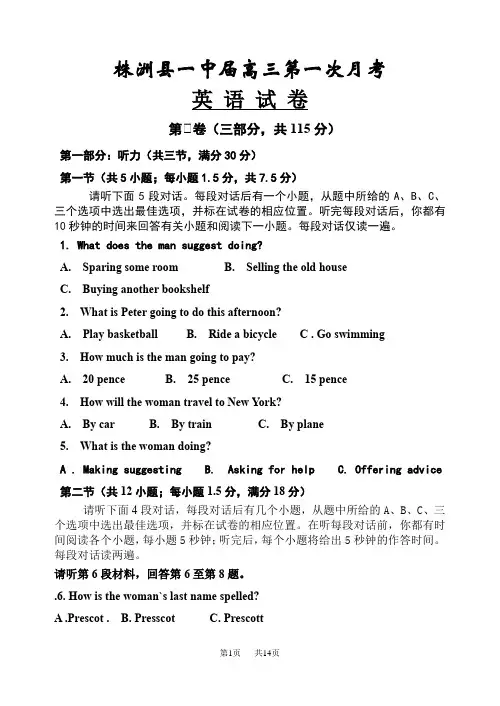
株洲县一中届高三第一次月考英语试卷第Ⅰ卷(三部分,共115分)第一部分:听力(共三节,满分30分)第一节(共5小题;每小题1.5分,共7.5分)请听下面5段对话。
每段对话后有一个小题,从题中所给的A、B、C、三个选项中选出最佳选项,并标在试卷的相应位置。
听完每段对话后,你都有10秒钟的时间来回答有关小题和阅读下一小题。
每段对话仅读一遍。
1. What does the man suggest doing?A. Sparing some roomB. Selling the old houseC. Buying another bookshelf2. What is Peter going to do this afternoon?A. Play basketballB. Ride a bicycle C . Go swimming3. How much is the man going to pay?A. 20 penceB. 25 penceC. 15 pence4. How will the woman travel to New York?A. By carB. By trainC. By plane5. What is the woman doing?A . Making suggesting B. Asking for help C. Offering advice 第二节(共12小题;每小题1.5分,满分18分)请听下面4段对话,每段对话后有几个小题,从题中所给的A、B、C、三个选项中选出最佳选项,并标在试卷的相应位置。
在听每段对话前,你都有时间阅读各个小题,每小题5秒钟;听完后,每个小题将给出5秒钟的作答时间。
每段对话读两遍。
请听第6段材料,回答第6至第8题。
.6. How is the woman`s last name spelled?A .Prescot . B. Presscot C. Prescott7. What is the woman`s address?A. Flat 2,40 , Fountain Road.B. Flat 2,14 , Fountain Road.C. Flat2 ,12, Canterbury Road8. What is the woman`s phone number?A . 752239B .755239 C. 755229请听第7段材料,回答第9至第11题。

Part I. Short Conversations (15 points)Directions: In this section, you will hear 15 short conversations. At the end of each conversation, a question will be asked about what was said. Both the conversation and the question will be spoken only once. After each question, there will be a pause. During the pause, you must read the four choices marked A), B), C), and D), and decide which is the best answer. Then mark the corresponding letter on Answer Sheet 1 with a single line through the centre.1. A) The man is going to the library.B) The woman is borrowing a book.C) The woman is helping the man find a book.D) The man is looking for a book on science.2. A) They are planning a trip.B) They are discussing the weather.C) They are talking about their work.D) They are comparing their schedules.3. A) The man has finished his homework.B) The woman is helping the man with his homework.C) The man needs more time to finish his homework.D) The woman is doing her own homework.4. A) The man is a doctor.B) The woman is a nurse.C) They are discussing a patient.D) They are going to the hospital.5. A) The woman is running a marathon.B) The man is going for a jog.C) They are planning to exercise together.D) They are discussing their fitness goals.6. A) The man is looking for a job.B) The woman is offering a job.C) They are discussing job opportunities.D) They are comparing their salaries.7. A) The man is going to the beach.B) The woman is going to the mountains.C) They are planning a vacation.D) They are discussing their travel preferences.8. A) The man is cooking dinner.B) The woman is cleaning the kitchen.C) They are preparing for a party.D) They are discussing their cooking skills.9. A) The man is teaching a class.B) The woman is studying for a test.C) They are discussing an assignment.D) They are planning a study group.10. A) The man is going to the gym.B) The woman is going to the movies.C) They are planning to do something together.D) They are discussing their free time activities.Part II. Long Conversations (20 points)Directions: In this section, you will hear 2 long conversations. At the end of each conversation, there will be some questions. Both the conversation and the questions will be spoken only once. After you hear a question, you must choose the best answer from the four choices marked A), B), C), and D). Then mark the corresponding letter on Answer Sheet 1 with a single line through the centre.Conversation 1Questions 11 to 13 are based on the conversation you have just heard.11. A) They are discussing the man's work experience.B) They are planning a business trip.C) They are comparing their travel itineraries.D) They are talking about a job offer.12. A) The man prefers to travel by train.B) The woman prefers to travel by plane.C) They are discussing the best mode of transportation.D) They are deciding on the date of their trip.13. A) They will meet in the morning.B) They will meet in the afternoon.C) They will meet at the train station.D) They will meet at the airport.Conversation 2Questions 14 to 16 are based on the conversation you have just heard.14. A) They are planning a birthday party.B) They are discussing a charity event.C) They are organizing a sports tournament.D) They are preparing for a graduation ceremony.15. A) The woman will provide the decorations.B) The man will provide the food.C) They will each bring something for the party.D) They will hire a caterer for the party.16. A) They will have a dance party.B) They will have a karaoke night.C) They will have a movie night.D) They will have a game night.Part III. Reading Comprehension (40 points)Directions: In this section, there are 4 passages, each with 5 questions. For each question, there are four suggested answers marked A), B), C), and D). You should choose the one that fits best according to the information given in the passage. Then mark the corresponding letter on Answer Sheet 1 with a single line through the centre.Passage 1Questions 17 to 21 are based on the following passage.The importance of exercise cannot be overstated. Regular physicalactivity is crucial for maintaining good health and preventing various diseases. According to the World Health Organization (WHO), adultsshould engage in at least 150 minutes of moderate-intensity aerobic physical activity throughout the week.One of the main benefits of exercise is that it helps to improve cardiovascular health. Regular exercise can lower blood pressure, reduce the risk of heart disease, and improve cholesterol levels. Additionally, it can enhance lung function and reduce the risk of respiratory diseases.Exercise also plays a significant role in mental health. Physical activity can reduce stress, anxiety, and depression. It promotes the release of endorphins, which are known as "feel-good" hormones, and can improve overall mood and well-being.Furthermore, exercise is essential for maintaining a healthy weight. Regular physical activity helps to burn calories and maintain a healthy metabolism. It can also improve muscle strength and endurance.In conclusion, exercise is a vital component of a healthy lifestyle. It offers numerous benefits, including improved cardiovascular health, mental well-being, and weight management. It is important for individuals of all ages and fitness levels to incorporate regular exercise into their daily routine.17. What is the main topic of the passage?A) The benefits of exerciseB) The risks of inactivityC) The history of exerciseD) The importance of sleep18. According to the passage, what is one of the benefits of exercise for cardiovascular health?A) It increases heart rate.B) It lowers blood pressure.C) It reduces cholesterol levels.D) It improves lung function.19. How does exercise affect mental health?A) It increases stress levels.B) It reduces anxiety and depression.C) It causes sleep disturbances.D) It decreases endorphin levels.20. What is the relationship between exercise and weight management?A) Exercise has no effect on weight.B) Exercise helps to burn calories and maintain a healthy metabolism.C) Exercise is harmful to weight management.D) Exercise can only be effective for weight loss.21. What is the author's overall conclusion about exercise?A) Exercise is not important for health.B) Exercise is beneficial for physical and mental health.C) Exercise is only important for athletes.D) Exercise should be avoided at all costs.Passage 2Questions 22 to 26 are based on the following passage.In recent years, there has been a growing concern about the impact of plastic pollution on the environment. Plastic waste is a significant threat to marine life, wildlife, and human health. It is estimated that over 8 million tons of plastic enter the oceans each year.One of the main sources of plastic pollution is single-use plastics, such as bags, straws, and bottles. These items are often used for only a few minutes before being discarded, but they can take hundreds of years to decompose in the environment.The consequences of plastic pollution are severe. It can harm marinelife by entangling or poisoning them. It can also enter the food chain, leading to potential health risks for humans. Moreover, plastic waste can disrupt ecosystems and reduce biodiversity.To address this issue, many countries and organizations are taking steps to reduce plastic consumption and increase recycling rates. Some citieshave implemented bans on single-use plastics, while others are promoting alternative materials and recycling programs.Individuals can also play a role in reducing plastic pollution. By using reusable bags, bottles, and containers, and properly disposing ofplastic waste, people can help to minimize their environmental impact.22. What is the main topic of the passage?A) The benefits of recyclingB) The impact of plastic pollution on the environmentC) The history of plastic useD) The role of individuals in reducing plastic pollution23. According to the passage, what is one of the main sources of plastic pollution?A) Paper productsB) Metal productsC) Single-use plasticsD) Biodegradable materials24. What are the consequences of plastic pollution?A) It improves water quality.B) It increases biodiversity.C) It disrupts ecosystems and reduces biodiversity.D) It promotes the growth of plant life.25. What steps are being taken to address the issue of plastic pollution?A) Increasing the production of single-use plasticsB) Implementing bans on single-use plasticsC) Decreasing recycling ratesD) Promoting the use of alternative materials26. What can individuals do to reduce plastic pollution?A) Use more plastic productsB) Properly dispose of plastic wasteC) Recycle all plastic wasteD) Ignore the issue of plastic pollutionPassage 3Questions 27 to 31 are based on the following passage.The Internet has revolutionized the way we communicate, access information, and conduct business. It has become an essential tool for individuals, businesses, and governments around the world. However, the Internet also presents challenges, including privacy concerns and cybersecurity threats.One of the main concerns regarding the Internet is privacy. With the increasing amount of personal data being collected and stored online, individuals are at risk of having their sensitive information compromised. Cybercriminals can use this information for identity theft, financial fraud, and other malicious activities.To protect their privacy, individuals should be cautious about sharing personal information online. They should use strong passwords, enable two-factor authentication, and be aware of the privacy policies of the websites and apps they use.Cybersecurity threats are also a significant concern. Hackers canexploit vulnerabilities in computer systems and networks to gain unauthorized access to sensitive data. This can lead to data breaches, financial loss, and reputational damage.To mitigate cybersecurity risks, individuals and organizations should implement strong security measures, such as firewalls, antivirussoftware, and regular software updates. They should also be vigilant about phishing scams and other forms of cyberattacks.In conclusion, while the Internet offers numerous benefits, it also poses risks to privacy and cybersecurity. It is important for individuals and organizations to be aware of these risks and take steps to protect themselves.27. What is the main topic of the passage?A) The benefits of the InternetB) The challenges of the InternetC) The history of the InternetD) The role of the Internet in society28. What is one of the main concerns regarding the Internet?A) The lack of access to informationB) Privacy concernsC) The cost of Internet serviceD) The negative impact on physical health29. How can individuals protect their privacy online?A) By sharing personal information with everyoneB) By using strong passwords and two-factor authenticationC) By ignoring privacy policiesD) By using public Wi-Fi networks30. What are cybersecurity threats?A) They are the same as privacy concerns.B) They are related to vulnerabilities in computer systems and networks.C) They are caused by the use of weak passwords.D) They are a result of poor internet service.31. What can individuals and organizations do to mitigate cybersecurity risks?A) By using weak passwordsB) By ignoring security updatesC) By implementing strong security measures and being vigilantD) By not using the InternetPassage 4Questions 32 to 36 are based on the following passage.The global climate crisis is one of the most pressing challenges of our time. The Earth's climate is changing at an unprecedented rate,primarily due to human activities, such as the burning of fossil fuels and deforestation. This has led to rising temperatures, extreme weather events, and rising sea levels.One of the most significant impacts of climate change is on agriculture. Increased temperatures and changes in precipitation patterns can affect crop yields and food security. This can lead to higher food prices and increased hunger in vulnerable populations.Another consequence of climate change is the loss of biodiversity. Many species are unable to adapt to the rapid changes in their habitats, leading to extinction. This loss of biodiversity can disrupt ecosystems and reduce the resilience of natural systems.To address the climate crisis, it is crucial to reduce greenhouse gas emissions and transition to renewable energy sources. This includes investing in renewable energy infrastructure, promoting energy efficiency, and developing sustainable agricultural practices.Individuals can also play a role in mitigating the effects of climate change. By reducing their carbon footprint, such as using publictransportation, reducing energy consumption, and supporting sustainable products, individuals can contribute to a healthier planet.32. What is the main topic of the passage?A) The benefits of renewable energyB) The impact of climate change on the environmentC) The history of the Earth's climateD) The role of individuals in addressing the climate crisis33. What are the main causes of the global climate crisis?A) Natural climate variabilityB) Human activities, such as burning fossil fuels and deforestationC) Volcanic eruptionsD) Solar radiation34. What are some of the impacts of climate change on agriculture?A) Increased crop yieldsB) Higher food prices and increased hungerC) Improved water qualityD) Increased biodiversity35. What is one of the consequences of climate change for biodiversity?A) Increased plant growthB) The loss of species and disruption of ecosystemsC) Improved air qualityD) Increased rainfall36. What can individuals do to mitigate the effects of climate change?A) By burning more fossil fuelsB) By reducing their carbon footprint, such as using public transportation and supporting sustainable productsC) By ignoring climate change and continuing with current practicesD) By promoting the use of non-renewable energy sourcesPart IV. Writing (25 points)Directions: For this part, you are allowed 30 minutes to write an essay。

英语试卷:English-test-with-answer-keyB2TrackTest English Level Practice TestThis sample English B2 Core Test from TrackTest provides a test structure, questions and tasks similar to the certificated TrackTest exam.The TrackTest English Core Test is focused on assessment of English receptive skills and contains three sections: SECTION I: Grammar (Use of English)SECTION II: Reading ComprehensionSECTION III: Listening ComprehensionTime: 45 minutes.In the official online version, you need to complete each section (grammar, reading, listening) before you proceed to the next section. The optional Speaking&Writing exam can be completed after the successful completion of the Core test.This sample test is provided for practice only, the official results and TrackTest certificates are provided only for computer tests taken through the website h ttps://tracktest.eu.More about the certificates for all English levels: h ttps://tracktest.eu/english-certification-online/SECTION I: Grammar (Use of English)1.Listen! A siren is ................... .a) splashing b) wailing c) crashing d) barking2.Sam hopes .... an astronaut one day.a) becoming b) become c) to become3.The man sitting next to me on the plane was very nervous. He..............................before.a) didn’t fly b) hadn’t flown c) hasn’t flown c) wasn’t flying4.Where’s the book I gave you? What...............................with it?a) have you been doing b) are you doing c) have you done5. "Paul lost his watch." "Well, if he had looked after it, he ... it."a) won′t lose b) wouldn’t lose c) wouldn′t have lost6.My father ... to be a teacher, but now he has retired.a) used b) got used c) is used7.In recent years there has been a large increase .............. the number of people who take noregular exercise.a) of b) in c) for8. By noon, Joe ......... for three hours.a) is going to fish b) will be fishing c) will have been fishing9. It rained so hard the whole village ..................a) scalded b) burnt c) flooded10. “I haven't seen Mark for weeks.” “Well, I …. him this afternoon. Why don't you come along?”a) am meeting b) have met c) meet11. I can't believe you're going on a cruise this summer; it must be costing the ..............!a) earth b) fortune c) nickel12. Try ................ with olive oil. It'll taste better.a) to cook b) cooking c) cook13. "Where is my bank book?" "If you ... in the drawer, you'll find it."a) had looked b) looked c) look14. "This cake tastes very sweet." "I think I put ... sugar in it."a) a lot b) too much c) too many15. Neil was reading the newspaper when he came ............. an article about an old friend of his.a) into b) across c) on d) up with16. Jenny seems …. very happy these days.a) to be b) be c) being17. “I ….. to reach Jane on the phone all day.” “Don't you know? She's gone on holiday.”a) tried b) have been trying c) have tried18. By the time Eric ……… at the airport, his flight had already departed.a) has arrived b) arrived c) was arriving19. She was grateful to all the volunteers ............ their help.a) for b) about c) of d) in20. Lisa ... the house when her husband came home.a) paints b) has painted c) was paintingEnd of Section I. Correct: ________SECTION II: Reading ComprehensionReading Task 1You are going to read a page from a brochure with advertisements for four unusual leisure experiences. For questions 1-7, choose from the advertisements (A-D). The advertisements may be chosen more than once or not chosen at all.Do Something DifferentA - Indoor SkydivingIf you have always wanted to try skydiving, but are afraid of flying, here is the answer - indoor skydiving. You will feel like you are freefalling from a plane, even though you are only about two feet off the ground, as a giant propeller blasts air at 200 mph, suspending you in the airflow. It is a freefall experience that everyone must try, at the world's biggest skydiving wind tunnel, in Bedfordshire, England. Compared to other similar experiences on the market, you will get more 'flight time' in the wind tunnel and, when you finish, a DVD containing footage of your flight for you to remember the experience. This facility also caters to international skydiving teams, so be assured that you'll be in the safest hands. The tunnel was originally built over fifty years ago to study aerodynamic forces, and later to test the strength of aeroplane parts such as ejector seats. Four decades later, the tunnel was restored. A reasonable level of fitness is required in order to participate. Spectators can watch the dive from the free viewing gallery, but the loud noise makes it unsuitable for very young children.B - The Cathedrals Express Steam TrainStep back into the 19th century as you take a train ride on the Cathedrals Express, which runs from central London to some of England's most beautiful cathedral cities. It's the perfect experience for romantic couples, Harry Potter fans and those whowant to relive the good old days. As you travel, you will dine on superb food while sitting at a table with lovely views of the countryside. The train is an exact replica of one that operated during Victorian times, and the carriage interiors are beautifully decorated. It is an unusual sight, so expect people to wave at you as you go by. Of course, you may wish to wave back! When the train pulls into the terminus, you are released from the fantasy for a short spell, as you have the chance to shop or see the sights. Trains and stations have ramps for wheelchair users. Spectators are welcome to see the train depart and meet it on its return.C - Traditional Circus SkillsDo you want to learn some new skills? Are you fed up with the usual routine and want to do something a little more exciting than walking around the shopping centre on Saturday mornings?Then roll up, roll up -come and join the circus! During your session at Britain's top circus skills school, you will learn about the physical strength required for the trapeze and acrobatics, practise your coordination skills while juggling and attempt to acrobalance (otherwise known as tightrope walking). All the instructors are professionals with first-hand knowledge of the techniques and equipment used. You'll be learning the basics in no time, so you can impress all your friends with your new skills when you get home. It is recommended that you wear casual clothes that don't restrict your movement - a tracksuit and trainers would be ideal. Participants must be at least 14 years old, and although they don't need to be in absolutely tip-top shape, a reasonable level of fitness is required if you want to get the most from this course. Spectators are welcome throughout. Unfortunately, there is no disabled access at the school.D - Scuba DivingAre you having trouble finding things to do with the kids? Here's an idea. At the Aqua Fun Programme, young adventurers are introduced to the thrill of breathing under water. They are first taught the basic procedures for scuba diving, including safety and communication with fellow divers, and familiarised with the equipment before dipping their toes into the water. All the instructors are qualified Diving Instructors. Then, under constant supervision, they get to dive and swim around in a swimming pool, at a maximum depth of only 6m, but still, experience what it would feel like to be in a natural diving environment. Parents are welcome to watch as their children learn to scuba dive and enjoy splashing around making bubbles underwater. Children don't have to be strong swimmers and previous experience is not needed. You must bring your own swimwear, but all other equipment will be provided.Which of the advertisements mention(s):1. something participants in the experience must bring with them? A - B - C - D2. giving you something to take home with you? A - B - C - D3. giving you the chance to take a break from normal life? A - B - C - D4. what participants will learn before the start of the activity? A - B - C - D5. regret that a specific type of visitor cannot enter the place? A - B - C - D6. that the place has been used for more than one purpose? A - B - C - D7. something which makes it possible for the disabled to participate? A - B - C - DA - Indoor Skydiving,B - The Cathedrals Express Steam Train,C - Traditional Circus Skill,D - Scuba DivingReading Task 2You are going to read a newspaper article about a politician who made a film about climate change. Seven sentences have been removed from the article. Choose from the sentences A-H the one which fits each gap (1-7). There is one extra sentence which you do not need to use.The Accidental Movie StarFormer Vice President of the U.S.A. Al Gore has made a film he hopes will help to change the way we view climate change. Al Gore has been concerned with climate change, or 'climate crisis' as he calls it, for the majority of his political career. As the years passed and he became more passionate about this issue, he started travelling the world in order to educate peopleabout the effects of global warming using computer slideshows. Free of charge, he explained to his audiences that the world is facing a 'planetary emergency' and that it isn't too late to stop it if appropriate action is taken now.It was during this time of touring and giving lectures that Gore was spotted by Hollywood producer Laurie David, who asked him to turn his slideshow into a documentary which he would play the starring role. {1 ________} E ventually, though, David managed to persuade him. The result was a fascinating documentary combining references to Gore's own life story with horrifying predictions about the future of our planet.Little did Gore know that just one year later he would be walking along the red carpet at the Cannes Film Festival and later collecting an Oscar for 'Best Documentary'. {2 _______ } A dvertised as 'the scariest movie you'll ever see,' it concentrates on the potentially terrifying consequences of climate change.'An Inconvenient Truth' certainly gives us much to consider. For example, is there a link between the frequency of strong hurricanes and global warming? Why was 2005 the hottest year ever recorded? Could whole cities such as San Francisco one day be submerged in water due to rising sea levels? {3_______ }As the title of the film suggests, however, it may be inconvenient for us to have to think about the future of the planet, but think we must.Published at the same time as the release of the film, Gore's book of the same title contains additional information and scientific analysis to further support his claims. {4 _______}Gore is delighted that some schools are even using the DVD to help them teach awareness of environmental issues to their students.As pessimistic as the film may seem, it ends on a positive note. {5______}If Gore was going to present a problem, he wanted to offer a potential solution, too. His main hope is that people accept the reality of the crisis and then turn that knowledge into action.Gore leads by example. {6________ } H e realises, however, that most people need a little more help when it comes to changing their habits. For this reason, he has also been working hard to encourage large shops to sell more environmentally friendly products.So can this one man's efforts really make a difference? {7 ________ }It may not seem as if the decisions of individuals can achieve very much, but put them all together and they may add up to something that will, literally, change the world.A. The movie owes its success to its ability to hold our attention.B. He insists on using biodiesel vehicles and has decided to become carbon neutral, which means that he reduces the amount of carbon dioxide he produces every day.C. Well, according to Gore, if we are clear about what the problem is, then we are more likely to introduce changes into our daily lives, such as choosing the 'greenest' light bulbs or cars.D. Whilst both the film and the book have largely been well received by critics, they have been criticised by some as being'exaggerated' and 'over-the-top'.E. The aim of the film certainly seems to be to 'shock' people into action, which may or may not be the best way to tackle the issue of global warming.F. The profits from both the film and the book are now funding other campaigns to spread the message about global warming.G. As Gore himself says, "It's not too late to solve this crisis, and solving it means avoiding the worst of the consequences and reversing this trend towards catastrophe."H. At first, Gore was reluctant, as he has always been a very private person, despite being used to being in the public eye. Correct: ________End of Section II.SECTION III: Listening ComprehensionL istening Task 1(from h ttps://tracktest.eu/english-practice-test-with-answers-b2)You will hear David telling his friend Janet about his recent trip to Brazil. Choose the best answer.1. Where was the first place he went?a)To the beach b) To the hotel c) To the Carnival2. What does Dave say about the dancers?a)They were tireless b) They were tiring c) They were tired3. What is the Sambodromo?a) A parade b) A street c) A dance4. What does Dave say about the nightlife?a)It is an interesting mix b) He did not go out much c) The nightclubs were great5. What is Janet going to do?a)Take some photos b) Look at some photos c) Get some photos developedL istening Task 2(from h ttps://tracktest.eu/english-practice-test-with-answers-b2)Listen to the radio interview and mark the best answers.1. Why was hypnosedation abandoned in India?a)because of the adverse side effects in patientsb)because of the discovery of chemical anestheticsc)because of the advances in surgical techniques2. According to the speakers, which country has made the most progress in the medical uses of hypnosis?a)Belgiumb)the U.S.A.c)India3. Which unconventional procedure is successfully used in Belgium today?a)local anesthesiab)pharmacological comac)hypnosedation4. Why can’t hypnosedation take the place of general anesthesia?a)There aren’t enough active supporters.b)Not everyone is affected by hypnosis.c)It’s not for people allergic to anesthetic drugs.5. What can we speculate about hypnosedation?a)It has been fully accepted by the medical world.b)It hasn’t been fully accepted by the medical world.c)60% of the general population is unresponsive to it.End of Section III.Correct: ________Answer Key:Grammar:1b (vocabulary), 2c (infinitive/ing), 3b (past tenses), 4c (past tenses), 5c (conditionals), 6a (past tenses), 7b (prepositions), 8c (future tenses), 9c (vocabulary), 10a (future tenses), 11a (idioms), 12b (infinitive/ing), 13c (conditionals), 14b (quantifiers), 15b (phrasal verbs), 16a (infinitive/ing), 17b (present tenses), 18b (past tenses), 19a (prepositions), 20c (past tenses)Questions: 20Correct answers: _____Reading:Task 1: 1D, 2A, 3C, 4D, 5C, 6A, 7BTask 2: 1H, 2A, 3E, 4F, 5G, 6B, 7CQuestions: 14Correct answers: ____Listening:Task 1: 1b, 2a, 3a, 4c, 5bTask 2: 1b, 2a, 3c, 4c, 5aQuestions: 10Correct a nswers: ____Total questions: 44The TOTAL number of correct answers: ________Calculation of the result: (Correct answers _____ / 44 )*100= _______%Cut score for passing the level core test is 65% and more.With a score of 65% and more, you would pass the B2 level and get the TrackTest B2 certificate.With a score of l ess than 65%, you would not pass the B2 level. You can try easier levels or take the same level again after 30 days.。

2022年普通高等学校招生全国统一考试(新高考全国Ⅰ卷)英语本试卷共10页,满分120分。
考试用时120分钟。
注意事项:1. 答卷前,考生务必用黑色字迹钢笔或签字笔将自己的姓名、考生号、考场号和座位号填写在答题卡上。
用2B铅笔将试卷类型(A)填涂在答题卡相应位置上。
将条形码横贴在答题卡右上角“条形码粘贴处”。
因笔试不考听力,选择题从第二部分的“阅读”开始,试题序号从“21”开始。
2. 作答选择题时,选出每小题答案后,用2B铅笔把答题卡上对应题目选项的答案信息点涂黑;如需改动,用橡皮擦干净后,再选涂其他答案,答案不能答在试卷上。
3. 非选择题必须用黑色字迹钢笔或签字笔作答,答案必须写在答题卡各题目指定区域内相应位置上;如需改动,先划掉原来的答案,然后再写上新的答案;不准使用铅笔和涂改液,不按以上要求作答的答案无效。
4. 考生必须保持答题卡的整洁:考试结束后,将试卷和答题卡一并交回。
第二部分阅读(共两节,满分50分)第一节(共15小题;每小题2.5分,满分37.5分)阅读下列短文,从每题所给的A、B、C、D四个选项中选出最佳选项。
AGrading Policies for Introduction to LiteratureGrading Scale90-100, A; 80-89, B; 70-79, C; 60-69, D; Below 60, E.Essays(60%)Your four major essays will combine to form the main part of the grade for this course: Essay 1 =10%; Essay 2=15%; Essay 3=15%; Essay 4=20%Group Assignments(30%)Students will work in groups to complete four assignments(作业)during the course. All the assignments will be submitted by the assigned date through Blackboard, our online learning and course management system.Daily Work/In-Class Writings and Tests/Group Work/Homework(10%)Class activities will vary from day to day, but students must be ready to complete short in-class writings or tests drawn directly from assigned readings or notes from the previous class' lecture/discussion, so it is important to take careful notes during class. Additionally, from time to time I will assign group work to be completed in class or short assignments to be completed at home, both of which will be graded.Late WorkAn essay not submitted in class on the due date will lose a letter grade for each class period it is late. If it is not turned in by the 4th day after the due date, it will earn a zero. Daily assignments not completed during class will get a zero. Short writings missed as a result of an excused absence will be accepted.21. Where is this text probably taken from?A. A textbook.B. An exam paper.C. A course plan.D. An academic article.22. How many parts is a student's final grade made up of?A. Two.B. Three.C. Four.D. Five.23. What will happen if you submit an essay one week after the due date?A. You will receive a zero.B. You will lose a letter grade.C. You will be given a test.D. You will have to rewrite it.BLike most of us, I try to be mindful of food that goes to waste. The arugula(芝麻菜)was to make a nice green salad, rounding out a roast chicken dinner. But I ended up working late. Then friends called with a dinner invitation. I stuck the chicken in the freezer. But as days passed, the arugula went bad. Even worse, I had unthinkingly bought way too much; I could have made six salads with what I threw out.In a world where nearly 800 million people a year go hungry, "food waste goes against the moral grain," as Elizabeth Royte writes in this month's cover story. It's jaw-dropping how much perfectly good food is thrown away—from “ugly"(but quite eatable)vegetables rejected by grocers to large amounts of uneaten dishes thrown into restaurant garbage cans.Producing food that no one eats wastes the water, fuel, and other resources used to grow it. That makes food waste an environmental problem. In fact, Royte writes, "if food waste were a country, it would be the third largest producer of greenhouse gases in the world."If that's hard to understand, let's keep it as simple as the arugula at the back of my refrigerator. Mike Curtin sees my arugula story all the time —but for him, it's more like 12 bones of donated strawberries nearing their last days. Curtin is CEO of DC Central Kitchen in Washington, D.C., which recovers food and turns it into healthy meals. Last year it recovered more than 807,500 pounds of food by taking donations and collecting blemished(有瑕疵的)produce that otherwise would have rotted in fields. And the strawberries? V olunteers will wash, cut, and freeze or dry them for use in meals down the road.Such methods seem obvious, yet so often we just don't think. "Everyone can play a part in reducing waste, whether by not purchasing more food than necessary in your weekly shopping or by asking restaurants to not include the side dish you won't eat," Curtin says.24. What does the author want to show by telling the arugula story?A. We pay little attention to food waste.B. We waste food unintentionally at times.C. We waste more vegetables than meat.D. We have good reasons for wasting food.25. What is a consequence of food waste according to the test?A. Moral decline.B. Environmental harm.C. Energy shortage.D. Worldwide starvation.26. What does Curtin's company do?A. It produces kitchen equipment.B. It turns rotten arugula into clean fuel.C. It helps local farmers grow fruitsD. It makes meals out of unwanted food.27. What does Curtin suggest people do?A. Buy only what is needed.B. Reduce food consumption.C. Go shopping once a week.D. Eat in restaurants less often.CThe elderly residents(居民)in care homes in London are being given hens to look after to stop them feeling lonely.The project was dreamed up by a local charity(慈善组织)to reduce loneliness and improve elderly people's wellbeing, It is also being used to help patients suffering dementia, a serious illness of the mind. Staff in care homes have reported a reduction in the use of medicine where hens are inuse.Among those taking part in the project is 80-year-old Ruth Xavier. She said: “I used to keep hens when I was younger and had to prepare their breakfast each morning before I went to school."I like the project a lot. I am down there in my wheelchair in the morning letting the hens out and down there again at night to see they've gone to bed."It's good to have a different focus. People have been bringing their children in to see the hens and residents come and sit outside to watch them. I'm enjoying the creative activities, and it feels great to have done something useful."There are now 700 elderly people looking after hens in 20 care homes in the North East, and the charity has been given financial support to roll it out countrywide.Wendy Wilson, extra care manager at 60 Penfold Street, one of the first to embark on the project, said: "Residents really welcome the idea of the project and the creative sessions. We are looking forward to the benefits and fun the project can bring to people here."Lynn Lewis, director of Notting Hill Pathways, said: "We are happy to be taking part in the project. It will really help connect our residents through a shared interest and creative activities."28. What is the purpose of the project?A. To ensure harmony in care homes.B. To provide part-time jobs for the aged.C. To raise money for medical research.D. To promote the elderly people's welfare.29. How has the project affected Ruth Xavier?A. She has learned new life skills.B. She has gained a sense of achievement.C. She has recovered her memory.D. She has developed a strong personality.30. What do the underlined words "embark on" mean in paragraph 7?A. Improve.B. Oppose.C. Begin.D. Evaluate.31. What can we learn about the project from the last two paragraphs?A. It is well received.B. It needs to be more creative.C. It is highly profitable.D. It takes ages to see the results.DHuman speech contains more than 2,000 different sounds, from the common "m" and "a" to the rare clicks of some southern African languages. But why are certain sounds more common than others? A ground-breaking, five-year study shows that diet-related changes in human bite led to new speech sounds that are now found in half the world's languages.More than 30 years ago, the scholar Charles Hockett noted that speech sounds called labiodentals, such as "f" and "v", were more common in the languages of societies that ate softer foods. Now a team of researchers led by Damián Blasi at the University of Zurich, Switzerland, has found how and why this trend arose.They discovered that the upper and lower front teeth of ancient human adults were aligned(对齐), making it hard to produce labiodentals, which are formed by touching the lower lip to the upper teeth. Later, our jaws changed to an overbite structure(结构), making it easier to produce such sounds.The team showed that this change in bite was connected with the development of agriculture in the Neolithic period. Food became easier to chew at this point. The jawbone didn't have to do as much work and so didn't grow to be so large.Analyses of a language database also confirmed that there was a global change in the sound of world languages after the Neolithic age, with the use of "f" and "v" increasing remarkably during the last few thousand years. These sounds are still not found in the languages of many hunter-gatherer people today.This research overturns the popular view that all human speech sounds were present whenhuman beings evolved around 300,000 years ago. "The set of speech sounds we use has not necessarily remained stable since the appearance of human beings, but rather the huge variety of speech sounds that we find today is the product of a complex interplay of things like biological change and cultural evolution," said Steven Moran, a member of the research team.32. Which aspect of the human speech sound does Damián Blasi's research focus on?A. Its variety.B. Its distribution.C. Its quantity.D. Its development.33. Why was it difficult for ancient human adults to produce labiodentals?A. They had fewer upper teeth than lower teeth.B. They could not open and close their lips easily.C. Their jaws were not conveniently structured.D. Their lower front teeth were not large enough.34. What is paragraph 5 mainly about?A. Supporting evidence for the research results.B. Potential application of the research findings.C. A further explanation of the research methods.D. A reasonable doubt about the research process.35. What does Steven Moran say about the set of human speech sounds?A. It is key to effective communication.B. It contributes much to cultural diversity.C. It is a complex and dynamic system.D. It drives the evolution of human beings.第二节(共5小题;每小题2.5分,满分12.5分)阅读下面短文,从短文后的选项中选出可以填入空白处的最佳选项。