
PASSIVEDEMODULAT...
- 格式:pdf
- 大小:2.71 MB
- 文档页数:65

Passive Voice
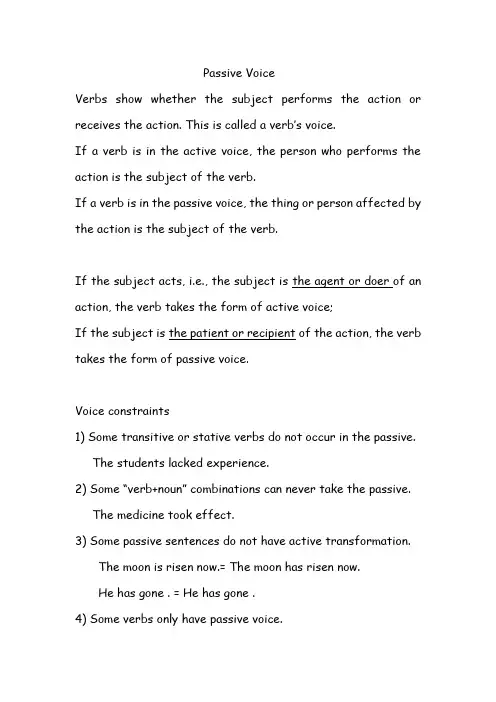
Verbs show whether the subject performs the action or
receives the action. This is called a verb’s voice.
If a verb is in the active voice, the person who performs the
action is the subject of the verb.
If a verb is in the passive voice, the thing or person affected by
the action is the subject of the verb.
If the subject acts, i.e., the subject is the agent or doer of an
action, the verb takes the form of active voice;
If the subject is the patient or recipient of the action, the verb
takes the form of passive voice.
Voice constraints
1) Some transitive or stative verbs do not occur in the passive.
The students lacked experience.
2) Some “verb+noun” combinations can never take the passive.
The medicine took effect.
3) Some passive sentences do not have active transformation.
Passive-interface的使用:
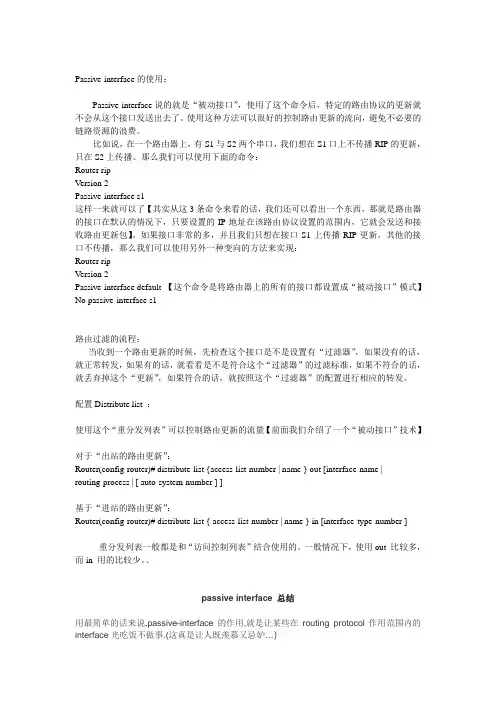
Passive-interface说的就是“被动接口”,使用了这个命令后,特定的路由协议的更新就不会从这个接口发送出去了。使用这种方法可以很好的控制路由更新的流向,避免不必要的链路资源的浪费。
比如说,在一个路由器上,有S1与S2两个串口,我们想在S1口上不传播RIP的更新,只在S2上传播。那么我们可以使用下面的命令:
Router rip
Version 2
Passive-interface s1
这样一来就可以了【其实从这3条命令来看的话,我们还可以看出一个东西,那就是路由器的接口在默认的情况下,只要设置的IP地址在该路由协议设置的范围内,它就会发送和接收路由更新包】。如果接口非常的多,并且我们只想在接口S1上传播RIP更新,其他的接口不传播,那么我们可以使用另外一种变向的方法来实现:
Router rip
Version 2
Passive-interface default 【这个命令是将路由器上的所有的接口都设置成“被动接口”模式】
No passive-interface s1
路由过滤的流程:
当收到一个路由更新的时候,先检查这个接口是不是设置有“过滤器”,如果没有的话,就正常转发,如果有的话,就看看是不是符合这个“过滤器”的过滤标准,如果不符合的话,就丢弃掉这个“更新”,如果符合的话,就按照这个“过滤器”的配置进行相应的转发。
配置Distribute list :
使用这个“重分发列表”可以控制路由更新的流量【前面我们介绍了一个“被动接口”技术】
对于“出站的路由更新”:
Router(config-router)# distribute-list {access-list-number | name } out [interface-name |
routing-process | [ auto-system-number ] ]

Glossary
pattern: 模板
Example: Pattern: QTP, SQTP, code or special requirements (blank otherwise). QTP Pattern #301.
shunt regulator: 并联稳压器
Example: Internal shunt regulator allows 12, 24, 48V operation.
shift: 平移
Example: The voltage at this pin shifts the output voltage.
slew rate
[1] 压摆率 n.
Example: The slew rate (SR) is defined as the maximum rate of change of the output on an op amp.
[2] 斜率,边沿斜率,变化率 n. (需请教资深工程师)
Example: Slew rate control is disabled for Standard Speed mode.
(1和2意义相同,都是指“电压转换速率-单位时间内的电压变化率dv/dt”这个词的译法很多,压摆率,斜
率,转换率,回转率,斜升率等,几乎没有个标准,不必计较太多。我建议译成“转换率”。
wiper
[1] 滑动端 n.
Example: The digital potentiometer IC has 64 wiper positions.
[2] 雨刷 n.
Example: Rain sensor switches off much too late, leaving the wipers rubbing a dry window.
wiper resistance: 滑动电阻
Example: Wiper resistance of the digital pot is proportional to VIN.
By Chen Liqing
1 The Passive Voice
一、观察与总结
Many people speak English.
English is spoken by many people.
正如汉语中的被字句,英语中的“被字句”我们称之为_____________。英语中两种语态:____________ 和_____________。英语的语态是通过动词的形式的变化表现出来的。
二、 被动语态的结构与时态。
被动语态由“be+及物动词的过去分词”构成。不及物动词本身没有被动语态。
及物动词——本身意义不完整,后必须带宾语。有些还可以带双宾。
不及物动词——本身意义完整,不需要带宾语。如带宾语必须通过介词。
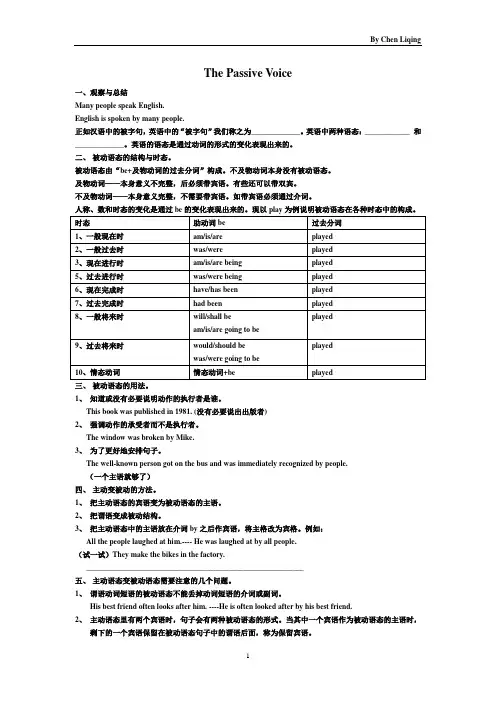
人称、数和时态的变化是通过be的变化表现出来的。现以play为例说明被动语态在各种时态中的构成。
时态 助动词be 过去分词
1、一般现在时 am/is/are played
2、一般过去时 was/were played
3、现在进行时 am/is/are being played
5、过去进行时 was/were being played
6、现在完成时 have/has been played
7、过去完成时 had been played
8、一般将来时 will/shall be
am/is/are going to be played
9、过去将来时 would/should be
was/were going to be played
10、情态动词 情态动词+be played
三、 被动语态的用法。
1、 知道或没有必要说明动作的执行者是谁。
This book was published in 1981. (没有必要说出出版者)
2、 强调动作的承受者而不是执行者。
The window was broken by Mike.
3、 为了更好地安排句子。