
英语语言学概论第二章phonology(共14张PPT)
- 格式:pptx
- 大小:1.78 MB
- 文档页数:14

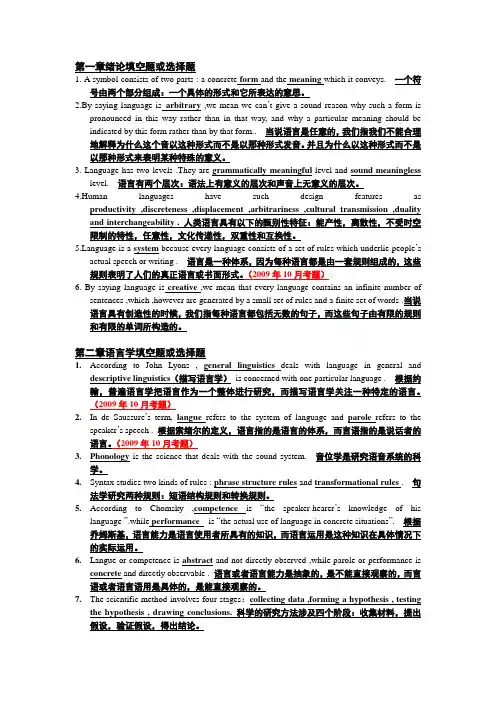
第一章绪论填空题或选择题
1. A symbol consists of two parts : a concrete form and the meaning which it conveys. 一个符号由两个部分组成:一个具体的形式和它所表达的意思。
2.By saying language is arbitrary ,we mean we can’t give a sound reason why such a form is
pronounced in this way rather than in that way, and why a particular meaning should be
indicated by this form rather than by that form.. 当说语言是任意的,我们指我们不能合理地解释为什么这个音以这种形式而不是以那种形式发音。并且为什么以这种形式而不是以那种形式来表明某种特殊的意义。
3. Language has two levels .They are grammatically meaningful level and sound meaningless
level. 语言有两个层次:语法上有意义的层次和声音上无意义的层次。
4.Human languages have such design features as
productivity ,discreteness ,displacement ,arbitrariness ,cultural transmission ,duality
and interchangeability . 人类语言具有以下的甄别性特征:能产性,离散性,不受时空限制的特性,任意性,文化传递性,双重性和互换性。
nguage is a system because every language consists of a set of rules which underlie people’s

英语语言学概论
1 1. What are the difference between general linguistics and descriptive
linguistics and what sis the relationship between them? (P.1)
A: Differences between general and descriptive linguistics:
(1) They have different goals:
General linguistics deals with language; descriptive linguistics study one
particular language;
(2) They have different aims:
General linguistics aims at developing a theory that describes the rules of
human language in general;
Descriptive linguistics attempts to establish a model that describes the rules of
this particular language.
Relationships between general and descriptive linguistics:
General and descriptive linguistics depend on each other:
(1) General linguistics provides descriptive linguistics with a general
framework in which a particular language can be analyzed and described;

大耳朵英语 www.ebigear.con 更好的英语互动平台
资料免费下载,助您成功!
第一章 绪论
1/ What is linguistics?
什么是语言学?
Linguistics is generally defined as the scientific study of language. It studies not any particular
language, but languages in general.
2/ The scope of linguistics
语言学的研究范畴
The study of language as a whole is often called general linguistics. (普通语言学)
The study of sounds, which are used in linguistic communication, is called phonetics. (语音学)
The study of how sounds are put together and used in communication is called phonology. (音系学)
The study of the way in which morphemes are arranged to form words are called morphology.
(形态学)
The study of how morphemes and words are combined to form sentences is called syntax. (句法学)
The study of meaning in language is called semantics. (语义学)
The study of meaning in context of use is called pragmatics. (语用学)

《英语语言学概论》精选试题 1
1. Which of the following statements about language is NOT true
A. Language is a system
B. Language is symbolic
C. Animals also have language
D. Language is arbitrary
2. Which of the following features is NOT one of the design features of language
A. Symbolic B. Duality C. Productive D. Arbitrary
3. What is the most important function of language
A. Interpersonal B. Phatic
C. Informative D. Metalingual
4. Who put forward the distinction between Langue and Parole
A. Saussure B. Chomsky
C. Halliday D. Anonymous
5. According to Chomsky, which is the ideal user's internalized knowledge of his language
A. competence B. parole
C. performance D. langue
6. The function of the sentence "A nice day, isn't it" is .
A. informative B. phatic
C. directive D. performative
7. Articulatory phonetics mainly studies .