气相色谱发分析流程
- 格式:doc
- 大小:15.58 KB
- 文档页数:3
气相色谱发分析流程
英文回答:
Gas Chromatography Analysis Procedure.
Gas chromatography (GC) is a separation technique used
to analyze the chemical composition of a sample. It is
based on the principle that different compounds have
different affinities for a stationary phase and a mobile
phase. The stationary phase is typically a solid or liquid
coated onto a glass or metal column. The mobile phase is a
gas that flows through the column, carrying the sample
compounds with it.
The sample is injected into the GC column, and the
compounds are separated as they pass through the column.
The compounds with the highest affinity for the stationary
phase will elute (exit the column) first, followed by the
compounds with the lowest affinity. The elution order of
the compounds is determined by their boiling points, molecular weights, and polarity.
The separated compounds are detected by a detector,
which is located at the end of the column. The detector
generates a signal that is proportional to the
concentration of the compound in the sample. The signal is
recorded on a chart or computer, and the resulting
chromatogram is used to identify and quantify the compounds
in the sample.
GC is a versatile technique that can be used to analyze
a wide variety of samples, including食品, 药品, and
environmental samples. It is a powerful tool for
identifying and quantifying compounds in complex mixtures.
中文回答:
气相色谱分析流程。
气相色谱(GC)是一种用于分析样品化学成分的分离技术。其原理是不同的化合物对固定相和流动相有不同的亲和力。固定相通常是涂布在玻璃或金属柱上的固体或液体。流动相是流经色谱柱的气体,携带样品化合物流动。
样品被注入到 GC 柱中,化合物在通过色谱柱时被分离。对固定相亲和力最高的化合物将首先洗脱(从色谱柱中流出),其次是对固定相亲和力最低的化合物。化合物的洗脱顺序由它们的沸点、分子量和极性决定。
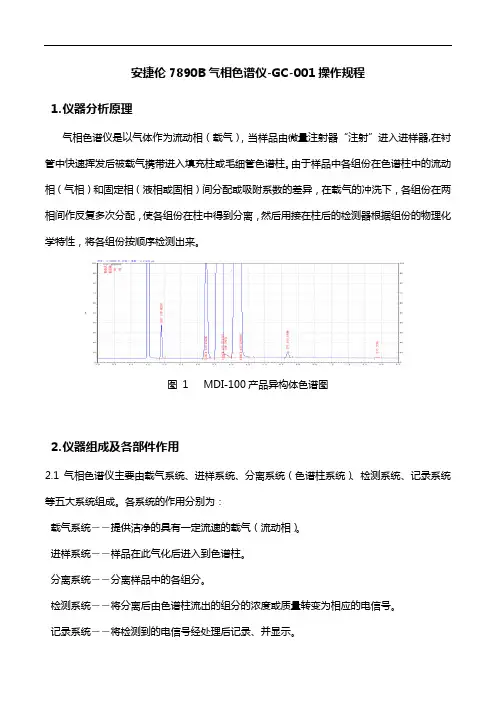
分离后的化合物由位于色谱柱末端的检测器检测。检测器产生一个信号,该信号与样品中化合物的浓度成正比。信号被记录在图表或计算机上,生成的色谱图用于识别和定量样品中的化合物。
GC 是一种通用的技术,可用于分析各种样品,包括食品、药品和环境样品。它是一种识别和定量复杂混合物中化合物的有力工具。