
语言学phonology音韵学PPT课件
- 格式:ppt
- 大小:4.83 MB
- 文档页数:93

Chapter 2 Phonology 音系学
1. The phonic medium of language 语言的声音媒介
Linguists are not interested in all sounds ;they are concerned
with only those sounds that are produced by the human speech organs in
so far as they have a role to play in linguistic communication .These
sounds are limited in number .This limited range of sounds which are
meaningful in human communication and are of interest to linguistic
studies are
the phonic medium of language ;and the individual sounds
within this range are the speech sounds.
语言学家也并不是对所有的声音感兴趣,他们只关注那些在语言交际中占有一席之地、由人类的发音器官所发出来的那些声音。这些声音在数量上是有限的。这些范围有限,但对人类交际活动意义重大、对语言学研究价值不菲的声音就是语言的声音媒介,凡是在这个范围的每个单个的声音都叫做语音。
2. Phonetics 语音学
2.1 What is phonetics? 什么是语音学?
Phonetics
is defined as the study of the phonic medium
of
language; it is concerned with all the
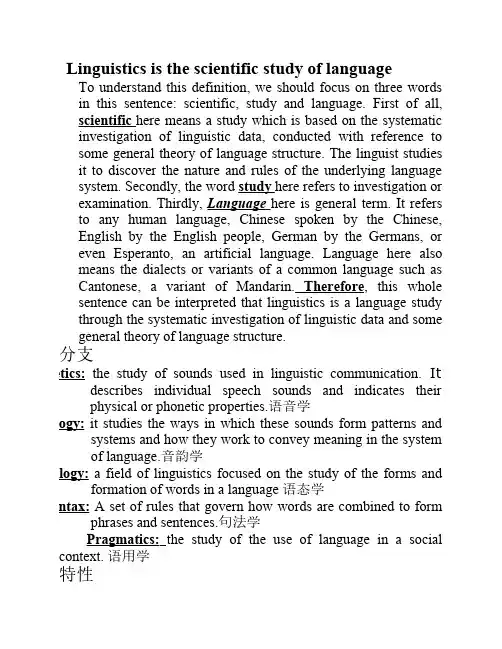
Linguistics is the scientific study of language
To understand this definition, we should focus on three words
in this sentence: scientific, study and language. First of all,scientific here means a study which is based on the systematic
investigation of linguistic data, conducted with reference to
some general theory of language structure. The linguist studies
it to discover the nature and rules of the underlying language
system. Secondly, the word study here refers to investigation or
examination. Thirdly, Language here is general term. It refers
to any human language, Chinese spoken by the Chinese,
English by the English people, German by the Germans, or
even Esperanto, an artificial language. Language here also
means the dialects or variants of a common language such as
Cantonese, a variant of Mandarin. Therefore, this whole

Phonology
Phonology is the study of sound patterns of language (i.e. how sounds are arranged to form meaningful units) and the
function of each sound.
It reveals what are the possible combinations of sounds in a language and explains why certain words take the form
they do.
Phone音子: the smallest perceptible discreet segment of sound in a stream of speech
i) phonetic unit
ii) not distinctive of meaning
iii) physical as heard or produced
iv) marked with [ ]
Phoneme音位:are abstract mental units that represent sounds
i) phonological unit
ii) distinctive of meaning
iii) abstract, not physical
iv) marked with
Minimal pairs最小对比对: The sounds that cause changes in the changing of a word are
called the “minimal pairs”
Allophones音位变体:phonetic forms that don’t contrast are called allophones, they are the various pronunciations of

英语语言学分支
语言学是研究语言的科学,包括多个分支,每个分支关注语言的不同方面。以下是一些主要的英语语言学分支:
1. 音韵学(Phonetics and Phonology): 研究语音的产生、传播和接收,以及语音单位在语言中的组合和分布。音韵学关注语音的物理性质和声学特征。
2. 形态学(Morphology): 研究语言中的词的内部结构和形态变化。形态学关注单词如何形成,以及单词内部构建的规则。
3. 句法学(Syntax): 研究句子的结构,包括词与词之间的关系,以及句子的组成方式。句法学关注语法规则是如何用来生成合乎语法规范的句子的。
4. 语义学(Semantics): 研究词和句子的意义。语义学关注语言中词汇和句法单位的意义,以及它们如何组合形成合适的语言表达。
5. 语用学(Pragmatics): 研究语言使用的上下文依赖性和语境中的语言交际。语用学关注说话者和听话者之间的信息传递,以及言语行为在特定情境中的作用。
6. 社会语言学(Sociolinguistics): 研究语言和社会之间的关系。社会语言学关注方言、语言变异、语言政策等与社会因素相关的语言现象。
7. 心理语言学(Psycholinguistics): 研究语言的心理过程,包括语言习得、语言记忆、语言理解等。心理语言学关注语言在认知过程中的作用。
8. 历史语言学(Historical Linguistics): 研究语言的历史演变和变化。历史语言学关注语言家族、语言演化、语言接触等方面的变化。
9. 比较语言学(Comparative Linguistics): 研究不同语言之间的相似性和差异。比较语言学关注语言之间的语法结构、词汇和语音的比较。
这些分支共同构成了语言学的广阔领域,每个分支都有其独特的研究对象和方法。