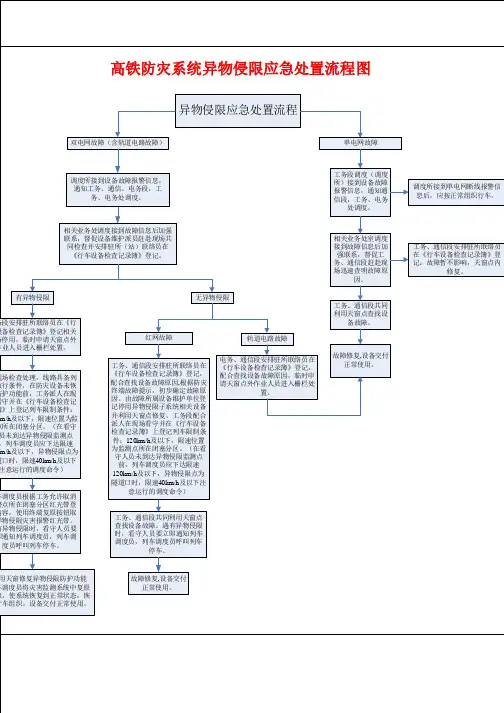
铁路机务,接触网挂有异物处置流程
- 格式:doc
- 大小:16.98 KB
- 文档页数:6
铁路机务,接触网挂有异物处置流程
英文回答:
Railway Rolling Stock, Procedure for Handling Foreign
Objects on Overhead Lines.
Introduction:
As a railway professional working in the rolling stock
department, I have encountered various situations where
foreign objects were found hanging on the overhead lines.
It is crucial to have a well-defined procedure in place to
ensure the safe and efficient removal of these objects. In
this article, I will outline the step-by-step process for
handling foreign objects on overhead lines.
Step 1: Identification and Assessment.
The first step is to identify the presence of a foreign
object on the overhead lines. This can be done through regular inspections or by receiving reports from train
drivers or other staff members. Once identified, the object
should be assessed for potential risks it may pose to the
train operation and the overhead line system.
For example, if a plastic bag is found hanging on the
overhead lines, it may not pose an immediate risk. However,
if a large metal object is detected, it could potentially
cause a short circuit or damage the pantograph of the train.
Step 2: Communication and Coordination.
After identifying the foreign object, it is essential
to communicate the findings to the relevant authorities,
including the control center, maintenance team, and the
train driver. Clear and concise communication is necessary
to ensure everyone is aware of the situation and can take
appropriate actions.
For instance, the train driver should be informed about
the foreign object so that they can adjust the speed or
take alternative routes if necessary. The maintenance team should be notified to prepare the required equipment and
personnel for the removal process.
Step 3: Removal Process.
The actual removal of the foreign object should be
carried out by trained and authorized personnel. The
procedure may vary depending on the nature and location of
the object. In some cases, it may be possible to remove the
object using a long pole with a hook or a specialized tool.
However, for more complex situations, such as a large tree
branch entangled in the overhead lines, additional
equipment like cranes or cherry pickers may be required.
During the removal process, safety precautions should
be strictly followed to protect the personnel involved and
prevent any further damage. This includes wearing
appropriate personal protective equipment (PPE) and
ensuring proper isolation of the overhead line system.
Step 4: Post-Removal Inspection and Testing.
Once the foreign object is successfully removed, a
thorough inspection of the overhead line system should be
conducted. This is to ensure that no damage or
abnormalities have occurred as a result of the incident.
Additionally, electrical testing may be necessary to verify
the integrity and functionality of the overhead lines.
For example, after removing a large metal object, it is
crucial to inspect the pantograph of the train for any
signs of damage. Electrical testing can also help identify
any potential issues with the overhead line system, such as
insulation faults.
中文回答:
铁路机务,接触网挂有异物处置流程。
简介:
作为铁路机务部门的一名专业人员,我遇到过各种挂在接触网上的异物。制定一个明确的程序,确保安全高效地清除这些异物至关重要。在本文中,我将详细介绍处理接触网上异物的逐步流程。
第一步,识别和评估。
首先要识别接触网上是否有异物。可以通过定期检查或接收列车司机或其他员工的报告来进行识别。一旦发现,应评估该物体对列车运行和接触网系统可能造成的潜在风险。
例如,如果发现接触网上挂着一个塑料袋,可能不会立即构成风险。然而,如果发现一个大的金属物体,可能会导致短路或损坏列车的受电弓。
第二步,沟通和协调。
在识别异物后,必须将发现情况通报相关部门,包括控制中心、维修团队和列车司机。清晰简明的沟通对确保每个人都了解情况并采取适当措施至关重要。
例如,应通知列车司机有关异物的情况,以便他们可以根据需要调整速度或选择其他路线。应通知维修团队准备所需的设备和人员进行清除工作。
第三步,清除过程。
实际的异物清除工作应由经过培训和授权的人员进行。清除程序可能因物体的性质和位置而异。在某些情况下,可以使用带钩的长杆或专用工具清除异物。然而,对于更复杂的情况,例如接触网上缠绕着一大根树枝,可能需要额外的设备,如起重机或升降机。
在清除过程中,必须严格遵守安全预防措施,以保护参与人员的安全并防止进一步损坏。这包括穿戴适当的个人防护装备(PPE)和确保接触网系统的正确隔离。
第四步,清除后的检查和测试。
成功清除异物后,应对接触网系统进行彻底检查。这是为了确保没有因此事故而造成损坏或异常。此外,可能需要进行电气测试以验证接触网的完整性和功能性。
例如,在清除大型金属物体后,至关重要的是检查列车受电弓是否有任何损坏迹象。电气测试还可以帮助发现接触网系统的任何潜在问题,如绝缘故障。