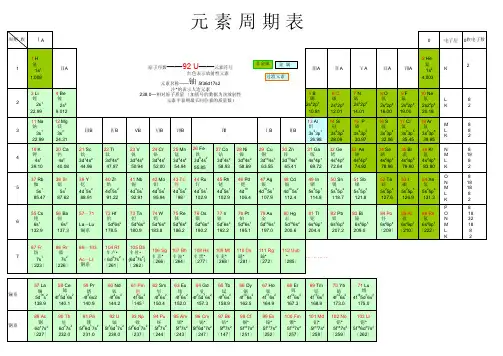
Periodic tableHydrogen is the chemical element with atomic number 1. It is represented by the symbol H. With an average atomic weight of 1.00794 u (1.007825 u for Hydrogen-1), hydrogen is the lightest and most abundant chemical element, constituting roughly 75 % of the Universe's elemental mass.[5] Stars in the main sequence are mainlycomposed of hydrogen in its plasma state.Naturally occurring elemental hydrogen isrelatively rare on Earth.The most common isotope of hydrogen isprotium (name rarely used, symbol 1H) with asingle proton and no neutrons. In ioniccompounds it can take a negative charge (ananion known as a hydride and written as H−), or as a positively charged species H+. The latter cation is written as though composed of a bare proton, but in reality, hydrogen cations in ionic compounds always occur as more complex species. Hydrogen forms compounds with most elements and is present in water and most organic compounds. It plays a particularly important role in acid-base chemistry with many reactions exchanging protons between soluble molecules. As the simplest atom known, the hydrogen atom has been of theoretical use. For example, as the only neutral atom with an analytic solution to the Schrödinger equation, the study of the energetics and bonding of the hydrogen atom played a key role in the development of quantum mechanics.) was first artificially produced in the Hydrogen gas (now known to be H2early 16th century, via the mixing of metals with strong acids. In 1766–81, Henry Cavendish was the first to recognize that hydrogen gas was a discrete substance,[6] and that it produces water when burned, a property which later gave it its name, which in Greek means"water-former." At standard temperature and pressure, hydrogen is a colorless, odorless, nonmetallic, tasteless, highly combustible.diatomic gas with the molecular formula H2Industrial production is mainly from the steam reforming of natural gas, and less often from more energy-intensive hydrogen production methods like the electrolysis of water.[7] Most hydrogen is employed near its production site, with the two largest uses being fossil fuel processing(e.g., hydrocracking) and ammonia production,mostly for the fertilizer market.Hydrogen is a concern in metallurgy as it canembrittle many metals,[8]complicating the design ofpipelines and storage tanksHelium is the chemical element with atomic number 2 and an atomic weightof 4.002602, which is represented by the symbol He. It is a colorless, odorless, tasteless, non-toxic, inert monatomic gas that heads the noblegas group in the periodic table. Its boiling and melting points are thelowest among the elements and it exists only as a gas except in extreme conditions. Next to hydrogen, it is the second most abundantelement in the universe, and accounts for 24% of the elemental mass ofour galaxy.An unknown yellow spectral line signature in sunlight was first observedfrom a solar eclipse in 1868 by French astronomer Pierre Janssen. Janssenis jointly credited with the discovery of the element with Norman Lockyer,who observed the same eclipse and was the first to propose that the linewas due to a new element which he named helium. In 1903, large reservesof helium were found in the natural gas fields in parts of the UnitedStates, which is by far the largest supplier of the gas.Helium is used in cryogenics (its largest single use, accounting forabout a quarter of production), the cooling of superconducting magnets, particularly the main commercial application in MRI scanners. Helium'sother industrial uses as a pressurizing and purge gas, and a protective atmosphere for arc welding and processes (such as growing crystals tomake silicon wafers), account for half of its use. Economically minoruses, such as lifting gas in balloons and airships are popularly known.[2]As with any gas with differing density from air, inhaling a small volumeof helium temporarily changes the timbre and quality of the human voice.In scientific research, the behavior of two fluid phases of helium-4,helium I and helium II, is important to researchers studying quantum mechanics (in particular the phenomenon of superfluidity) and to thoselooking at the effects that temperatures near absolute zero have on matter (such as superconductivity).Helium is the second lightest element and is the second most abundant in the observable universe, being present in the universe in masses more than 12 times those of all the heavier elements combined. Its abundance is also similar to this in our own Sun and Jupiter. This is due to the very high binding energy (per nucleon) of helium-4 with respect to the next three elements after helium (lithium, beryllium, and boron). This helium-4 binding energy also accounts for itscommonality as a product in both nuclearfusion and radioactive decay. Most helium inthe universe is helium-4, and is believed tohave been formed during the Big Bang. Some newhelium is being created currently as a resultof the nuclear fusion of hydrogen in starsgreater than 0.5 solar masses.On Earth, the lightness of helium has caused its evaporation from the gas and dust cloud from which the planet condensed, and it is thus relatively rare—0.00052% by volume in the atmosphere. What helium is present today has been mostly created by the natural radioactive decay of heavy radioactive elements (thorium and uranium), as the alpha particles that are emitted by such decays consist of helium-4 nuclei. This radiogenic helium is trapped with natural gas in concentrations up to seven percent by volume, from which it is extracted commercially by a low-temperature separation process called fractional distillation.Lithium is a soft, silver-white metal that belongs to the alkali metal group of chemical elements. It is represented by the symbol Li, and it has the atomic number 3. Under standard conditions it is the lightest metal and the least dense solid element. Like all alkali metals, lithium is highly reactive and flammable. For this reason, lithium metal is typically stored in mineral oil. When cut open, lithium exhibits a metallic luster, but contact with moist air corrodes the surface quickly to a dull silvery gray, then black, tarnish. Because of its high reactivity, lithium only appears naturally in the form of compounds. Lithium occurs in a number of pegmatitic minerals, but is also commonlyobtained from brines and clays. On a commercial scale, lithium metal is isolatedelectrolytically from a mixture of lithium chloride and potassium chloride.The nuclei of lithium are not very stable asthe two stable lithium isotopes found innature have among the lowest bindingenergies per nucleon of all stable nuclides.As a result, they can be used in fissionreactions as well as fusion reactions ofnuclear devices. Due to its low stability,lithium is less common in the solar systemthan 25 of the first 32 chemical elementseven though the nuclei are very light in atomic weight.[1]Trace amounts of lithium are present in the oceans and in some organisms, though the element serves no apparent vital biological function in humans. The lithium ion Li+ administered as any of several lithium salts has proved to be useful as a mood stabilizing drug due to neurological effects of the ion in the human body. Lithium and its compounds have several industrial applications, including heat-resistant glass and ceramics, high strength-to-weight alloys used in aircraft, lithium batteries and lithium-ion batteries. Lithium also has important links to nuclear physics. The transmutation of lithium atoms to tritium was the first man-made form of a nuclear fusion reaction, and lithium deuteride serves as a fusion fuel in staged thermonuclear weaponsBeryllium is the chemical element with the symbol Be and atomic number 4.A bivalent element, beryllium is found naturally only combined with other elements in minerals. Notable gemstones which contain beryllium include beryl (aquamarine, emerald) and chrysoberyl. The free element is a steel-gray, strong, lightweight brittle alkaline earth metal. It isprimarily used as a hardening agent in alloys, notably beryllium copper. Structurally, beryllium's very low density (1.85 times that of water), high melting point (1287 °C), hightemperature stability and lowcoefficient of thermal expansion,make it in many ways an idealaerospace material, and it has beenused in rocket nozzles and is asignificant component of plannedspace telescopes. Because of itsrelatively high transparency toX-rays and other ionizing radiationtypes, beryllium also has a number ofuses as filters and windows for radiation and particle physics experiments.Commercial use of beryllium metal presents technical challenges due to the toxicity (especially by inhalation) of beryllium-containing dusts. Beryllium produces a direct corrosive effect to tissue, and can cause a chronic life-threatening allergic disease called berylliosis in susceptible persons.Beryllium is a relatively rare element in both the Earth and the universe. The element is not known to be necessary or useful for either plant or animal life.Boron is the chemical element with atomic number 5 and the chemical symbol B. Boron is a metalloid, which occurs abundantly in the evaporite ores borax and ulexite.Remarkably, pure boron is a rare substance, boron tends to form refractory material containing small amounts of carbon or other elements. Several allotropes of boron exist: amorphous boron is a brown powder and crystalline boron is black, extremely hard (about 9.5 on Mohs' scale), and a poor conductor at room temperature. Boron is used as adopant in the semiconductor industry, while boron compounds play specialized roles as structural and refractory materials and reagents for the synthesis of organic compounds, including pharmaceuticals.Carbon is the chemical element with symbol C and atomic number 6. As a member of group 14 on the periodic table, it is nonmetallic and tetravalent—making four electrons available to form covalent chemical bonds. There are three naturally occurring isotopes, with 12C and 13C being stable, while 14C is radioactive, decaying with a half-life of about 5730 years.[9] Carbon is one of the few elements known since antiquity.[10][11] The name "carbon" comes from Latin languageThere are several allotropes of carbon of which the best known are graphite, diamond, and amorphous carbon.[12]Thephysical properties of carbon varywidely with the allotropic form. Forexample, diamond is highly transparent,while graphite is opaque and black.Diamond is amongthe hardest materialsknown, while graphite is soft enoughto form a streak on paper (hence itsname, from the Greek word "to write"). Diamond has a very low electrical conductivity, while graphite is a very good conductor. Under normal conditions, diamond has the highest thermal conductivity of all known materials. All the allotropic forms are solids under normal conditions but graphite is the most thermodynamically stable.All forms of carbon are highly stable, requiring high temperature to react even with oxygen. The most common oxidation state of carbon in inorganic compounds is +4, while +2 is found in carbon monoxide and other transition metal carbonyl complexes. The largest sources of inorganic carbon are limestones, dolomites and carbon dioxide, but significant quantities occur in organic deposits of coal, peat, oil and methane clathrates. Carbon forms more compounds than any other element, with almost ten million pure organic compounds described to date, which inturn are a tiny fraction of such compounds that are theoretically possible under standard conditions.[13]Carbon is the 15th most abundant element in the Earth's crust, and the fourth most abundant element in the universe by mass after hydrogen, helium, and oxygen. It is present in all known lifeforms, and in the human body carbon is the second most abundant element by mass (about 18.5%) after oxygen.[14] This abundance, together with the unique diversity of organic compounds and their unusual polymer-forming ability at the temperatures commonly encountered on Earth, make this element the chemical basis of all known life.Nitrogen (NYE-tro-jin) is a chemical element that has the symbol N, atomic number of 7 and atomic mass 14.00674 u. Elemental nitrogen is a colorless, odorless, tasteless and mostly inert diatomic gas at standard conditions, constituting 78.08% by volume of Earth's atmosphere.Many industrially important compounds, such as ammonia, nitric acid, organic nitrates (propellants and explosives), and cyanides, contain nitrogen. The extremely strong bond in elemental nitrogen dominates nitrogen chemistry, causing difficulty for both organisms and industryinto useful compounds, butin breaking the bond to convert the N2releasing Spectral lines ofNitrogenlarge amounts of often useful energy,when these compounds burn, explode,or decay back into nitrogen gas.The element nitrogen was discoveredby Scottish physician DanielRutherford in 1772. Nitrogen occursin all living organisms. It is aconstituent element of amino acidsand thus of proteins, and of nucleicacids (DNA and RNA). It resides in thechemical structure of almost all neurotransmitters, and is a defining component of alkaloids, biological molecules produced by many organisms.Oxygen (OK-si-jin; from the Greek roots ὀξύς (oxys) (acid, literally "sharp", from the sour taste of acids) and -γενής (-genēs) (producer, literally begetter)) is the element with atomic number 8 and represented by the symbol O. It is a member of the chalcogen group on the periodic table, and is a highly reactive nonmetallic period 2 element that readily forms compounds (notably oxides) with almost all other elements. At standard temperature and pressure, two atoms of the element bind to form dioxygen, a colorless, odorless, tasteless diatomic gas with the . Oxygen is the third most abundant element in the universe formula O2by mass after hydrogen and helium[1]and the most abundant element by mass in the Earth's crust.[2] Diatomic oxygen gas constitutes 20.8% of the volume of air.[3]All major classes of structural molecules in living organisms, such as proteins, carbohydrates, and fats, contain oxygen, as do the major inorganic compounds that comprise animal shells, teeth, and bone. Oxygen is produced from water by cyanobacteria, algae and plants in the form of O2during photosynthesis and is used in cellular respiration for all complex life. Oxygen is toxic to obligately anaerobic organisms, which were thebegan to accumulate in the dominant form of early life on Earth until O2atmosphere 2.5 billion years ago.[4]Another form (allotrope) of oxygen, ozone (O), helps protect the biosphere from ultraviolet radiation with3the high-altitude ozone layer, but is a pollutant near the surface where it is a by-product of smog. At even higher low earth orbit altitudes atomic oxygen is a significant presence and a cause of erosion for spacecraft.[5] Oxygen was independently discovered by Carl Wilhelm Scheele, in Uppsala, in 1773 or earlier, and Joseph Priestley in Wiltshire, in 1774, but Priestley is often given priority because his publication came out in print first. The name oxygen was coined in 1777 by Antoine Lavoisier,[6]whose experiments with oxygen helped to discredit the then-popular phlogiston theory of combustion and corrosion. Oxygen is produced industrially by fractional distillation of liquefied air, use of zeolites to remove carbon dioxide and nitrogen from air,electrolysis of water and other means. Uses of oxygen include the production of steel, plastics and textiles; rocket propellant; oxygen therapy; and life support in aircraft, submarines, spaceflight and diving.Fluorine is the chemical element with atomic number 9, represented by the symbol F. Fluorine forms a single bond with itself in elemental form,resulting in the diatomic F2 molecule. F2(fluorine) is a supremelyreactive, poisonous, pale, yellowish brown gas. Elemental fluorine is the most chemically reactive and electronegative of all the elements. For example, it will readily "burn" hydrocarbons at room temperature, in contrast to the combustion of hydrocarbons by oxygen, which requires an input of energy with a spark. Therefore, molecular fluorine is highly dangerous, more so than other halogens such as the poisonous chlorine gas.Fluorine's highest electronegativityand small atomic radius give uniqueproperties to many of its compounds.For example, the enrichment of 235U,the principal nuclear fuel, relies onthe volatility of UF6. Also, thecarbon–fluorine bond is one of thestrongest bonds in organic chemistry. Tan or Yellow gasThis contributes to the stability and persistence of fluoroalkane based organofluorine compounds, such as PTFE/(Teflon) and PFOS. Thecarbon–fluorine bond's inductive effects result in the strength of many fluorinated acids, such as triflic acid and trifluoroacetic acid. Drugs are often fluorinated at biologically reactive positions, to prevent their metabolism and prolong their half-lives.Neon is the chemical element that has the symbol Ne and an atomic number of 10. Although a very common element in the universe, it is rare on Earth.A colourless, inert noble gas under standard conditions, neon gives a distinct reddish-orange glow when used in discharge tubes and neon lampsand advertising signs.[4][5] It iscommercially extracted from air, in whichit is found in trace amounts.Neon is the second lightest inert gas.Neon has three stable isotopes: 20Ne(90.48%), 21Ne (0.27%) and 22Ne (9.25%).21Ne and 22Ne are nucleogenic and their variations are well understood. In contrast, 20Ne (the cosmogenicprimordial isotope made in stellar nucleosynthesis) is not known to be nucleogenic, save for cluster decay production, which is thought to produce only a small amount. The causes of the variation of 20Ne in theEarth have thus been hotly debated.[9] The principal nuclear reactionswhich generate neon isotopes are neutron emission, alpha decay reactionson 24Mg and 25Mg, which produce 21Ne and 22Ne, respectively. The alpha particles are derived from uranium-series decay chains, while theneutrons are mostly produced by secondary reactions from alpha particles.The net result yields a trend towards lower 20Ne/22Ne and higher 21Ne/22Neratios observed in uranium-rich rocks such as granites. Isotopicanalysis of exposed terrestrial rocks has demonstrated the cosmogenic production of 21Ne. This isotope is generated by spallation reactions on magnesium, sodium, silicon, and aluminium. By analyzing all three isotopes, the cosmogenic component can be resolved from magmatic neonand nucleogenic neon. This suggests that neon will be a useful tool in determining cosmic exposure ages of surficial rocks and meteorites.[10]Similar to xenon, neon content observed in samples of volcanic gases are enriched in 20Ne, as well as nucleogenic 21Ne, relative to 22Ne content.The neon isotopic content of these mantle-derived samples represents anon-atmospheric source of neon. The 20Ne-enriched components areattributed to exotic primordial rare gas components in the Earth,possibly representing solar neon. Elevated 20Ne abundances are found in diamonds, further suggesting a solar neon reservoir in the Earth.Neon is the second-lightest noble gas. It glows reddish-orange in a vacuum discharge tube. According to recent studies, neon is the least reactive noble gas and thus the least reactive of all elements.[12]Also,neon has the narrowest liquid range of any element: from 24.55 K to 27.05K (−248.45 °C to −245.95 °C, or −415.21 °F to −410.71 °F). It has over 40 times the refrigerating capacity of liquid helium and three times that of liquid hydrogen (on a per unit volume basis).[13] In most applications it is a less expensive refrigerant than helium.[14]Sodium (/ˈsoʊdiəm/SOH-dee-əm) is a metallic element with a symbol Na(from Latin natrium or Arabic نورتانnatrun; perhaps ultimately fromEgyptian netjerj) and a tomic number11. It is a soft, silvery-white,highly reactive metal and is a memberof the alkali metals within "group 1"(formerly known as ‘group IA’). Ithas only one stable isotope, 23Na.Elemental sodium was first isolatedby Humphry Davy in 1807 by passing anelectric current through molten sodium hydroxide. Elemental sodium does not occur naturally on Earth, because it quickly oxidizes in air and is violently reactive with water, so it must be stored in an inert medium, such as a liquid hydrocarbon. The free metal is used for some chemical synthesis, analysis, and heat transfer applications.Sodium ion is soluble in water in nearly all of its compounds, and is thus present in great quantities in the Earth's oceans and other stagnant bodies of water. In these bodies it is mostly counterbalanced by the chloride ion, causing evaporated ocean water solids to consist mostly of sodium chloride, or common table salt. Sodium ion is also a component of many minerals.Sodium is an essential element for all animal life (including human) and for some plant species. In animals, sodium ions are used in opposition to potassium ions, to allow the organism to build up an electrostatic charge on cell membranes, and thus allow transmission of nerve impulses when the charge is allowed to dissipate by a moving wave of voltage change. Sodium is thus classified as a “dietary inorganic macro-mineral” for animals. Sodium's relative rarity on land is due to its solubility inwater, thus causing it to be leached into bodies of long-standing water by rainfall. Such is its relatively large requirement in animals, in contrast to its relative scarcity in many inland soils, that herbivorous land animals have developed a special taste receptor for the sodium ionMagnesium(/mæɡˈn iːziəm/mag-NEE-zee-əm) is a chemical element withthe symbol Mg, atomic number 12 and common oxidation number +2. It is an alkaline earth metal and the eighth most abundant element in the Earth's crust, where it constitutes about 2% by mass,[2]and ninth in theknown Universe as a whole.[3][4] Thispreponderance of magnesium is relatedto the fact that it is easily built upin supernova stars from a sequentialaddition of three helium nuclei tocarbon (which in turn is made fromthree helium nuclei). Magnesium ion'shigh solubility in water helps ensurethat it is the third most abundantelement dissolved in seawater.[5]Magnesium is the 11th most abundant element by mass in the human body; its ions are essential to all living cells, where they play a major role in manipulating important biological polyphosphate compounds like ATP, DNA, and RNA. Hundreds of enzymes thus require magnesium ions to function. Magnesium is also the metallic ion at the center of chlorophyll, and is thus a common additive to fertilizers.[6] Magnesium compounds are used medicinally as common laxatives, antacids (i.e., milk of magnesia), and in a number of situations where stabilization of abnormal nerve excitation and blood vessel spasm is required (i.e., to treat eclampsia). Magnesium ions are sour to the taste, and in low concentrations help to impart a natural tartness to fresh mineral waters.The free element (metal) is not found naturally on Earth, as it is highly reactive (though once produced, is coated in a thin layer of oxide (see passivation), which partly masks this reactivity). The free metal burnswith a characteristic brilliant white light, making it a useful ingredient in flares. The metal is now mainly obtained by electrolysis of magnesium salts obtained from brine. Commercially, the chief use for the metal is as an alloying agent to make aluminium-magnesium alloys, sometimes called "magnalium" or "magnelium". Since magnesium is less dense than aluminium, these alloys are prized for their relative lightness and strength.Aluminium (UK i/ˌæljʉˈmɪniəm/AL-ew-MIN-ee-əm)[5] or aluminum (US i/əˈl uːmɪnəm/ə-LOO-mi-nəm) is a silvery white member of the boron groupof chemical elements. It has the symbol Al and its atomic number is 13. It is not soluble in water under normal circumstances. Aluminium is the most abundant metal in the Earth's crust, and the third most abundant element, after oxygen and silicon. It makes up about 8% by weight of the Earth's solid surface. Aluminium istoo reactive chemically to occur innature as a free metal. Instead, it isfound combined in over 270 differentminerals.[6] The chief source ofaluminium is bauxite ore.Aluminium is remarkable for themetal's low density and for its abilityto resist corrosion due to thephenomenon of passivation. Structuralcomponents made from aluminium and itsalloys are vital to the aerospaceindustry and are very important inother areas of transportation and building. Its reactive nature makes it useful as a catalyst or additive in chemical mixtures, including ammonium nitrate explosives, to enhance blast power.Silicon(/ˈsɪlɪkən/SIL-ə-kən or /ˈsɪlɪkɒn/SIL-ə-kon; Latin: silicium) isthe most common metalloid. It is a chemical element, which has the symbol Si and atomic number 14. A tetravalent metalloid, silicon is less reactive than its chemical analog carbon.Silicon is the eighth most common element in the universe by mass, but silicon very rarely occurs as the purefree element in nature. It is morewidely distributed in dusts, sands,planetoids and planets as variousforms of silicon dioxide (s ilica)or silicates. In Earth's crust,silicon is the second most abundantelement after oxygen, making up 25.7%of the crust by mass.[4]Silicon has many industrial uses. It is the principal component of most semiconductor devices, most importantly integrated circuits or microchips. Silicon is widely used in semiconductors because it remains a semiconductor at higher temperatures than the semiconductor germanium and because its native oxide is easily grown in a furnace and forms a better semiconductor/dielectric interface than any other material.In the form of silica and silicates, silicon forms useful glasses, cements, and ceramics. It is also a constituent of silicones, a class-name for various synthetic plastic substances made of silicon, oxygen, carbon and hydrogen, often confused with silicon itself.Silicon is an essential element in biology, although only tiny traces of it appear to be required by animals.[5] It is much more important to the metabolism of plants, particularly many grasses, and silicic acid (a type of silica) forms the basis of the striking array of protective shells of the microscopic diatoms.Phosphorus(/ˈfɒsfərəs/FOS-fər-əs) is the chemical element that has the symbol P and atomic number 15. A multivalent nonmetal of the nitrogengroup, phosphorus is commonly foundin inorganic phosphate rocks.Elemental phosphorus exists in twomajor forms – white phosphorus andred phosphorus. Although the term (yellow cut), red, violet and black phosphorus "phosphorescence", meaning glow after illumination, derives from phosphorus, glow of phosphorus originates from oxidation of the waxy white white (but not red) phosphorus and should be called chemiluminescence.Due to its high reactivity, phosphorus is never found as a free element in nature on Earth. The first form of phosphorus to be discovered (white phosphorus, in 1669) emits a faint glow upon exposure to oxygen –hence its name given from Greek mythology, Φωσφόρος meaning"light-bearer" (Latin Lucifer), referring to the "Morning Star", the planet Venus.Phosphorus is a component of DNA, RNA, ATP, and also the phospholipids that form all cell membranes. It is, thus, an essential element for all living cells. The most important commercial use of phosphorus-based chemicals is the production of fertilizers.Phosphorus compounds are also widely used in explosives, nerve agents, friction matches, fireworks, pesticides, toothpaste, and detergents.Sulfur or sulphur(/ˈsʌlfər/SUL-fər;see spelling below) is the chemicalelement that has the atomic number 16.It is denoted with the symbol S. Itis an abundant, multivalentnon-metal. Sulfur, in its nativeform, is a bright yellow crystallinesolid. In nature, it can be found asthe pure element and as sulfide andsulfate minerals. It is an essential Spectral lines of Sulfur。