
Unit5 Do you have a soccer ball PPT
- 格式:pptx
- 大小:3.48 MB
- 文档页数:11

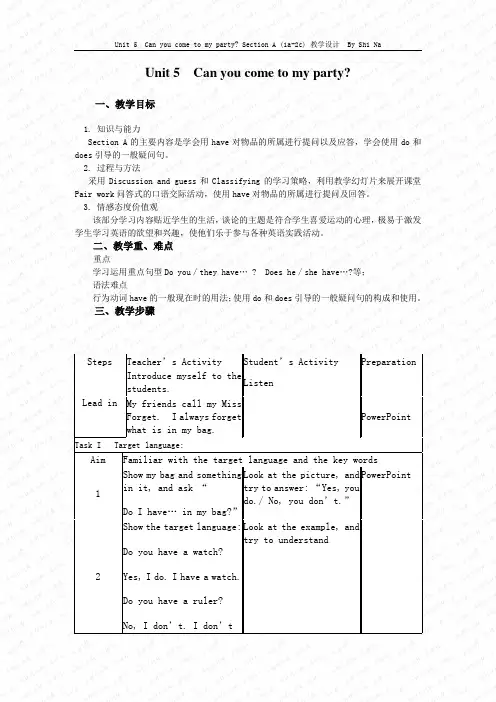
Unit 5 Can you come to my party? Section A (1a-2c) 教学设计 By Shi Na
Unit 5 Can you come to my party?
一、教学目标
1. 知识与能力
Section A的主要内容是学会用have对物品的所属进行提问以及应答,学会使用do和does引导的一般疑问句。
2. 过程与方法
采用Discussion and guess和Classifying的学习策略,利用教学幻灯片来展开课堂Pair work问答式的口语交际活动,使用have对物品的所属进行提问及回答。
3. 情感态度价值观
该部分学习内容贴近学生的生活,谈论的主题是符合学生喜爱运动的心理,极易于激发学生学习英语的欲望和兴趣,使他们乐于参与各种英语实践活动。
二、教学重、难点
重点
学习运用重点句型Do you/they have… ? Does he/she have…?等;
语法难点
行为动词have的一般现在时的用法;使用do和does引导的一般疑问句的构成和使用。
三、教学步骤
Steps Teacher’s Activity Student’s Activity Preparation
Lead in Introduce myself to the
students. Listen
My friends call my Miss
Forget. I always forget
what is in my bag. PowerPoint
Task I Target language:
Aim Familiar with the target language and the key words
1 Show my bag and something
in it, and ask “

Unit 5 Do you have a soccer ball
Section A
Words:tennis, racket, bat, volleyball, basketball, television, welcome, our, sports, center, like, we,
many, club, ping-pong, more, join, class…
重点句型: Do you have a TV? Yes, I do. /No. I don’t.
Do they have a computer? Yes, they do. /No, I don’t.
Does he/she have a soccer ball? Yes, he/she does. /No, he/she doesn’t
Let’s play soccer. I don’t have a soccer ball. /That sounds good.
语法重点:由do/does引导的一般疑问句的构成以及回答
Do you/they have a TV ? Yes, I/they do. No, I/they don’t
Does he/she have a soccer ball? Yes, he/she does. No, he/she doesn’t
问题探究与拓展活动
动词的第三人称单数形式:当句子的主语是“第三人称单数”时,即:不是I,不是you的其它单数形式时,谓语动词必须改变形式,也就是在词尾加一s或 一es (同名词的复数形式),我们可以简称为“三单形式”。有些动词的变化是特殊的,如:have的三单形式是has。在构成否定句时。要在动词前加助动词don’t或doesn’t;在构成疑问句时,则要在主语前加上助动词do或does,does/doesn’t是do/don’t的三单形式。助动词后应该用动词的原形。

1
Unit5 Do you have a soccer ball?
Section B 2 (2a-2c)
一、教学目标:
1. 掌握下列词汇: watch TV, student, sport, play sports, to,
same, love, with, them, only, like, easy, after, class,
classmate
2. 阅读有关体育用品收藏的小短文,并能获得相关信息。
3. 通过阅读有关运动的文章和对话, 使学生更加热爱体育活动并培养一种适合自己的体育爱好。
二、教学重难点
1. 教学重点:
引导学生进行阅读训练,来掌握行为动词一般现在时的肯定句、否定句的结构,尤其是单三形式的变化。
2. 教学难点:
行为动词一般现在时的肯定句、否定句的结构,尤其是单三形式的变化。
三、教学过程
Ⅰ. Revision
Make conversations.
play computer games interesting
play volleyball boring
watch TV relaxing
play basketball difficult
fun
Ⅱ. Brainstorm
Try to list as many ball games as you can. 2
Ⅲ. Writing
1. Find the sports words in the unit. Write them in the
correct column.
2. Make a report to your partner first.
S1: I have a soccer ball, a volleyball, two tennis balls,

1 Unit 5 Do you have a soccer ball?
Part 1 Words and Expressions
do /duː/ (第三人称单数形式does /dʌz/) aux v. 用于构成否定句和疑问句v. 做;干
have /hæv/ v. 有
tennis /'tenɪs/ n. 网球
ball /bɔːl/ n. 球
ping-pong /'pɪŋpɔŋ/ n. 乒乓球
bat /bæt/ n. 球棒;球拍
soccer /'sɒkə(r)/ n. (英式)足球
soccer ball (英式)足球
volleyball /'vɒlibɔːl/ n. 排球
basketball /'bɑːskɪtbɔːl/ n. 篮球
hey /heɪ/ interj. 嘿;喂
let /let/ v. 允许;让
us /ʌs/ pron. (we的宾格)我们
let’s = let us 让我们(一起)
go /gəʊ/ v. 去;走
we /wiː/ pron. 我们
late /leɪt/ adj. 迟到
has /hæz/ v. (have的第三人称单数形式) 有
get /get/ v. 去取(或带来);得到
great /greɪt/ adj. 美妙的;伟大的
play /pleɪ/ v. 参加(比赛或运动);玩耍
sound /saʊnd/ v. 听起来好像
interesting /'ɪntrəstɪŋ/ adj. 有趣的
boring /'bɔːrɪŋ/ adj. 没趣的;令人厌倦的
fun /fʌn/ adj. 有趣的;使人快乐的 n. 乐趣;快乐
difficult /'dɪfɪkəlt/ adj. 困难的