
when you are old
- 格式:ppt
- 大小:55.50 KB
- 文档页数:6
“When You are Old”三个译本的解析及比较摘要:本文选取爱尔兰诗人叶芝最受欢迎的代表作“when you are old”的三个不同译本,根据许渊冲先生关于诗歌翻译“真与美”的看法及相关理论,从译本的语言、意义、风格、音律等各方面比较和解析。
关键词:“when you are old”解析比较一、“when you are old”创作背景威廉·巴特勒·叶芝(william butler yeats)是爱尔兰的伟大诗人,剧作家,1923年诺贝尔文学奖的获得者,“爱尔兰文艺复兴运动”的领袖,也是艾比剧院的创建者之一。
其作品历经晚期浪漫主义、唯美主义、象征主义、现代主义几个时期,虽作品风格在变化,但在每一个时期他的作品独具气质和魅力,每个时期的创作都取得巨大成就。
正如瑞典学院诺贝尔奖委员会主席佩尔·哈尔斯特龙在1923年给叶芝的授奖词中说:“……虽然叶芝熟读英国诗歌大师的作品,他的诗自有一种新的特点。
节奏和色彩起了变化,仿佛它们移入了另一种空气——来到了大海边凯尔特地区的朦胧暮色。
与现代英国诗歌相比,叶芝的诗有着更强的歌的成分,音乐更凄凉,节奏更柔和。
尽管诗很自由,但却象一个梦游人一样步履平稳,于是我们有了另一种节奏的感觉——风在缓缓地吹,大自然的力量在跳动永久的脉搏。
当这种艺术达到最高峰时,它富有绝对的魔幻,但要把握住它,总是不容易的事。
确实,它常常是如此隐晦,需要费很大力气才能理解,其原因一部分在于实际主题的神秘性,另一部分也许在于凯尔特民族的气质;这种气质在激情、精致、深沉中,而不是在清晰之中才更为显著……。
”叶芝诗歌有两大主题:政治和爱情。
他的诗歌很大一部分与爱尔兰民族解放运动息息相关,同时又有一部分来自于他丰富情感世界的灵感。
对于爱尔兰民族解放运动领袖莫德·冈(maud gonne)追求的漫长与痛苦成就了叶芝在诗歌领域的一部部佳作,犹如贝壳酝酿珍珠的痛苦,叶芝在求之不得,没有回应的情感带给他痛苦与折磨中,沉淀出了一首又一首闪光的诗篇。
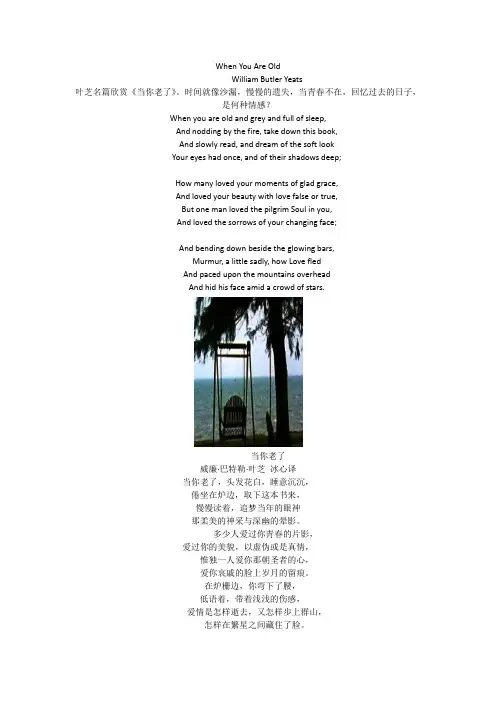
When You Are OldWilliam Butler Yeats叶芝名篇欣赏《当你老了》。
时间就像沙漏,慢慢的遗失,当青春不在,回忆过去的日子,是何种情感?When you are old and grey and full of sleep,And nodding by the fire, take down this book,And slowly read, and dream of the soft lookYour eyes had once, and of their shadows deep;How many loved your moments of glad grace,And loved your beauty with love false or true,But one man loved the pilgrim Soul in you,And loved the sorrows of your changing face;And bending down beside the glowing bars,Murmur, a little sadly, how Love fledAnd paced upon the mountains overheadAnd hid his face amid a crowd of stars.当你老了威廉·巴特勒·叶芝冰心译当你老了,头发花白,睡意沉沉,倦坐在炉边,取下这本书来,慢慢读着,追梦当年的眼神那柔美的神采与深幽的晕影。
多少人爱过你青春的片影,爱过你的美貌,以虚伪或是真情,惟独一人爱你那朝圣者的心,爱你哀戚的脸上岁月的留痕。
在炉栅边,你弯下了腰,低语着,带着浅浅的伤感,爱情是怎样逝去,又怎样步上群山,怎样在繁星之间藏住了脸。

When You Are Old 当你老了William Butler YeatsWhen you are old and grey and full of sleep,当你老了,头发斑白,在炉火边昏昏欲睡,And nodding by the fire, take down this book,取下这本书,细细地品读,And slowly read, and dream of the soft look回想你眼神中曾有的温柔Your eyes had once, and of their shadows deep;和那幽深的眼眸。
How many loved your moments of glad grace,你年轻优雅的时候,多少人爱过你,爱着你的美貌,或真或假。
And loved your beauty with love false or true,But one man loved the pilgrim soul in you,但只有一个人爱你圣洁的灵魂,爱你那渐渐变老的容颜上的哀伤。
And loved the sorrows of your changing face;And bending down beside the glowing bars, 你在炽热的壁炉边弯下身子,有点悲伤地感叹,真爱流逝,漫步在头顶的山间,把他的面孔隐没在繁星之间。
Murmur, a little sadly, how Love fledAnd paced upon the mountains overheadAnd hid his face amid a crowd of stars.When you are old, your hair turning grey, you becoming sleepy and nodding by the fire, take down this book I wrote for you and read it slowly, and reminisce about how soft your eyes had once looked and how deep they were when you were young. When you are young and beautiful, many men loved you with love whether false or true. But among them, there was only one man, which was me, who loved your holy soul and the sorrows of your aging face rather than your attractive appearance. Then you bend down beside the stove and murmur sadly how you ignored my love for you just as you did toward others’, but I still loved you silently.In this poem,an anonymous narrator requests a former lover to remember her youth and his love for her, creating a surreal sense of mystery that only reveals some shadows of his own past love life.As the woman is "nodding by the fire," she leafs through the book and recollects times of her "soft looks" and "sorrows" as she changed. She remembers her faded beauty that was admired by many, but then remembers the only man, the narrator, that loved her for her unique soul. He loved her even as she grew less beautiful and as her being changed in the fullness of time. However, Yeats calls the old woman to "Murmur a little sadly" about those bygone days now that he is through with "pacing upon themountains overhead" and has now "hidden his face amid a crowd of stars." These said details provide a peak into the narrator's torn-apart heart as he evokes from her memories how patiently he waited for her as the sorrows of time wore away at her fragile beauty. His unconditional love for her was ignored and eventually forgotten as just another one of her "false" and "true" loves among the stars in the night sky. The narrator seems to be full of regret that, with the passage of time, she never took advantage of his love for her, and that he had to watch her aging without his unconditional love from afar.The most telling component of this poem is, of course, the point of view. This narrator is calling upon a woman that is not yet through with youth to, once past her prime, recall the days he was in her life and very much in love with her. Obviously, he wants her to remember him for his unique and unqualified love for her, and how she is choosing to ignore it in the present. By writing this poem in this fashion, the narrator could possibly hope to achieve either of the following: a) The woman, once old, will remember the days when she was young with happiness but grow regretful that she did not take advantage of his love, or b) The woman, in the present, will see what an opportunity she is missing by ignoring his love for her and leaving him to fade into the past. Yeats chooses not to directly say that he is the narrator to match the mysterious qualities of the third stanza, but in doing so, he has allowed the reader to interpret somesecrets of himself. The poet expresses his deep love for his lover. Though other people might love the beauty when she was young, they left her when she was old. But the poet is different—he will still love her very much despite her aging face. He fears that his lover will not act upon his love for her and that she will only remember him in the book of memories. He hopes that if, once old, she pulls down the book, she will grow chilly and sorrowful that she did not see how steadfast his love was but how foolish she was for taking no notice of it. He is already fearful that she will grow old without him, and this can be seen as he requests that she remember him "a little sadly" and as a missed chance to have a happy future.This sad and reminiscent poem is not designed primarily to make an old woman regretful, but to keep a young woman from ignoring the narrator and making the wrong decision. Yeats hopes that the distressing ending to his poem will cause the reader to reconsider her future and not to grow old without him by her side.I love this poem. I am deeply touched by the poet’s deep and true love for his lover. What is true love? This poem tells us that, it isn’t to love your lover’s attractive appearances when they are young and leave them when they are old, but to love what they truly are, in other words, to love what’s inside them. What’s more, true love can stand the test of time. If you love truly a person, you will love him or her forever. If we canhave such memorable experience, we will regard it as the best gift in our life.This poem is written in iambic pentameter, consisting in four stanzas. The rhyme scheme for it is abba cddc deed. In this poem, the poet compares his love for the woman with many others’ to emphasize his true love for her and to her attention to his love. In the ending, “how Love fled/And paced upon the mountains overhead/ And hid his face amid a crowd of stars.”, the poet personifies his love to show that his genuine love was ignored by his lover and compares other s’love toward the woman to “ a crowd of stars,” again to differentiate his love, but also to show he was ignored and wanted his lover can pay attention to his unique and true love.。
