UNIT 3 Getting Together TOPIC 3 What would you like to drink Section B 课件2-优质公开课-科普社7上精
- 格式:ppt
- 大小:730.00 KB
- 文档页数:8

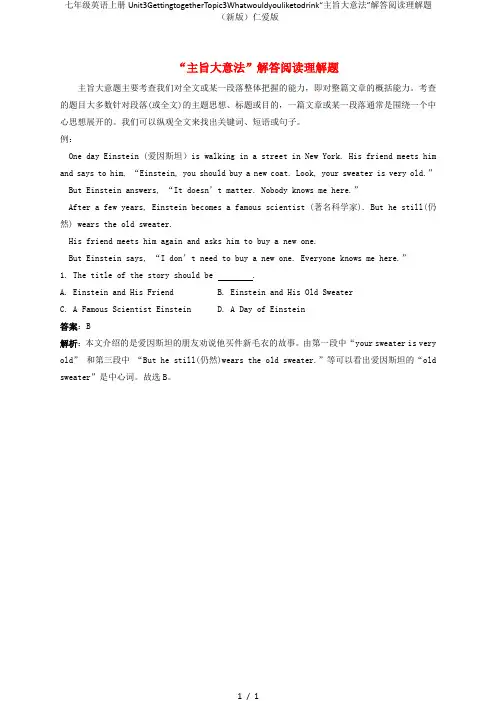
七年级英语上册Unit3Gettingtogethe rTopic3Whatwouldyouliketodrink“主旨大意法”解答阅读理解题(新版)仁爱版“主旨大意法”解答阅读理解题主旨大意题主要考查我们对全文或某一段落整体把握的能力,即对整篇文章的概括能力。
考查的题目大多数针对段落(或全文)的主题思想、标题或目的,一篇文章或某一段落通常是围绕一个中心思想展开的。
我们可以纵观全文来找出关键词、短语或句子。
例:One day Einstein (爱因斯坦)is walking in a street in New York. His friend meets him and says to him, “Einstein, you should buy a new coat. Look, your sweater is very old.”But Einstein answers, “It doesn’t matter. Nobody knows me here.”After a few years, Einstein becomes a famous scientist (著名科学家). But he still(仍然) wears the old sweater.His friend meets him again and asks him to buy a new one.But Einstein says, “I don’t need to buy a new one. Everyone knows me here.”1. The title of the story should be .A. Einstein and His FriendB. Einstein and His Old SweaterC. A Famous Scientist EinsteinD. A Day of Einstein答案:B解析:本文介绍的是爱因斯坦的朋友劝说他买件新毛衣的故事。

乏公仓州月氏勿市运河学校Unit 3 Getting TogetherTopic 3 What would you like to drink?笔试局部〔总分值100分〕I.词组互译〔10分〕1.一杯桔汁 _______________2.一些牛奶 ______________3.两袋大米_______________4.五片面包________________5.一篮子梨_______________6. something to drink____________7. four cups of water__________8. would like to go _____________9. help yourself______________10. a bowl of rice _______________II.选择题〔15分〕( ) 1. I’d like .A. a bottle of orangesB. a bottle of orangeC. a bottle of an orangeD. a bottle orange( )2. —Would you like some milk?— .A. Yes, pleaseB. Yes, I’d likeC. No, pleaseD. Yes, I’d like to( )3. Would you like something ?A. drinkB. drinkingC. to drinkD. drinks( )4. I would like to eat .A. some meatsB. some riceC. some cakeD. some breads ( )5.Would you like apples?A. anyB. someC. manyD. am( )6. There are on the table.A. a glass of waterB. a glass of milkC. two glasses of waterD. a glass of orange( )7. Look! Some meat in the box. Some apples in the basket.A. is, isB. are, areC. is, areD. are, is ( )8. What would you like supper?A. atB. toC. inD. for( )9. What do you think the coffee?A. onB. ofC. inD. at( )10. Chinese people are very .A. friendB. friendlyC. friendsD. friends ( )11. there any meat on the table?A. IsB. AreC. HaveD. Has( )12. I have no pears now. What apples?A. isB. aboutC. areD. does ( )13. Why have some noodles?A. don’tB. isn’tC. notD. /( )14. I’m thirsty〔口渴〕.I want to something.A. eatB. drinkC. takeD. know ( )15. Help to some meat, Lucy.A. youB. yoursC. yourselvesD. yourself III.改错。

Unit 3 Getting TogetherTopic 3 What would you like to drink?第2课时Section BI. Teaching aims1. Knowledge aims能根据已学语音、音标及发音规则,正确朗读下列词汇并在实际的情景对话操练中加以应用:usually, breakfast, lunch, dinner, food, may, take, order, sir, something, glass, mm;能在情景对话中就一日三餐的饮食习惯及在饭店点餐与服务员对话这两个话题进行交流,如:(1)—What do you usually have for breakfast/lunch/dinner?—I usually have …for breakfast/lunch/dinner.(2)—May I take your order, sir?—Some fish with vegetables and a bowl of rice, please.在教师的帮助与指引下,通过对话操练、听力训练等活动, 能掌握for + breakfast/lunch/dinner的用法。
2. Skill aims能听懂有关一日三餐饮食习惯及饭店点餐等的简单对话;能就一日三餐饮食习惯及饭店点餐话题进行交流;能正确朗读对话,注意语音语调;能根据图文理解有关就餐的对话与小短文,并根据要求进行学习活动;能根据图文完成有关就餐的对话填空。
3. Emotional aims在学习过程中,创设真实的情景,并采用小对话、小表演等灵活多样的授课方式,激发学生的好奇心和求知欲,培养学生学习英语的兴趣和积极主动的学习精神;鼓励学生积极大胆,敢于模仿,培养学生学好英语的信心;使学生乐于接触并了解中西方餐饮习惯的差别,同时养成良好的饮食习惯。
II. The Key Points and Difficult Points1.学生能在情景对话中,熟练运用谈论日常饮食及点餐的表达法。