
英语九大状语从句
- 格式:ppt
- 大小:1.25 MB
- 文档页数:50

1
状语从句知识点详解(初中英语专项复习)
状语从句的概念: 用一个句子作状语来修饰动词和形容词,以表明动作发生或状态存在的时间、地点、原因等,这个句子就叫做状语从句。
状语从句的分类 :状语从句共分为九大类,包括:时间、地点、原因、条件、让步、目的、结果、方式、比较状语从句。下面分别讲解:
一、时间状语从句
概念:用来表示时间的状语从句,由when, while, as, till, until, before, after, since等引导。
由于时间状语从句的引导词所表示的意思并非一致,不同引导词表达不同的时间,它们在句子中对应的时态、语态等也有所不同。例如:
when /while引导的时间状语从句
when引导的从句的谓语动词通常是瞬间动词,也可以是延续性动词。从句动作可与主语动作通常先后发生也可同时发生。
I was writing when my sister came back.( come是瞬间动词,只能用when引导,不能用while)
He often wrote me when/while he studied in Shanghai International Studies University.( study是延续性动词,while可代替when)
While my mother was cooking , I was playing chess with dad. (cook是延续性的动词,cook和play同时发生)
I like playing chess while my sister likes reading stories.我喜欢下棋,而我姐姐喜欢看小说。(while表示对比)
when和while的区别还有:while引导的时间状语从句多用于进行时态,而when引导的时间状语从句多用于一般时态。
While we were playing games, our headmaster called me .我们正在做游戏的时候,校长叫我了。

1 【中考英语专项复习——宾语从句】
(一)宾语从句的种类
宾语从句在句中作及物动词的宾语,或介词的宾语,或形容词的宾语。根据引导宾语从句的不同连词,宾语从句可分为三类。
1. 由that引导的宾语从句。that只有语法作用,没有实在的意义,在口语和非正式文体中可以省略。例如:
He said (that) he wanted to stay at home.
She doesn’t know (that) she is seriously ill.
I am sure (that) he will succeed.
2. 由连接代词who, whom, whose, what, which和连接副词when, where, why,
how引导的宾语从句。这些连接代词和连接副词在宾语从句中充当某个成分。例如:
Do you know who (whom) they are waiting for?
He asked whose handwriting was the best.
Can you tell me where the No.3 bus stop is?
I don’t know why the train is late.
3. 由if或whether引导的宾语从句。if和whether在句中的意思是“是否”。例如:
I want to know if (whether) he lives there.
He asked me whether (if) I could help him.
(二)宾语从句的语序
宾语从句的语序应为陈述句的语序。例如:
I hear (that) physics isn’t easy.
I think (that) you will like this school soon.
Can you tell me how I can get to zoo?

1 状语从句
状语修饰动词、形容词、副词或整个句子。通常由副词、介词短语、动词不定式、分词和从句等担当。例如:
1. Naturally , our grandparents were pleased to get our phone call . (副词)
2. We worked hard , from sunrise to sunset . (介词状短语)
3. To help my disabled aunt , I spend an hour working in her house every day . (不定式)
4. Seen from a distance , the farmhouse looked deserted . (过去分词)
5. I know how to light a camp fire because I had done it before .(原因状语从句)
在复合句中修饰主句或主句中的某一成分的从句叫状语从句。状语从句通常由从属连词或起连词作用的词组引导,有时甚至不需要连词直接和主句连接起来。状语从句根据它表达的意思不同,可分为时间、地点、原因、目的、结果、条件、方式、比较、让步等九类。状语的位置比较灵活,可以位于句首、句末或句中。enough用作状语修饰形容词和副词时必须后置。
一、 时间状语从句
时间状语从句是表示时间关系的从句。可以引导时间状语从句的连词很多,根据意义和主从句之间的时间关系,通常可分为以下几种情况:
A when, while, as, whenever
when, while, as表示主句谓语作和从句的谓语动作同时发生或几乎同时发生。
1.when
①when表示点时间时,从句中用短暂性动词;表示段时间时,用持续性动词。
When I got home, my family were already having dinner.
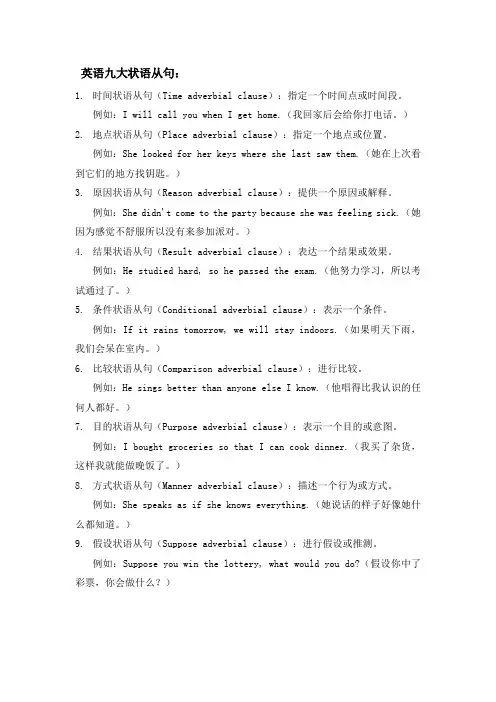
英语九大状语从句:1. 时间状语从句(Time adverbial clause):指定一个时间点或时间段。
例如:I will call you when I get home.(我回家后会给你打电话。)
2. 地点状语从句(Place adverbial clause):指定一个地点或位置。
例如:She looked for her keys where she last saw them.(她在上次看到它们的地方找钥匙。)
3. 原因状语从句(Reason adverbial clause):提供一个原因或解释。
例如:She didn't come to the party because she was feeling sick.(她因为感觉不舒服所以没有来参加派对。)
4. 结果状语从句(Result adverbial clause):表达一个结果或效果。
例如:He studied hard, so he passed the exam.(他努力学习,所以考试通过了。)
5. 条件状语从句(Conditional adverbial clause):表示一个条件。
例如:If it rains tomorrow, we will stay indoors.(如果明天下雨,我们会呆在室内。)
6. 比较状语从句(Comparison adverbial clause):进行比较。
例如:He sings better than anyone else I know.(他唱得比我认识的任何人都好。)
7. 目的状语从句(Purpose adverbial clause):表示一个目的或意图。
例如:I bought groceries so that I can cook dinner.(我买了杂货,这样我就能做晚饭了。)
8. 方式状语从句(Manner adverbial clause):描述一个行为或方式。