七年级下册英语期中考复习知识点
- 格式:docx
- 大小:40.65 KB
- 文档页数:14
七年级下册英语期中考复习知识点
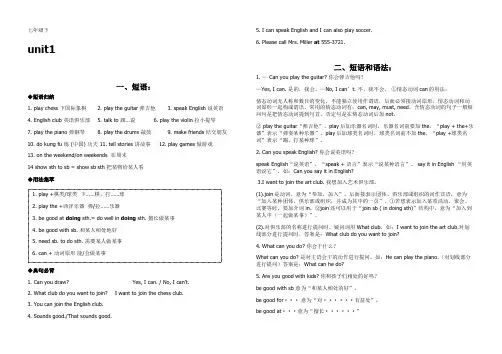
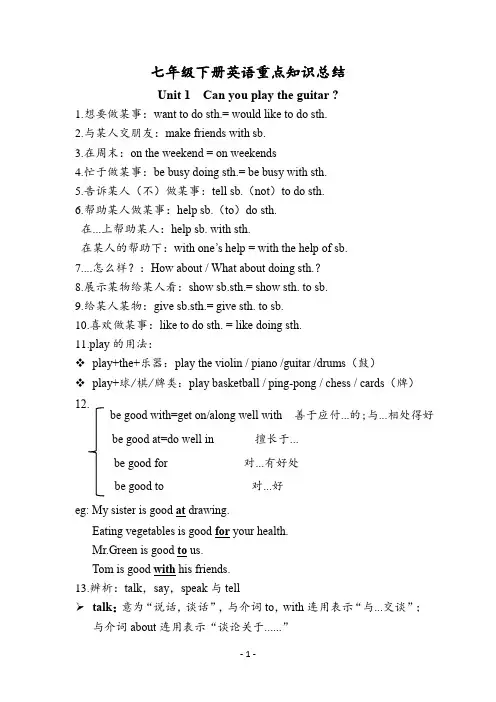
Unit 1: Can you play the guitar?
1."Can" + verb base form does not change with subject or
number。For example。"Can you play the guitar?" "Yes。he can
play the guitar" or "No。he can't play the guitar." She can speak
English very well.
2."Play" + the + XXX。"Play basketball," "Play the guitar,"
or "Play chess."
3."Want" + "to do" something。For example。"I want to join
the music club."
4."Good" phrases: "Be good with sb" means to be good XXX。For example。"She is good with the old people." "Be good at"
means to be XXX in something。For example。"I am good at
English" or "He is good at swimming." "Be good for" means to be
beneficial for something。For example。"It is good for health."
5."Tell" + "sb" + something or "tell" + "sb" + "to do"
something。For example。"Tell stories" or "XXX."
6."Talk" + "to" + "sb" or "talk" + "with" + "sb" + "about" +
"sth." For example。"Talk to your parents" or "He talks with me
about soccer."
7."Or" means "either" in a negative XXX。"I don't like pears
or bananas" or "Is he a student or a XXX?"
8."Need to do" something means to require or have to do
something。For example。"I need to go to school at six."
9.Other phrases: "Make friends with sb" means to XXX"
means during the weekend.
XXX facility。English-speaking students XXX。This is Unit
2.where we learn about special XXX that begin with "what time"
or "when." Rewrite: XXX。In Unit 2.we study unique XXX that start
with "what time" or "when."
If we want to ask about Jack's shower time。we can say。"When does Jack usually take a shower?" or "What time does Jack
take a shower?"
Rewrite: XXX。we can ask。"At what time does Jack
typically shower?" or "When does Jack take his daily shower?"
We use "o'clock" to indicate whole hours。such as "ten
o'clock a.m." For non-whole hours。we can read the numbers in
order。like "six-ten" for 6:10 or "eight-fifty" for 8:50.If the
minutes are less than 30.we use "past," such as "five past eleven"
for 11:05 or "a quarter past eleven" for 11:15.If the minutes are
more than 30.we use "to," such as "twenty-five to twelve" for
11:35 or "a XXX" for 11:45.
Rewrite: To express time in English。we say "o'clock" for
full hours。like "ten o'clock a.m." For partial hours。we can
pronounce the numbers。such as "six-ten" for 6:10 or "eight-fifty"
for 8:50.If the minutes are under 30.we use "past," such as "five past eleven" for 11:05 or "a quarter past eleven" for 11:15.If the
minutes are over 30.we use "to," such as "twenty-five to twelve"
for 11:35 or "a XXX" for 11:45.
We can use "always" to mean "all the time," "usually" to
mean "most of the time," "often" to mean "frequently," and
"sometimes" to mean "nally."
Rewrite: "Always" means "constantly," "usually" means
"typically," "often" means "frequently," and "sometimes" means
"infrequently."
XXX" and "too" can be used to show agreement in positive
sentences。and "either" is used in negative sentences。"Also" is
used to add n to a sentence.
Rewrite: "XXX" and "too" indicate agreement in affirmative
sentences。while "either" is used in negative XXX"Also" adds
XXX.
We can say "eat breakfast well" to mean "have a XXX" and
"XXX" to mean "XXX." Rewrite: "XXX" implies "have a XXX," while "XXX" means
"XXX."
Unit 3: How Do You Get to School?
In this unit。we will learn about different ways to travel to
school and work。We will also learn some XXX.
Important Phrases:
Get up: Wake up in the morning
Go to work/school: Travel to work or school
XXX: Clean your body with water
Go to bed: Sleep at night
Do one's homework: XXX
Can't play basketball: Not able to play basketball
Get dressed: Put on clothes
XXX XXX: XXX
How Long Does It Take You to Get to School?
To talk about the time it takes to travel to school。we use the
sentence structure "It takes + sb + time + to do sth." For example。"It takes me about an hour to drive to school." We can also ask
"How long does it take you to get to school?"
How Far Is It from A to B?
To ask about the distance een two places。we use the n "How
far is it from A to B?" The answer can be given in meters。miles。or kilometers。such as "It's 10 kilometers away." Alternatively。we can say "It's about ten minutes' walk/ride."
It's + Adjective + for + sb + to do sth.
To express an n about something。we use the sentence
structure "It's + adjective + for + sb + to do sth." For example。"It's very XXX."
XXX XXX: