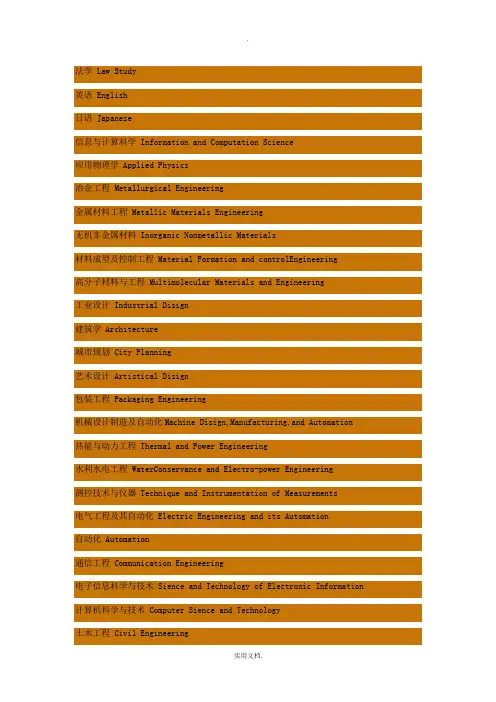
信息类专业英语翻译
- 格式:doc
- 大小:86.50 KB
- 文档页数:28
Dynamic topology:
As the channel of communicationchanges, some of the neighbors who
were reachable on theprevious channel might not be reachable on the
currentchannel and vice versa. As a result the topology of the network
changes with the change in frequency of operation resulting in route
failures and packet loss.
Heterogeneity:
Different channels may support differenttransmission ranges, data rates
and delay characteristics.
Spectrum-Handoff delay:
For each transition from onechannel to another channel
due to the PU’s
activity, thereis a delay involved in the transition called Spectrum-
Handoff delay.
All these factors decrease the predictability of the cause of
transit-delay and subsequent packet loss on the network. The
time latency during channel hand-off in cognitive networks
might cause the TCP round trip timer to time out. TCP will
wrongly recognize the delays and losses due to the above
factors as network congestion and immediately take steps to
reduce the congestion window size knowing not the cause of
packet delay. This reduces the efficiency of the protocol in
such environments. 动态技术:
随着信道通信的变化,一些邻进信道的用户在原信道没有发生变化而在新信道发生变化,或者相反。随着操作频段的变化,网络的拓扑结构发生变化导致路由失败和丢包。
异构:
不同的信道支持不同的传输范围,传输速率,延迟特点。
频谱切换延迟:
由于主用户的出现,每个从一个信道切换到另一个信道,在过渡中,一种延迟被包括叫做频谱切换延迟。
所有因素减少了在网络中,传输延迟和随后丢包的原因的预测性。在认知网络的信道切换过程中潜在的时间引起TCP的RTT的超时。TCP错误的认为延迟和丢包由于以上因素比如网络拥塞和立刻采取减少拥塞窗口大小,而不知道包延迟的原因。这些降低协议在这样环境的效率。
Throughput maximization is one of the main challenges
in cognitive radio ad hoc networks, where the availability of
local spectrum resources may change from time to time and hop by
hop. For this reason, a cross-layer opportunistic spectrum access
and dynamic routing algorithm for cognitive radio networks is
proposed, which is called the routing and dynamic spectrum allocation
(ROSA) algorithm. Through local control actions,
ROSA aims to maximize the network throughput by performing joint routing, dynamic spectrum allocation, scheduling, and transmit
power control. Specifically, the algorithm dynamically allocates
spectrum resources to maximize the capacity of links without
generating harmful interference to other users while guaranteeing
a bounded bit error rate (BER) for the receiver. In addition, the
algorithm aims to maximize the weighted sum of differential backlogs
to stabilize the system by giving priority to higher capacity
links with a high differential backlog. The proposed algorithm
is distributed, computationally efficient, and has bounded BER
guarantees. ROSA is shown through numerical model-based evaluation
and discrete-event packet-level simulations to outperform
baseline solutions, leading to a high throughput, low delay, and
fair bandwidth allocation
在认知ad hoc网络中,吞吐量最大化是重要挑战之一,随着时间和跳数的变化当地的频谱资源的可用性发生变化。考虑这些原因,提出了认知网络的跨层机会频谱接入和动态路由算法,叫做路由动态频谱分配算法ROSA。通过当地的控制作用,ROSA通过实行共同路由、动态频谱分配、时序安排传输功率控制,目的在于最大化网络吞吐量。具体的就是,没有产生有害的干扰对其他用户保证接收方在一定限制的无比特率,动态算法分配频谱资源来最大化链路容量。另外,算法通过认为带有高不同的累积有比较高的链路容量,目的在于最大化不同累积的加权和来稳定系统。提出的算法是分布式的,计算效率高,保证限定误比特率。
通过基于模型的数值估计展示ROSA和时间分离包数量仿真胜过基本解决方法,得到一个高吞吐量,低时延,公平的带宽分配。
Cognitive radio is considered as one of the main
enablers for provisioning dynamic and flexible
spectrum/channel allocation in wireless communications. On
the other hand several physical layer mechanisms such as
adaptive modulation, multiple-input multiple output systems,
advanced channel coding and/or combinations of them
enhance the capacity of wireless networks. However little effort
has been put till now in studying the performance gains of
physical layer mechanisms with the presence of cognition
capabilities. The incorporation of cognitive mechanisms
demands more detailed studies for assessing the impact on the
spectral efficiency. To this direction, cross-layer combination
of such a physical layer with upper layers should be also
considered as a case study in a cognitive wireless environment.
In this work we present a study on the spectral efficiency of
adaptive modulation and coding which is one of the most
promising schemes of applying cognitive radio at the physical
layer. Besides, we study a cross-layer combination of adaptive
modulation with upper layers in the same cognitive context. We prove that the performance gain of cognitive radio over
such a physical layer is not negligible.
认知无线电所能提供的主要能力之一是在无线通信中,提供动态的灵活的频谱信道分配。另一方面几种物理层机制像适应性调制,多输入多输出系统,先进的信道译码和结合他们增强无线网络容量。然而直到现在,在研究带有存在认知能力的物理层机制增加的性能当中,提出很少的成果。认知机制的结合要求较多的详细的研究对频谱效率的影响。朝着这个方向,和上层的物理层的跨层结合可以被看作个案研究在认知无线环境。在这个工作中,我们提出一个研究适应性的调制解调的频谱效率,他是在物理层应用认知无线电最有希望的策略之一。并且我们研究带有上层的适应性调制解调的跨层结合在相同认知背景。我们证明了在这些的物理层上的认知无线电增加的性能不是忽略不计的。
Abstract—Congestion control in wireless multi-hop networks