
Cloze Practice2
- 格式:ppt
- 大小:207.00 KB
- 文档页数:5


初中英语星级训练完形填空+首字母六年级全文共3篇示例,供读者参考篇1My English Star Level Cloze PracticeHey friends! I'm so excited to share with you this awesome cloze practice passage I found. It's perfect for honing our skills and preparing for those tough (1) f______ tests. Let's dive right in!Last summer, my family and I went on an (2) a_________ camping trip to Yosemite National Park. We packed our trusty (3) t_______ and all the essential (4) g______ like a tent, sleeping bags, and enough snacks to feed a (5) h_____! The scenic drive there was absolutely (6) b_________, with winding roads surrounded by towering trees and majestic mountains.When we finally arrived at our campsite, my little brother and I (7) i_____________ set up our tent while Mom and Dad gathered firewood. After a few minor (8) s_________, we managed to pitch it correctly. Phew! I was already getting (9) t______ from all the work.That night, we roasted marshmallows and told (10) s_______ stories around the crackling campfire. The star-filled sky wassimply (11) b______________! I had never seen so many twinkling lights before. We (12) e_______ every second of being surrounded by nature's grandeur.The next morning, bright and early, we embarked on a (13) h______ along one of the park's famous trails. The fresh mountain air was (14) i______________ and rejuvenating. Along the way, we spotted a family of deer gracefully (15) m_______ through the forest. What a magical sight!Halfway through our hike, we stumbled upon a (16) c_______ waterfall cascading down a rocky cliff. The (17) r_______ water was incredibly refreshing as we took a short break to admire the scenery. My brother and I couldn't resist (18) w_______ our faces and feet in the cool stream. Ah, blissful!As we continued our trek, the trail became steeper and more (19) c____________. But we pushed on, determined to reach the breathtaking (20) v_______ point we had read about. After what felt like an eternity of (21) s_________, our efforts were rewarded with a panoramic view that left us (22) s__________. The entire valley stretched out before us, lush and green, with granite peaks (23) t________ above the trees. It was, hands down, the most spectacular (24) s______ I had ever witnessed.On our descent, we passed by groves of tall (25) s_________ trees, their reddish bark making them look like giant matchsticks. We also spotted some (26) c_______ black bears lumbering along, thankfully at a safe distance. Seeing wildlife in their (27) n________ habitats was an incredible privilege.By the time we got back to our campsite, we were (28)e_________ but elated from our adventure. As the sunlight began to fade, we fired up the (29) g______ one last time to prepare a hearty campfire dinner. Surrounded by loved ones in such a (30) p________ setting, I felt an overwhelming sense of peace and contentment wash over me.Little did I know, this camping excursion would (31) s______ an unforgettable memory and a deep appreciation for the great (32) o__________. Looking back, I'm so grateful we stepped out of our (33) c________ zone and embraced nature's raw beauty. It was an experience that (34) s_______ changed my perspective on life. Now, I can't wait for our next (35) a_________ getaway!篇2It was a bright and sunny Saturday morning. Samantha woke up feeling refreshed and excited for the day ahead. She had beenlooking forward to this day for weeks - it was the annual school festival!Samantha quickly got dressed and headed downstairs for breakfast. Her mom had prepared her favorite - pancakes with (1. c_______) chocolate chips and fresh strawberries. "Thanks, Mom!" Samantha said as she dug in. "This is delicious!"After finishing her breakfast, Samantha gathered her things and said goodbye to her parents. It was (2. o_______) a short walk to the school from her house. As she approached the gates, she could already hear the sounds of music and laughter.The school grounds had been transformed into a bustling fair, (3. f_______) of colorful tents, game booths, and food stands. Samantha took a deep breath, taking in the delicious scents of popcorn, cotton candy, and fresh (4. l_______) lemonade.Her first stop was the book fair tent. Samantha loved reading and was always eager to add new books to her collection. She browsed the tables, running her fingers along the spines of the books, until she found a (5. f_______) fantasy novel that caught her eye.Next, Samantha made her way to the game booths. She tried her hand at the ring toss, (6. k_______) the milk bottles down witha well-aimed throw. To her delight, she won a giant stuffed panda bear!As she wandered through the festival, Samantha came across a (7. s_______) stage set up in the middle of the courtyard.A group of students were performing a lively dance routine. Samantha stopped to watch, tapping her foot to the beat of the music.Feeling (8. h_______), Samantha decided to grab a snack. She purchased a bag of freshly made kettle corn and a cold glass of lemonade. As she munched away, she noticed a (9. l_______) line forming near one of the tents.Curious, Samantha followed the line and discovered it was for the dunk tank. A few of the teachers were taking turns sitting on the (10. s_______) above the water, good-naturedly accepting their fate as students tried to hit the target and drop them in.Samantha couldn't help but laugh as she watched her English teacher, Mr. Thompson, get (11. s_______) into the water after a well-aimed throw from one of his students. He emerged sputtering but with a big grin on his face.As the day wore on, Samantha continued to explore the festival. She stopped to (12. w_______) a group of studentsperforming a magic show, their sleight of hand leaving her amazed and perplexed. She also had her face painted like a beautiful (13. t_______) tiger by one篇3Silently, I stared at the empty desk in front of me, wondering what adventures (1)____ year would bring. Intense feelings of excitement and apprehension swirled within me as I (2)____ for my first day of middle school. Xenophobic thoughts crept into my mind, worrying (3)____ I might not fit in or make new friends.Years of preparation in primary school (4)____ led up to this moment. Each subject, from math to English, had steadily (5)____ more challenging. Assuredly, middle school would test my abilities even further. Remembering (6)____ hard I had worked gave me confidence, but I still felt small stepping (7)____ this new academic environment.Surely, the coursework would be intense, with higher expectations (8)____ ever before. Important study habits would need to be reinforced and new ones (9)____ to ensure success. Xtra effort in all my classes was an absolute must.Nervously, I entered the building, the sound of lockers clanging and students chatting (10)____ the air. Peering around, Itried to get my bearings and find (11)____ classrooms. Realizing I was lost, a friendly face approached and offered (12)____ assistance. Instantly, I felt more at ease knowing there were kind people (13)____ to help.Marching down the hall, my new friend pointed out important locations (14)____ told me about the different clubs and sports teams. Amazingly, there were (15)____ many options, I wondered how I would choose. Repeatedly, my friend assured (16)____ that I would find my niche and settle in with time.At last, (17)____ arrived at my first class - English. Yearning to make a good impression, (18)____ took a seat near the front and unpacked my materials. Several students (19)____ in, some confident, others visibly anxious. Easing my nerves, the teacher (20)____ a warm welcome and outlined our coursework for the term."Reading, writing, (21)____ grammar will be our core focus areas," she explained. "You will (22)____ challenged to analyze texts, craft persuasive essays, and speak confidently. Every (23)____ of you has amazing potential to grow as a student and person."Allowing (24)____ words to sink in, I felt reassured. Realizing this was just the (25)____ of my journey filled me with newfounddetermination. Surely, there would be (26)____ struggles, but I vowed to persevere no matter what obstacles arose.Initiating (27)____ new chapter, I looked around at my classmates' eager faces. Surely, (28)____ would become great friends united by our shared hopes and apprehensions. Excitedly, (29)____ began unpacking the syllabus, ready to tackle any academic challenge.Yearning (30)____ make the most of middle school, I committed to working hard. Embracing (31)____ this new beginning wholeheartedly was the first step. Aspiring for academic (32)____ personal growth, I felt prepared to conquer any hurdle. Resolutely, I (33)____ determined to make my family, teachers, and myself proud over these next (34)____ formative years. Surely, middle school would be an unforgettable experience!。


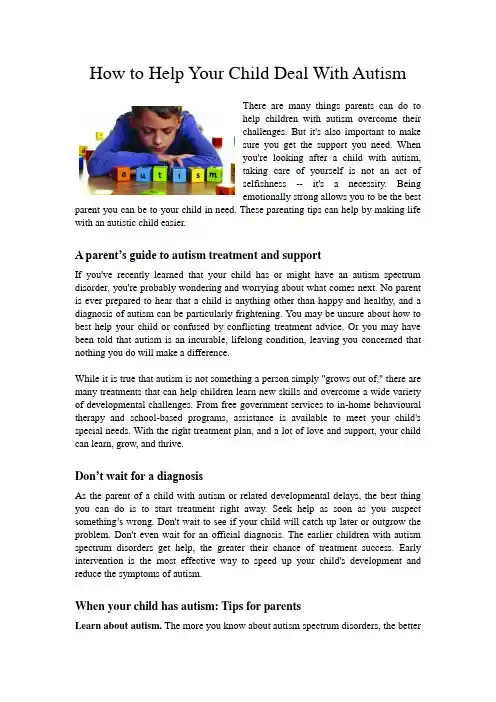
How to Help Your Child Deal With AutismThere are many things parents can do tohelp children with autism overcome theirchallenges. But it's also important to makesure you get the support you need. Whenyou're looking after a child with autism,taking care of yourself is not an act ofselfishness -- it's a necessity. Beingemotionally strong allows you to be the best parent you can be to your child in need. These parenting tips can help by making life with an autistic child easier.A parent’s guide to autism treatment and supportIf you've recently learned that your child has or might have an autism spectrum disorder, you're probably wondering and worrying about what comes next. No parent is ever prepared to hear that a child is anything other than happy and healthy, and a diagnosis of autism can be particularly frightening. You may be unsure about how to best help your child or confused by conflicting treatment advice. Or you may have been told that autism is an incurable, lifelong condition, leaving you concerned that nothing you do will make a difference.While it is true that autism is not something a person simply "grows out of," there are many treatments that can help children learn new skills and overcome a wide variety of developmental challenges. From free government services to in-home behavioural therapy and school-based programs, assistance is available to meet your child's special needs. With the right treatment plan, and a lot of love and support, your child can learn, grow, and thrive.Don’t wait for a diagnosisAs the parent of a child with autism or related developmental delays, the best thing you can do is to start treatment right away. Seek help as soon as you suspect something’s wrong. Don't wait to see if your child will catch up late r or outgrow the problem. Don't even wait for an official diagnosis. The earlier children with autism spectrum disorders get help, the greater their chance of treatment success. Early intervention is the most effective way to speed up your child's development and reduce the symptoms of autism.When your child has autism: Tips for parentsLearn about autism. The more you know about autism spectrum disorders, the betterequipped you’ll be to make informed decisions for your child. Educate yourself about the treatment options, ask questions, and participate in all treatment decisions.Become an expert on your child.Figure out what triggers your kid’s ―bad‖ or disruptive behaviours and what elicits a positive response. What does your autistic child find stressful? Calming? Uncomfortable? Enjoyable? If you understand what affects your child, you’ll be better at troubleshooting problems and preventing situations that cause difficulties.Accept your child, quirks and all. Rather than focusing on how your autistic child is different from other children and what he or she is ―missing,‖ practice acceptance. Enjoy your kid’s special quirks, celebrate small successes, and stop comparing your child to others. Feeling unconditionally loved and accepted will help your child more than anything else.Don’t give up.It’s impossible to predict the course of an autism spectrum disorder. Don’t jump to conclusions about what life is going to be like for your child. Like everyone else, people with autism have an entire lifetime to grow and develop their abilities.Helping children with autism tip 1: Provide structure and safety Learning all you can about autism and getting involved in treatment will go a long way toward helping your child. Additionally, the following tips will make daily home life easier for both you and your autistic child:Be consistent.Children with autism have a hard time adapting what they’ve learned in one setting (such as the therapist’s office or school) to others, including the home. For example, your child may use sign language at school to communicate, but never think to do so at home. Creating consistency in your child’s environment is the best way to reinforce learning. Find out what your child’s therapists are doing and continue their techniques at home. Explore the possibility of having therapy take place in more than one place in order to encourage your child to transfer what he or she has learned from one environment to another. It’s also important to be consistent in the way you interact with your child and deal with challenging behaviours.Stick to a schedule.Children with autism tend to do best when they have a highly-structured schedule or routine. Again, this goes back to the consistency they both need and crave. Set up a schedule for your child, with regular times for meals, therapy, school, and bedtime. Try to keep disruptions to this routine to a minimum. If there is an unavoidable schedule change, prepare your child for it in advance. Reward good behaviour.Positive reinforcement can go a long way with children with autism, so make an effort to ―catch them doing something good.‖ Praise themwhen they act appropriately or learn a new skill, being very specific about what behaviour they’re being praised for. Also look for other ways to rew ard them for good behaviour, such as giving them a sticker or letting them play with a favourite toy. Create a home safety zone. Carve out a private space in your home where your child can relax, feel secure, and be safe. This will involve organizing and setting boundaries in ways your child can understand. Visual cues can be helpful (coloured tape marking areas that are off limits, labelling items in the house with pictures). You may also need to safety proof the house, particularly if your child is prone to tantrums or other self-injurious behaviours.Helping children with autism tip 2: Find nonverbal ways to connect Connecting with a child with autism can be challenging, but you don’t need to talk in order to communicate and bond. You communicate by the way you look at your child, the way you touch him or her, and by the tone of your voice and your body language. Your child is also communicating with you, even if he or she never speaks. You just need to learn the language.Look for nonverbal cues. If you are observant and aware, you can learn to pick up on the nonverbal cues that children with autism use to communicate. Pay attention to the kinds of sounds they make, their facial expressions, and the gestures they use when they’re tired, hungry, or want something.Figure out the need behind the tantrum.It’s only natural to feel upset when you are misunderstood or ignored, and it’s no different for children with autism. When children with autism act out, it’s often because you’re not picking up on their nonverbal cues. Throwing a tantrum is their way communicating their frustration and getting your attention.Make time for fun. A child coping with autism is still a kid. For both children with autism and their parents, there needs to be more to life than therapy. Schedule playtime when your child is most alert and awake. Figure out ways to have fun together by thinking about the things that make your child smile, laugh, and come out of their shell. Your child is likely to enjoy these activities most if the y don’t seem therapeutic or educational. There are tremendous benefits that result from your enjoyment of your child’s company and from your child’s enjoyment of spending unpressured time with you. Play is an essential part of learning and shouldn’t feel like work.Pay attention to your child’s sensory sensitivities. Many children with autism are hypersensitive to light, sound, touch, taste, and smell. Other children with autism are ―under-sensitive‖ to sensory stimuli. Figure out what sights, sounds, sme lls, movements, and tactile sensations trigger your kid’s ―bad‖ or disruptive behavioursand what elicits a positive response. What does your autistic child find stressful? Calming? Uncomfortable? Enjoyable? If you understand what affects your child, you’l l be better at troubleshooting problems, preventing situations that cause difficulties, and creating successful experiences.Helping children with autism tip 3: Create a personalised autism treatment planWith so many different autism treatments available, and it can be tough to figure out which approach is right for your child. Making things more complicated, you may hear different or even conflicting recommendations from parents and doctors. When putting together an autism treatment plan for your child, keep in mind that there is no single treatment that will work for everyone. Each person on the autism spectrum is unique, with different strengths and weaknesses.Your child’s treatment should be tailored according to his or her individual needs. You know your child best, so it’s up to you to make sure those needs are being met. You can do that by asking yourself the following questions:A good autism treatment plan will:Build on your child's interests.Offer a predictable schedule.Teach tasks as a series of simple steps.Actively engage your child's attention in highly structured activities.Provide regular reinforcement of behaviour.Involve the parents.Source: National Institute of Mental HealthWhat are my child’s strengths?What are my child’s we aknesses?What behaviours are causing the most problems?What important skills is my child lacking?How does my child learn best (through seeing, listening, or doing)?What does my child enjoy and how can those activities be used in treatment? Finally, keep in mind that no matter what autism treatment plan is chosen, your involvement is vital to success. You can help your child get the most out of treatment by working hand-in-hand with the autism treatment team and following through with the therapy at home.Choosing autism treatmentsWhen it comes to autism treatment, there are a dizzying variety of therapies andapproaches. Some autism therapies focus on reducing problematic behaviours and building communication and social skills, while others deal with sensory integration problems, motor skills, emotional issues, and food sensitivities.With so many choices, it is extremely important to do your research, talk to autism treatment experts, and ask questions. But keep in mind that you don't have to choose just one type of therapy. The goal of autism treatment should be to treat all of your child's symptoms and needs. This often requires a combined treatment approach that takes advantage of many different types of therapy.Common autism treatments include behaviour therapy, speech-language therapy, play-based therapy, physical therapy, occupational therapy, and nutritional therapy. Helping children with autism tip 4: Find help and supportCaring for a child with an autism spectrum disorder can demand a lot of energy and time. There may be days when you feel overwhelmed, stressed, or discouraged. Parenting isn’t ever easy, and raising a child with special needs is even more challenging. In order to be the best parent you can be, it’s essential that you take c are of yourself.Don’t try to do everything on your own. You don’t have to! There are many places that families of autistic kids can turn to for advice, a helping hand, advocacy, and support:Autism support groups – Joining an autism support group is a great way to meet other families dealing with the same challenges you are. Parents can share information, get advice, and lean on each other for emotional support. Just being around others in the same boat and sharing their experience can go a long way toward reducing the isolation many parents feel after receiving a child’s autism diagnosis.Respite care – Every parent needs a break now and again. And for parents coping with the added stress of autism, this is especially true. In respite care, another caregiver takes over temporarily, giving you a break for a few hours, days, or even weeks. To find respite care options in your area, see Resources section below.Individual, marital, or family counselling – If stress, anxiety, or depression is getting to you, you may want to see a therapist of your own. Therapy is a safe place where you can talk honestly about everything you’re feeling—the good, the bad, and the ugly. Marriage or family therapy can also help you work out problems that the challenges of life with an autistic child are causing in your spousal relationship or with other family members.Karley Ashfield 18MAY15。