
牛津深圳八年级英语上册Unit 6 Language 课件
- 格式:ppt
- 大小:3.17 MB
- 文档页数:24


1 Unit 6
Ancient stories
1. understand 【v.】懂,理解 (understand - understood - understood)▲
make oneself understood 表达自己的意思,让旁人理解自己的意思
【例】Can you make yourself understood in English? 你能用英语表达自己的意思吗?
2. difference 【n.】区别,不同之处▲
常用结构:the difference(s) between... and... 。。。与。。。之间的差别
different 【adj.】不同的,差别的
常用结构:be different from 与......不一样 反义词:be the same as 与......相同
differently 【adv.】不同地,差别地
【例】Can you find the differences between the two?
The chairs in your house are different from ours?
3. captain 【C.】 队长,首领,船长
【例】His father is a captain.
4. huge 【adj.】庞大的,巨大的 =very big▲
【例】The party was a huge success. 聚会非常成功。
5. main adj. 主要的 =very important
【例】the main gate, the main street.
6. celebrate 【v.】 庆祝,庆贺 celebration【n.】 祝贺
Eg: All the Chinese people are celebrating the Spring Festival.

语法填空。
When I’m growing up, I don’t hear the words “I love you” from my father. If your father never says
them (16) _______ you when you are a child, it’ll get harder and harder for him to say those words
as he gets (17) ________ (old). I can’t remember when I last (18) ______ (say) those words to him
either. I decided (19) _______ (make) the first move. In the next phone conversation I said, “Dad …
I love you!”
There was a silence at the other end and Dad was (20) _________ (surprise) to answer, “Well, the
same back to you!”
“Dad, I know you love me; you will say what you want to say,” I cried.
Fifteen (21) ________ (minute) later my mother called and nervously asked, “Paul, (22) ______ (be)
everything OK?”
A few weeks later, on the phone my father said, “Paul, I love you.” I was at work (23) ______ the
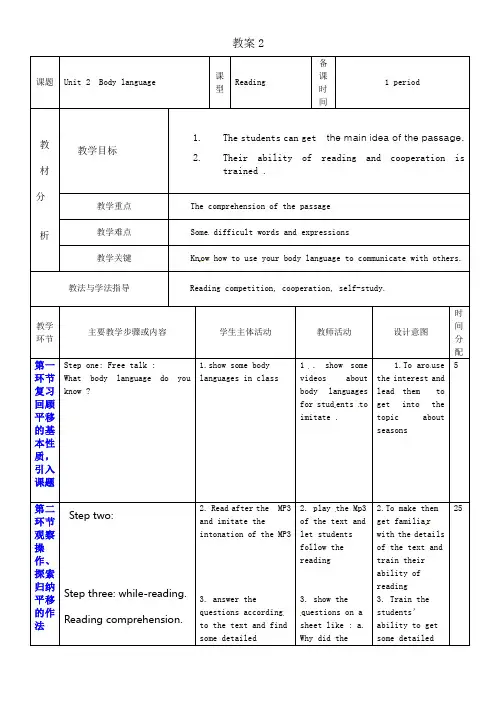
教案2
课题 Unit 2 Body language 课型 Reading 备课时间 1 period
教
材
分
析 教学目标 1. The students can get the main idea of the passage.
2. Their ability of reading and cooperation is
trained .
教学重点 The comprehension of the passage
教学难点 Some difficult words and expressions
教学关键 Know how to use your body language to communicate with others.
教法与学法指导 Reading competition, cooperation, self-study.
教学环节 主要教学步骤或内容 学生主体活动 教师活动 设计意图 时间
分配
第一环节
复习回顾平移的基本性质,引入课题
Step one: Free talk :
What body language do you
know ? 1.show some body
languages in class 1. show some
videos about
body languages
for students to
imitate .
1.To arouse
the interest and
lead them to
get into the
topic about
seasons 5
第二环节
观察操作、探索归纳平移的作法
Step two:
Step three: while-reading.
Reading comprehension. 2. Read after the MP3
and imitate the
intonation of the MP3

1 Unit 6 Ancient stories
The bus is very crowded. A man tries to get on, but no one gives way to him.
"Hey, let me get on the bus! "the man shouts.
"It's too crowded. You'd better take the next bus. "a passenger says to him.
"But you can't go without me. I'm the driver!" the man shouts again.
1. understand 【v.】懂,理解 (understand - understood - understood)▲
make oneself understood 表达自己的意思,让旁人理解自己的意思
【例】Can you make yourself understood in English? 你能用英语表达自己的意思吗?
2. difference 【n.】区别,不同之处▲
常用结构:the difference(s) between... and... 。。。与。。。之间的差别
different 【adj.】不同的,差别的
常用结构:be different from 与......不一样 反义词:be the same as 与......相同
differently 【adv.】不同地,差别地
【例】Can you find the differences between the two?
The chairs in your house are different from ours?
3. captain 【C.】 队长,首领,船长