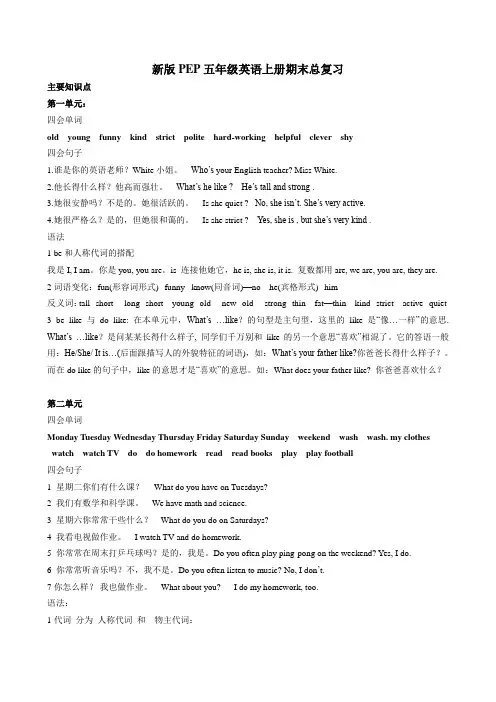
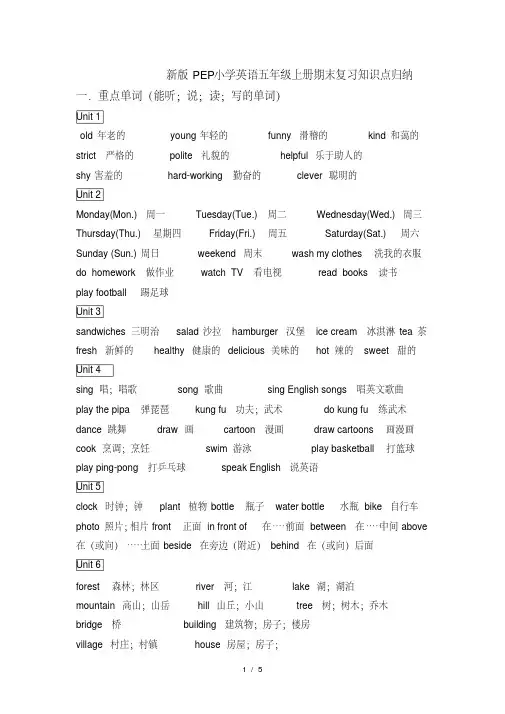
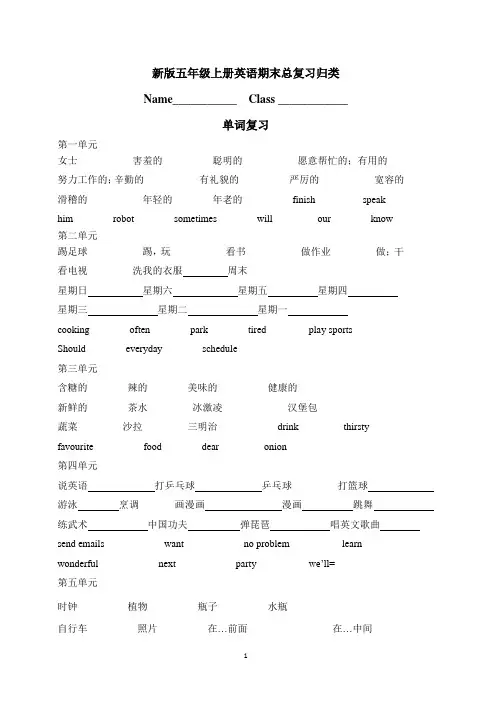
英语新版PEP五年级上学期期末总复习
- 格式:docx
- 大小:42.10 KB
- 文档页数:4
Unit 1 What's he like?他是什么样的?一.重点句型1.Do you know Mr Young ?你知道杨老师(Mr指男士)吗?Do you know + 人名? 表示“你知道某人吗?肯定回答用:Yes ,I do 否定回答用:No, I don't .2.Who is she? 她是谁? who:“谁”,用来提问人Who +is +she/he?“她/他是谁?”回答:She/ He is +其他(根据实际情况回答)eg: A:Who is she? B:She is my English teacher .3.Is + she/ he + 形容词“她/他是······的吗?”肯定回答用:Yes , she/he is. 否定回答:No, she/he isn't4.What's + 人 + like ? “某人是什么样的”回答:人+be +表示性格或外貌的形容词。
“某人是····样的”二. 单词和词组课程:maths 数学 English 英语 Chinese 语 Science 科学 Art美术 PE 体育表示性格的词:quiet 安静的 friendly 友好的 polite 有礼貌的at home在家 but 但是(表示转折) really “确实,非常”表示外貌特征的词:thin 瘦的 fat 胖的 tall 高的 short 矮的Unit 2 My week 我的一周一.重点句型:1.What do you have on Monday ?你周一有什么课?What do you have on + 星期几“你星期几有什么课?”回答:I have +课程+on+星期几“我星期有·····课”2.What's that ? “那是什么?”回答:It's +名词“它是····”eg:What's that?那是什么? It's a story book它是一本故事书3.What do you often do on the weekend ?“你经常在周末做什么?”回答:I often +动词“我经常······”4.Do you often +动词+时间/地点?“你经常在某时/某地做什么吗?”肯定回答用:Yes , I do . 否定回答:No , I don't5.What about you ? 你呢?回答时根据实际情况及语境回答。
二.单词:in this park 在这个公园里 very much 非常 listen to musci 听音乐on the weekend 在周末 clean(打扫) my room 打扫我的房间draw pictures 画画 You look tired 你看起来很疲倦do some shopping 购物 play with +人/物“和某人/某物一起玩”put back 放回在具体的星期几前要用 on 如:on Sunday 在周日在周末:on the weekendUnit 3 What would you like ? 你想要什么?一.重点句型:1.What would you like to eat (吃)/ drink(喝) ? 你想要吃/喝什么?回答:①(用eat提问时)直接回答食物/(用drink提问时)饮料② I'd like +事物/饮品eg: A:What would you like to eat? (要回答食物) B:Salad / I'd like some salad. A: What would you like to drink ?(回答饮料) B:Milk / I'd like some milk .2.What's your favourite food / drink?你最喜欢的食物/饮料是什么?回答:①直接回答食物/饮料②My favourite food/drink is +事物/饮料(单数)形容事物味道:It's +表示味道的形容词“它是····的”(单数食物)They are +表示味道的形容词“他们是····的”(复数事物)eg: I like ice cream , it's sweet .我喜欢冰淇淋,它是甜的。
I like cakes , they are delicious . 我喜欢蛋糕,他们是美味的。
3.I'm hungry . 我饿了。
4.I don't like beef but chicken is OK. 我不喜欢牛肉但是鸡肉没问题。
5.I like vegetables(蔬菜) but not carrots . 我喜欢蔬菜,但是不喜欢胡萝卜。
but "但是" 表示转折。
连接的两部分情况发生不同的变化。
and "和" 表示并列。
连接的两部分情况是相同的。
with “和····一起”后面可以经常接人/物eg: I like bread and sandwich .我喜欢面包和三明治。
I have cooking class with your grandma on Thursday .我周末和你的奶奶一起上烹饪课。
6.What can they both eat ?他们能一起吃什么?回答两种食物二.单词:hungry 饥饿 rice米饭 bread 面包 vegetable 蔬菜 water 谁 milk 牛奶orange juice 橙汁 beefnoodles 牛肉面 order= menu 菜单 hot dog 热狗 today 今天be careful 小心 No problem 没问题 at the farm在农场Unit 4 What can you do ? 你会做什么?一.重点句型:1.What can you do for the party ? 你能为聚会做什么?回答: I can + 动词2.How about you ? 你呢?根据实际情况回答3.Can you do any Kong fu ?你能表演一些功夫吗?疑问句中“一些”用any .肯定回答:Yes ,I can . 否定回答:No , I can't .4.We'll have an English party next week.我们下周将要举行一个英语聚会。
5.Today we'll learn some Kong fu .今天我们将要学一些功夫。
肯定句中“一些”用some.6.I can do things for you.我能为你做事情。
7.can的使用人+can +动词原形+其他“某人会······”人+can't +动词原形“某人不会·····”Can +人+动词原形+其他“某人会····吗?”回答时:肯定回答:Yes , 人+ can 否定回答:No, 人+ can'tWho can +动词“谁会·····?”回答:直接回答某人eg: A:Who can sing English songs ? B:Tom二.单词:speak English/ Chinese 说英语/汉语 make a pupet / robot 制作木偶/机器人wonderful 好极了 send me an email 给我寄一封电子邮件here 这里 wait a minute等一下注:球类运动前不加the ,弹奏的乐器前加theUnit 5 There is a big bed有一张大床一.重点句型1.there be句型肯定句的结构: ①There is + a/an +单数名词+地点②There are + 复数名词 + 地点表示“某地有某物”eg: There are some books in my room.在我的房间里有一些书。
There is a bike in front of the tree.在树前面有一辆自行车否定句的结构:将肯定句①中的is 改为isn't 或将肯定句②中的are 改为aren't表示“某地没有某物”eg:There isn't a lake in the nature park .在公园里没有一个湖There aren't any ducks on the lake . 在湖上没有一些鸭子一般疑问句:将肯定句中的is /are提前放在句首,表示“某地有某物吗?”肯定回答用:Yes ,there is/are 是的,有否定回答用:No , there isn't / aren't 不,没有eg: ①A:Is there a forest in the park ? 在公园里有一个森林吗?B:Yes , there is/ No, there isn't 是的,有 / 不,没有②A: Are there any tall buildings in the nature park?在自然公园里有高楼吗?B:Yes ,there isn't / No ,there aren't 是的,有 / 不,没有就近原则:there be 句型中be 动词要根据紧挨be动词的名词来确定。
如果be动词后的名词是复数,要用are , 如果是单数,要用is .eg:There are some books and a pen on the desk.在桌子上有一些书和一只钢笔。
There is a tree and some flowers in the garden.在花园里有一棵树和一些花2.You look cool .你看起来很酷3.This is my room .这是我的房间4.What's in the room ? 在房间里有什么?回答:用there be 句型根据语境和实际情况回答。