新概念第一册时态总结
- 格式:doc
- 大小:45.50 KB
- 文档页数:7
1
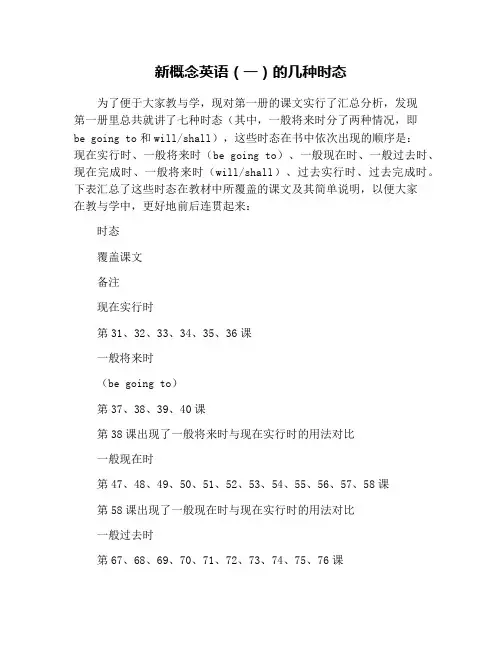
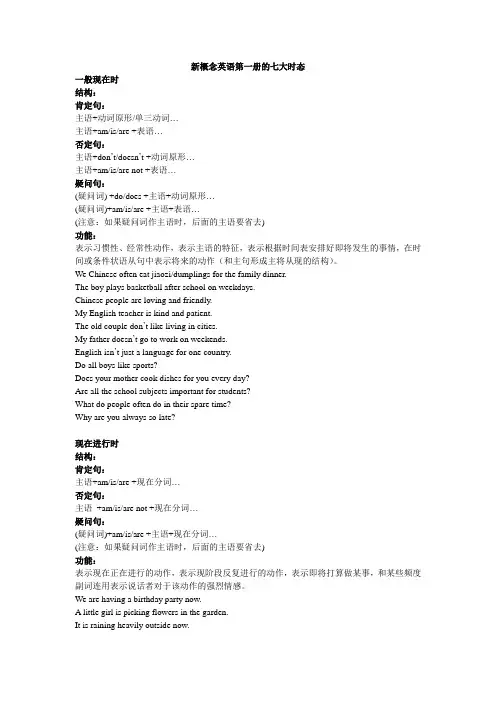
新概念英语第一册语法总结 —— 时态
时态:一般现在时,现在进行时,一般将来时,一般过去时 / 现在完成时,过去进行时,过去完成时,过去将来时
1. 一般现在时:表示一般性,常常性的动作或一般性事实。
* 含有be动词的句子 (He is a teacher.; The girl is very beautiful. ;Tim and Jack are students.)
★变疑问句将be动词移到句首 (Is he a teacher?; Is the girl very beautiful?; Are Tim and Jack students?)
★变否定句在be动词后面加not (He is not a teacher.;The girl is not very thin.;Tim and Jack are not students.)
★肯定回答及否定回答 (Yes he is. No he is not.Yes she is. No she is not.Yes they are. No they are not.)
* 不含be有动词的句子,即含有一般动词的句子
第三人称单数及单数名词 (He likes books.;She likes him. ;The dog likes bones.)
★变疑问句在句首加does 动词变为原型 (Does he like books?Does she like him?Does the dog like bones?)
★变否定句在主语及动词之间加doesn’t 动词变为原型
(He doesn’t like books. She doesn’t like him. The dog doesn’t like bones.)
★肯定回答及否定回答
Yes he does. No he doesn’t. Yes she does. No she doesn’t. Yes it does. No it doesn’t.
(注意:第三人称单数形式一般在动词后面加S,不要和名词复数混淆)
其他人称及复数茗词
I want to have a bath.
We have some meat.
The students like smart teachers.
★变疑问句在句首加do
Do you want to have a bath? Do we have any meat? Do the students like smart teachers?
★变否定句在主语和动词之间加don’t. 2 You don’t want to have a bath. We don’t have any meat. The students don’t like smart teachers.
★肯定回答及否定回答Yes I do. No I don’t. Yes we do. No we don’t. Yes they do. No they don’t.
2. 现在进行时,表示现在正在进行的动作。
构成: 主语+be动词+动词的现在分词+其它成分(现在分词的构成见附录)
We are having lunch.
He is reading a book.
The dog is running after a cat.
The boys are swimming across the river.
★变疑问句将be动词移到句首
Are we having lunch? Is he reading a book? Is the dog running after a cat?
Are the boys swimming across the river?
★变否定句在be动词后面加 not
We are not having lunch. He is not reading a book.
The dog is not running after a cat. The boys are swimming across the river.
* 特别疑问句:what / which/ how/ where/ who
疑问词+动词+主语+现在分词
What are you doing? What is she doing? What is the dog doing?
* 没有进行时的动词
表示状态,思想,感情和感觉的动词不能表示正在进行的动作
表示感觉、感官的词see、hear、like、love 、want
have/ has 当”拥有”讲时 ,没有进行时
3.一般将来时 表示将来将要发生的动作,常常和tomorrow、 next year 、the day after tomorrow 、the year after
the next 、in five hours’ time etc. 表示将来的词联用
* 结构: 主语+助动词will+动词原形 3 I will go to America tomorrow.
The pilot will fly to Japan the month after the next.
Jack will move into his new house tomorrow morning.
★变疑问句将助动词移到句首
Will you go to America tomorrow?
Will the pilot fly to Japan the month after the next?
Will Jack move into his new house tomorrow morning?
★变否定句在助动词后面加not
I will not go to America tomorrow.
The pilot will not fly to Japan the month after the next.
Jack will not move into his new house tomorrow morning
★肯定回答及否定回答
Yes I will. No I will not. Yes he/she will. No he/she will not. Yes he will. No he will not.
* 特别疑问句: What will you do?
* Be going to do 表示打算,预备,计划做某事
结构:主语+be动词+going to +动词原型
I am going to make a bookcase.
They are going to paint it.
The father is going to give the bookcase to his daughter.
★变疑问句将be动词移到句首
Are you going to make a bookcase? Are they going to paint it?
Is the father going to give the bookcase to his daughter?
★变否定句在be动词后面加not
I am not going to make a bookcase. 4 They are going to paint it.
The father is not going to give the bookcase to his daughter.
★肯定回答及否定回答
Yes I am. No I am not. Yes they are. No they are not. Yes he is. No he is not.
* 特别疑问句
What are you going to do?
What are they going to do?
What is the father going to do?
4.一般过去时 表示过去发生的动作或事件,常和表示过去的时间状语连用,如yesterday、 last night 、the day
before yesterday、 3 days ago
* 含有be动词的句子,将动词变为过去式,
(am is的过去式为was,are的过去式为were)
I was at the butcher’s.
You were a student a year ago.
The teacher was very beautiful ten years ago.
★变疑问句将be动词移动到句首
Were you at the butcher’s?
Were you a student a year ago?
Was the teacher very beautiful ten years ago?
★变否定句在be动词后面加not
I was not at the butcher’s. You were not a student a year ago.
The teacher was not very beautiful ten years ago.
★肯定回答否定回答
Yes I was. No I was not. Yes you were. No you were not. Yes he/she was. No he/she was not. 5 * 特别疑问句:What did you do?
不含有be动词的句子,将动词变为过去式,动词过去式构成见附录
I finished my homework yesterday.
The boy went to a restaurant.
The Sawyers lived at King Streeta year ago.
★变疑问句在句首加did,动词变为原型
Did you finish your homework yesterday?
Did the boy go to a restaurant?
Did the Sawyers live at King Streeta year ago?
★变否定句在主语和动词之间加did not
I did not finish my homework yesterday.
The boy did not go to a restaurant.
The Sawyers did not live at King Streeta year ago.
★肯定回答及否定回答 Yes I did. No I didn’t./ Yes he did. No he didn’t. /Yes they did. No they did not.
5、现在完成时 构成 主语+助动词have has+过去分词
* 表示过去发生的和现在有某种联系的动作,常和just 、usually、 already、 since等时间副词连用