人教新目标英语八年级上册unit1单元知识点总结
- 格式:doc
- 大小:93.50 KB
- 文档页数:6
人教新目标英语八年级上册
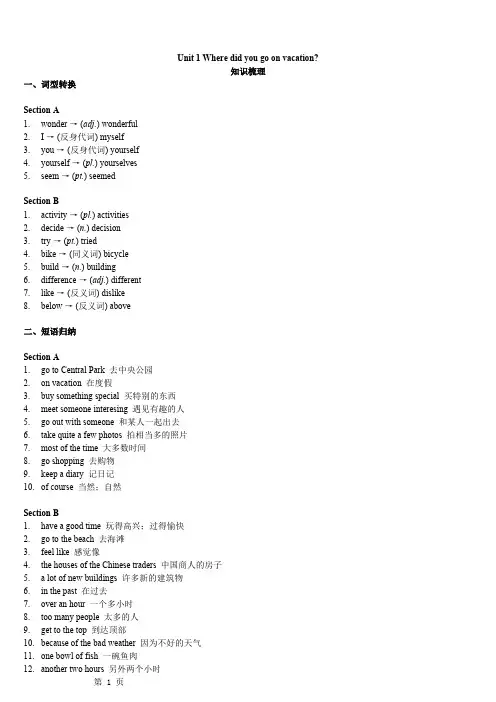
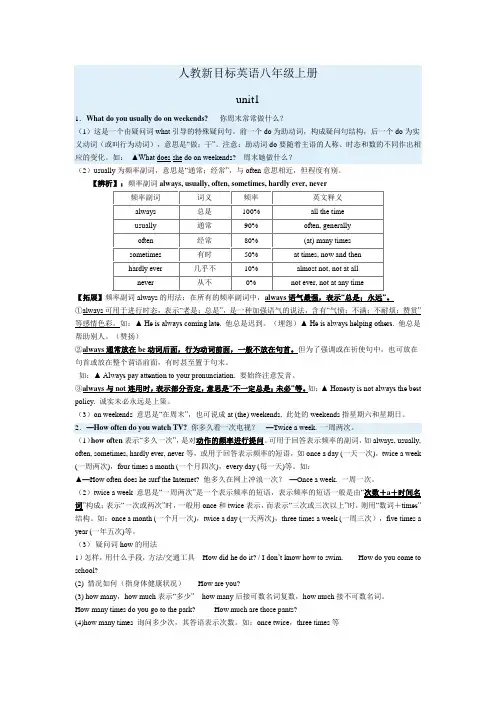
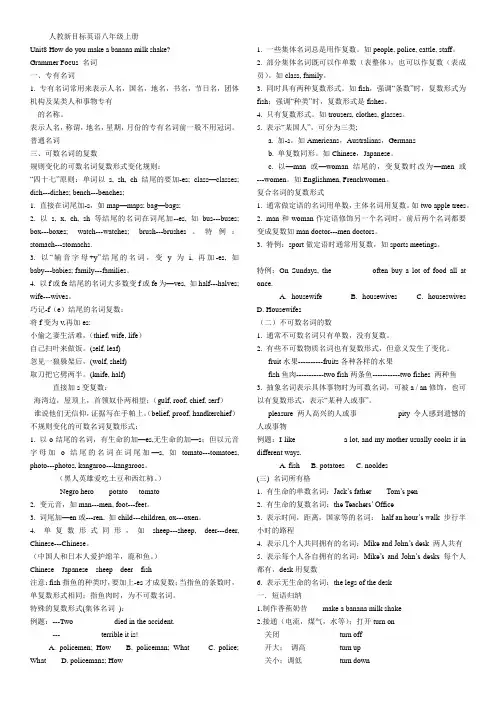
Unit1 Where did you go on vacation?单元知识要点
一、语法:
一般过去时
1. 概念
一般过去时表示过去某个时间里发生的动作或状态;过去习惯性、经常性的动作、行为。常与过去的时间状语连用。例如:yesterday, the day before yesterday,last week,last month,in 2008,two days ago,this morning/afternoon/evening,when引导的状语从句(动词过去时),just now,in the old days,at that time, at that
moment等。
2. 谓语构成:动词的过去式
动词过去式的变化:1)规则变化:
2)不规则变化:
3)have---had are---were is/am---was do---did
二、一般过去时结构
(1)有Be动词的过去时结构:
肯定句:主语+was/were+其他
Jim was angry last night..
否定句:主语+was/were+not+其他
Jim wasn’t angry last night..
一般疑问句:was/were+主语+其他?
Was Jim angry last night?
肯定回答:Yes, 主语 + was/were. Yes, he was. 否定回答:No, 主语 + wasn’t/weren’t. No, he wasn’t.
特殊疑问句:特殊疑问词+一般疑问句结构? How was Jim last
night?
(2)句中没有be动词的一般过去时的句子
肯定:主语+动词过去式+其他
eg. Jim went home yesterday.
否定:主语+ didn’t +动词原形+其他
Jim didn’t go home yesterday.
一般疑问句:Did+主语+动词原形+其他
Did Jim go home yesterday?
肯定回答:Yes, 主语 + did. Yes, he did.
否定回答:No, 主语 + didn’t. No, he didn’t.
特殊疑问句:疑问词+did+主语+动词原形+其他?
What did Jim do yesterday? Who went to home yesterday?
复合不定代词和复合不定副词
英语中,像something等这样的词叫复合不定代词;像somewhere这样的词叫复合不定副词。
类别 复合不定代词 复合不定副词 指人 指物
some系列 someone
somebody something somewhere
any系列 anyone
anybody anything anywhere
no系列 no one
nobody nothing nowhere
every系列 everyone
everybody everything everywhere
1、复合不定代词的用法:
①复合不定代词在句中可用作主语、宾语或表语,但不能用作定语。something, someone 等和 anything, anyone等的区别与
some 和 any 的区别一样,前者一般用于肯定句,后者一般用于否定句、疑问句或条件句。
I know nothing about this person.我对这个人一无所知。
②复合不定代词作主语时,谓语动词必须用第三人称单数形式。 Everything begins to grow in spring.春天万物开始生长。
③复合不定代词被形容词修饰时,复合不定代词要放在形容词之前。There is nothing wrong with the radio. 这收音机没有毛病。
④在反意疑问句中,表示人的复合不定代词在陈述句中作主情况 方法 示例
①一般情况 +ed work-- worked
look--looked
②以不发音的e结尾 +d live --lived
hope--hoped
③以辅音字母+y结尾 变y为i+ed study—studied
carry--carried
④以重读闭音节结尾且末尾只有一个辅音字母 双写最后的辅音字母+ed stop—stopped
plan--planned 语时,简略问句中的主语用he或they:如果表示物的复合不定代词在陈述句中作主语,简略问句中的主语用it。例如:
Nobody knows the answer, does he/do they? 没有人知道答案,是吗?
Someone is waiting for you at the school gate,isn’t he/aren’t
they? 有人在门口等你,是不是?
Everything is ready,isn’t it?一切都准备好了,是吗? 复合不定副词在句中可作表语,也可作状语修饰动词或其他副词。形容词修饰复合不定副词时,放在不定副词后面。
Your bike must be somewhere in your school. 你的自行车一定在学校的什么地方。
We went somewhere nice yesterday.昨天我们去了一个美丽的地方。
I can’t find it anywhere.我到处找不到它。短语归纳
1、go on vacation去度假 ,
2、stay at home 呆在家,
3、go to the mountains 上山/进山 ,
4、go to the beach到海边去,
5、visit museums 参观博物馆,
6、go to summer camp 去夏令营,
7、quite a few 相当多,
8、study for为……学习,
9、go out 出去,
10、most of the time 大部分时间/绝大多数时间,
11、taste good 尝起来味道好,
12、have a good time玩的开心,
13、of course当然可以,
14、feel like(doing sth)感觉像……/想要,
15、go shopping购物,
16、in the past 在过去,
17、walk around绕……走,
18、too many 太多(可数名词前面),
19、because of 因为,
20、one bowl of 一碗……,
21、find out 查出来/发现 ,
22、go on继续,
23、take photos 照相,
24、something important重要的事情,
25、up and down上上下下,
26、come up出来 - 3 - ➢ 习惯用法、搭配
1. buy sth. for sb.=buy sb. sth. 为某人买某物
2. taste/look/smell/sound/feel + adj. 尝起来/看起来/闻起来/听起来/摸起来……
3. have nothing to do but + V.(原形) 除了……之外什么都没有
There was nothing much to do in the evening but read.晚上除了读书以外无事可做。
4. seem + (to be) + adj 看起来;似乎…
5. arrive in + 大地方 / arrive at + 小地方 到达某地
6. decide to do sth. 决定做某事
7. try doing sth. 尝试做某事 / try to do sth. 尽力做某事
8. enjoy doing sth. 喜欢做某事
9. want to do sth. 想去做某事
10. start doing sth. 开始做某事
11. stop doing sth. 停止正在做的某事
stop to do sth 停下来去做另外一件事
12. dislike doing sth. 不喜欢做某事
13. Why not do sth.= why don’t you do sth为什么不做…….呢?
What about doing sth ?=How about doing sth? ….怎么样?
Would you like to do sth? 你想去做某事吗?
Would you mind doing sth?你介意做某事吗?
14. so + 形容词 + that + 从句 如此……以至于……
too+ 形容词+ to +动词原形 太……而不能…..
such+(a/an)+形容词+名词that + 从句 如此……以至于……
She is ______ old to walk so long.
A. too B. so C. very D. such
15. tell sb. (not) to do sth. 告诉某人(不要) 做某事
16. keep doing sth. 继续做某事
17. forget to do sth. 忘记去做某事 / forget doing sth 忘记做过某事
18.How do you like…=what do you think of …? 你认为…怎么样
19. enough +名词,形容词+enough
20.不定代词+形容词,如;something new, anything important,
nothing interesting
21. have a good time = have fun = enjoy oneself 玩得开心,玩得愉快
二、课文要点:
SectionA
1.buy anything special 买特别的东西。(P2)
1)buy及物动词,意为“买;购买”。其过去式为______。
拓展:buy sth. for sb.=buy sb. sth. 意为“给某人买某物”。
My uncle_____ _____a bike.= My uncle_____ _____for me.
2)anything不定代词,意为“某事;某件东西”,主要用于疑问句或否定句中。
a.Do you want to buy anything for me?
b.I can’t say anything about it.
3) anthing special表示“特别的东西”,形容词修饰不定代词时后置。
Is there________ ________in this book?这本书里有新的内容吗?
2.Oh, did you go anywhere interesting?哦,你去有趣的地方了吗?(P2)
1)本句是did开头的一般疑问句
2)anywhere用作副词,意为“在任何地方”。
eg:Did you go anywhere during the summer vacation?