反义疑问句讲解及答案
- 格式:docx
- 大小:19.73 KB
- 文档页数:8
反义疑问句讲解及答案
反义疑问句
一.句型解释
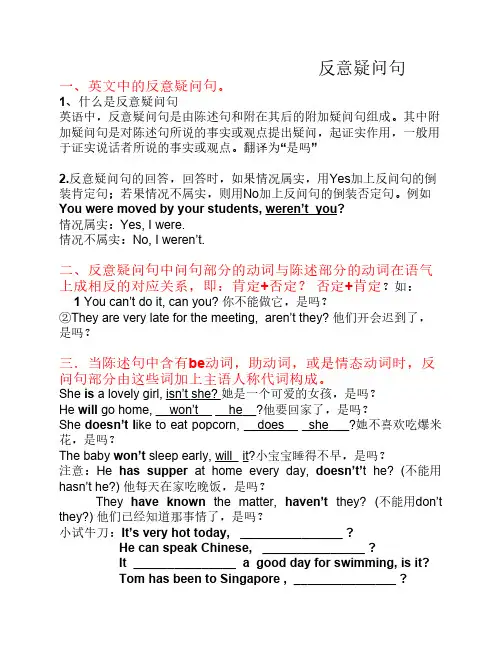
反义疑问句(The Disjunctive Question):即附加疑问句。它表示提问人的看法,没有把握,需要对方证实。
反义疑问句由两部分组成:前一部分是一个陈述句,后一部分是一个简短的疑问句,两部分的人称时态应保持
一致。
1.陈述部分肯定式+疑问部分否定式
2.陈述部分否定式+疑问部分肯定式
She was ill yesterday, wasn’t she?
You didn’t go, did you?
二.特殊的句型
1.祈使句。祈使句后一般加上will you或won't you构成反意疑问句,用will you 多表示“请求”,用won't you 多表示提醒对方注意。例如:
Let引导的祈使句有两种情况:
1) Let's...,后的反意疑问句用shall we或shan't we。
例如:Let's go home, shall we/ shan't we? 回家吧,好吗?
2)Let us/me...后的反意疑问句用will you或won't you。
例如:Let me have a try, will you/won't you?
3)祈使句都用will you 或won’t you
2.当陈述部分含I think (believe, suppose...)that... 结构时,其反意疑问句须与从句的主、谓语保持一致,注意主
句的主语必须是第一人称。例如:I don't think he will come, will
he?
若是非第一人称,则与主句的主语相一致
He thinks that she will come, doesn’t he?
反意疑问句的陈述部分为I(We) don’t think(believe, suppose, consider)+ that从句时,从句为否定意义,问句部
分的动词和主语仍与that从句保持一致且用肯定式。如:
①I don’t think that you can do it, can you? (不用do I?)
②We don’t believe that the news is true, is it? (不用do
we?)
反意疑问句的陈述部分为主语+said( told, reported, asked……)
+ that从句时,问句部分的动词和主语与陈述部分
的主句动词和主语保持一致。如:
①They said that you had finished your work, didn’t they?
(不用hadn’t you)
②Kate told you that she would go there, didn’t she? (不用wouldn’t she?)
3.当反意疑问句的陈述部分为从句时,若主句主语为I ,反意部分的主语为从句主语;若不为I ,反义部分的
主语为主句主语。
①I know your father is a worker, isn't he?
①she knows your father is a worker, doesn’t she?
4.当陈述部分含有以下这些含有否定意义的词时:few, little,
seldom,hardly, never, not, no, no one, nobody, nothing, none,
neither等,其反意疑问句需用肯定结构。例如:He is never late for
school, is he?
5.当陈述部分所含的否定词是通过加前缀或后缀构成的,其后的反意疑问句依然用否定结构。
例如:It is unfair, isn't it? 这不公平,是吧?
6.陈述部分主、谓语是I am...时,反意疑问句用aren't I ,而不是am not I (可用am I not)。
例如:I'm working now, aren't I? 我在工作,是吗?
7. 陈述部分的主语是everybody, everyone, anybody, anyone,
somebody, someone, nobody, no one, none, neither 时, 其反意疑问句的主语需用复数代词they。例如: Everyone is here, aren't they? 大家都到了,是吗?
No one knows about it, do they? 没有人知道这件事,对吗?
8.陈述部分的主语是everything, nothing, anything或something 时,反意疑问句的主语应用代词it。
例如:Something is wrong with my radio, isn't it?
我的收音机出毛病了,是吧?
9.陈述部分的主语是指示代词this或that时,反意疑问句的主语用it,当陈述部分的主语是指示代词these或those 时,其反意疑问句的主语用they。
例如:This is a plane, isn't it? 这是一架飞机,是吗?
These are grapes,aren't they? 这些是葡萄,是吗?
10.陈述部分的主语是不定代词one时,反意疑问句的主语可以用one,也可用you。
例如:One should be ready to help others, shouldn't one?
每个人都应该乐于助人,是吧?
11. 当陈述部分谓语动词是need, dare,且这些词被用作实义动词时,其反意疑问句需用do的适当形式。
例如:He needs help, doesn't he?他需要帮助,是吗?
12.当陈述部分主语是从句、不定式(短语)、动词-ing形式时,反意疑问句的主语应该用it。
例如:What you need is more important, isn't it?
你需要的东西更重要,是吧?
12.have(has)不是表示“有”的意思,并在句中做谓语时,其反意疑问句的助动词要用do, does, did。
例如:They had a meeting just now,didn't they?
他们刚才开了个会,是吗?
15.陈述部分有have to 时,其反意疑问句要用助动词的否定形式。
例如:You have to water the vegetables every day, don't you?
You had to water the vegetables every day, didn't you?
16.He used to stay up late, usedn’t he/ didn’t he
17.陈述部分是there be句型时,其反意疑问句中要用there。
There was a hospital here, wasn't there?
18.陈述部分有had better时,反意疑问句中要用hadn't。
例如:We’d better go to school at once, hadn't we?
He’d rather go home, wouldn’t he?
19.当陈述部分含有情态动词must时,我们便要分析一下must的含义。如果must 作“一定;要;必须”讲,
反意疑问句须用mustn't或needn't;而当must作推测意义“一定是;必定”讲时,反意疑问句则需根据must 后的动词原形选用相应的形式。
例如:He must work hard at physics, mustn't he?
他必须努力学物理,是吧?
Tom must be at home,isn't he? 汤姆一定在家,是吧
①He might have forgotten his pen in the classroom
yesterday, didn’t he?
(不用mightn’t he?/ hasn’t he?)
②You must have got up late this morning, didn’t you?(不用mustn’t you?/haven’t you?)
20.反意疑问句的回答用yes,no,但是,回答意思相反,当陈述部分是否定形式时,回答要按事实。
例如:They don’t work hard, do they?
Yes, they do. 不,他们工作努力。/No, they don’t. 对,他们工作不努力。
反意疑问句的陈述部分为I am……时,问句部分习惯上用aren’t
I?表示。如:
I am a very honest man, aren’t I?
反意疑问句练习
1. I suppose the shoes will last you at least one year,
____________? A. won’t t hey
B. will they
C. do I
D. don’t
2. Everyone is surprised at the news, _____________?
A, is he B. are they C. aren’t they D. is not he
3. ----- You will come to have dinner with us, won’t you?
----- ____________
A. Excuse me, I won’t.
B. I haven’t been there.
ry nice of you.
C. You are welcome.
D. Yes. That’s ve
-working student, for it is the third time he has been late,
______________?
4. Tom isn’t a hard
A. wasn’t it
B. hasn’t it
C. isn’t it
D. hasn’t he
5. You don’t have to go school on Sundays, _____________
you?
A. have
B. do
C. should
D. would
6. I don’t think he had his supper at the school, _____________?
A. had he
B. did he
C. do I