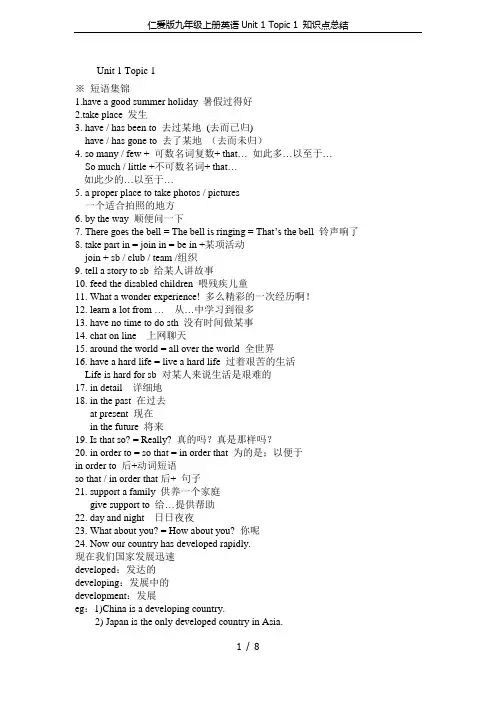
仁爱版英语 九年级上册unit 1 topic 1知识点总结
- 格式:doc
- 大小:58.55 KB
- 文档页数:2
1 Unit 1 The Changing World 知识点总结
Topic 1 Our country has developed rapidly.
序 短语/句型 翻译 例句/用法
1 be+adj.+to do sth 做某事很… Kangkang is happy to see his friends.
2 You have just come back from your
hometown. 你刚从你的家乡回来。 此句为“现在完成时”句型,即“have/has+动词过去分词”,此句中,just为现在完成时的标志词,意为“刚刚”。
3 Great changes have taken place in
our hometown. 在我家乡已经发生了巨大的变化。 take place:发生。注意:辨析:take place和happen
take place:指特定情况下的发生,有计划、有安排的发生,其后往往不跟宾语。
happen:指偶然间、碰巧的发生,其后须跟“to”再加宾语。
4 Where have you been? 你去了哪里? been为be的过去分词,have been指去过某地,但目前已经返回。
5 There were so many people that I
couldn’t find a good place to take photos. 那里人非常多以至于我找不到一个拍照的好地方。 ①此句为“so...that…”引导的结果状语从句。
②从句中,动词不定式“to take photos”做定语修饰“place”
6 by the way 顺便问一下
7 She has gone to Cuba to be a
volunteer. 她去了古巴去做一名志愿者。 gone为go的过去分词,have gone指去了某地,并且目前依旧在此地,没有回来。
8 There goes the bell. 铃响了。 此句为倒装句,即主语和谓语颠倒位置。此句中,主语是“the bell”,谓语是“goes”,但此句开头的词语为“there”,是方位副词,故引起主谓倒装。
9 I haven’t seen you for a long time. 我好久没有见到你了。 此句为现在完成时的否定句形式,句中“for+时间段”为现在完成时的标志。
10 You took part in some volunteer
activities during the summer
holidays, didn’t you? 你在假期期间参加了一些志愿者活动,对吗? ①take part in:参加。辨析:take part in和join:
take part in指参加某个具体的项目或者某个会议、聚会
join指加入一伙人或是某个组织、团体、社团。
②此句中“didn’t you”为反义疑问句,反义疑问句由两部分组成,前后两句,前句为肯定句,后句为否定句;反之交换。前后句动词一致,时态一致。
11 What a wonderful experience! 多棒的一次经历啊! 此句为“what”引导的感叹句。强调其后的名词“experience”。experience:①经历(可数)②经验(不可数)
12 learn sth from sth/sb 从某人/某物那里学到… I have learnt a lot from it.
13 Though I had no time to travel, I still
felt very happy. 尽管我没有时间旅行,但是我仍然感觉很开心。 though…still…:尽管….但是仍然….
14 put on funny shows 表演有趣的短剧 put on;①穿上;②上演
15 To help others makes us happy. 帮助他人快乐自己。 此句中,主语是动词不定式“to help others”,动词不定式做主语,谓语动词用单三形式。
16 do sth meaningful 做一些有意义的事情 形容词修饰不定代词要后置。
17 She has seen the changes in Beijing
herself. 她已经亲眼目睹了背景的变化。 see sth oneself:亲眼目睹
18 living conditions(可数) 居住条件
19 ring roads(可数) 环形公路
20 be crowded into 挤进…里
21 have a chance to do sth 有机会做某事 Few children had the chance to receive a good education.
22 receive a good education 接受良好的教育
23 keep in touch with sb 与某人保持联系
24 the reform and opening-up 改革开放政策
25 China has developed rapidly since
the reform and opening-up. 自改革开放以来,中国已经快速发展了。 此句为现在完成时,句中“since+时间点”意为“自从某时以来”,是现在完成时的时间标志。
2 26 satisfy one’s need 满足某人的需求 need:在句中为名词且可数,译为“需求”
27 make progress 取得进步 progress:进步、成就(不可数名词)
28 Beijing has already succeeded in
hosting the 2008 Olympic Games. 背景已经成功举办了2008年奥运会。 ①already:已经。是现在完成时的标志词,且只用于肯定句中。
②succeed in doing sth:成功做某事
29 I think it’s important to remember
the past, live in the present and
dream about the future. 我认为铭记历史、活在当下、畅想未来是很重要的。
30 leisure activity(可数) 业余活动
31 play an important part(role) in 在某方面扮演重要角色 Leisure activities play an important part in people’s lives.
32 in the past 在过去 一般过去时的时间标志
33 in one’s free(spare) time 在某人的空闲时间里
34 spend+时间/金钱+on sth 在某事/物上花时间/金钱 People have spent more time on the leisure activities.
35 stay at home 呆在家
36 chat with sb on the Internet 网上和某人聊天
37 place of interest 名胜古迹
38 make a tour abroad 出国旅行 People even make a tour abroad to see the world.
语法解析
现在完成时态Ⅰ
1. 概念:过去的一个动作做到现在完成了或是还会继续,并且对现在造成了一定的影响。
2. 结构:have/has+动词过去分词
3. 标志词:just(刚刚)、already(已经)、for+时间段、since+时间点
4. have been to和have gone to的区别:
have been:指去过某地,现在已经回来;have gone to:指去了某地,现在还没回来。