高考情态动词归纳
- 格式:doc
- 大小:125.50 KB
- 文档页数:10
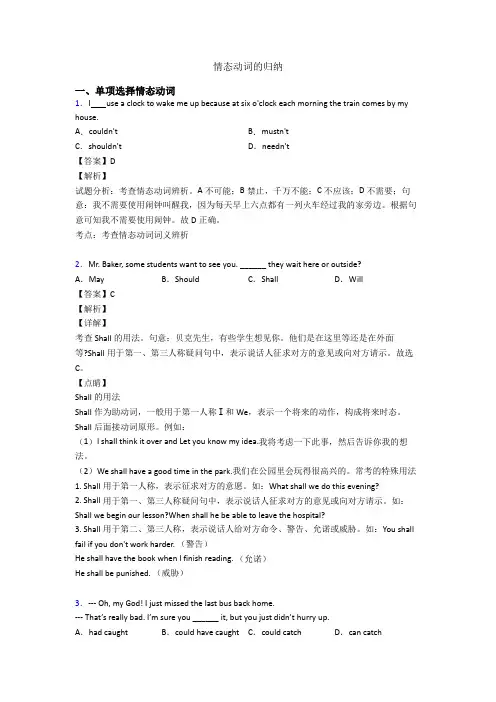
1 情态动词归纳表
情态V 词义&用法 注意事项 特殊用法
can
could 1.表具备某种能力 Can表现在能力;Could表示过去能力.可用be able to代替;was/were able to to表示成功做了某事 (1)表惊异、怀疑、不相信、不耐烦等。(此意常用于否定句、疑问句或惊叹句语气)Can/Could this be true?
(2)can not„too\enough表示"无论怎样``````也不过分","越``````越好":
You can't be too careful.
2.表请求和允许 ①请求用could 语气委婉
②允许不用 could.
3.表“可能性”
① can用于否定和疑问句(could不限)
② can (be)表示有时候会(常与sometimes, at times 连用)
may
might 1.表请求和允许 ①请求用might语气更委婉。
②允许时用may,表示“可以”(表示允许时不用might)。 (1)may/might well+V原形:表"完全可能,,很可能"= be very likely to:He may
well be proud for his son.
(2)may/might as well+V原形:"最好,满可以,倒不如"
You may as well stay here over night. 2.表可能性“也许” 此意常用于肯定句。(might可能最小)
3表祝愿 固定句型为“May+主语+V原型”:
May you succeed!
must 1.表“必须” ① must多表主观、现在/将来义务;
have to多表客观、过去义务
② mustn't表"禁止";否定用needn't /
don't have to (1)表示必然结果:
All men must die.人固有一死。
(2)表示一种与说话人愿望相反、不耐烦的感情色彩,可译为“一定要、偏偏、非要”:
If you must know, her name is Mary. 2.表推测:“肯定是、准是” 只用于肯定句。在否定句/疑问句中用can/could
will
would 1.表意愿,决心等 Would此时为will过去式,无意义差别 (1)will表命令(说话者确定命令一定会得到执行)或允诺:You will report to
me afterwards.(命令)They will get
enough money from me.(允诺)
(2)可用于祈使句附加疑问句(反义疑问句):(此时would比will委婉) Don’t go
now, will you?
(3)would短语:would rather/would
prefer宁愿;would like/would love喜欢/想要(见注意①) 2.表经常性,习惯性,倾向性, Would表过去反复的动作/某种倾向(相对于used to无“现已无此习惯”之义。)
3.表功能,性质 叙述真理:The tree will leave without
water for 3 months.
4.表估计:“想必,大概”(只时态区别) 此意表对目前事物的预料。That will be
the postman ringing.(would表示过去/现在;will表示现在/将来)
5.表“请求/要求”
(Will you?) 此意用于疑问句,常与you连用
Will you give me a piece of paper?
shall
/shan’t 1.表征求意见(“好不好”) 用在第一、三人称Shall the reporters wait
outside or what? 点2其他示例:
He shall have the book when I finish
reading.(允诺)
You shall fail if you don't work harder.(警告)
You shall come at once.(命令) 2.表允诺、威胁、警告、命令或根据规定有义务做 用于第二、第三人称
Passengers shall not talk with the driver
while the bus is moving
3.表规章、法令、预言:“必须” 用于所有人称
Every competitor shall wear a number
should
ought to 1.表示道义上的责任,义务或要求, 有时表示劝告:You ought to /should pay
more attention to what your lawyer says. (1)should 用于疑问句中表示说话人对某事不能理解,惋惜,感到意外,赞叹,愤怒、惊异等感情,意为“竟会”,有时也用于陈述句中
(2)Should还可以用在if引导的条件从句,表示一件事听起来可能性很小,但也不是完全没有可能,相当于“万一”的意思。(见注意②) 2.表示推测和可能性,是“ (按理说)应该”之意 肯定的语气没有must用于推测时强
This pen ought to /should be yours.
3.表示说话人的一种谦逊,客气,委婉的语气 此意常用于第一人称时:
You are mistaken , I should say . (依我看你是搞错了)
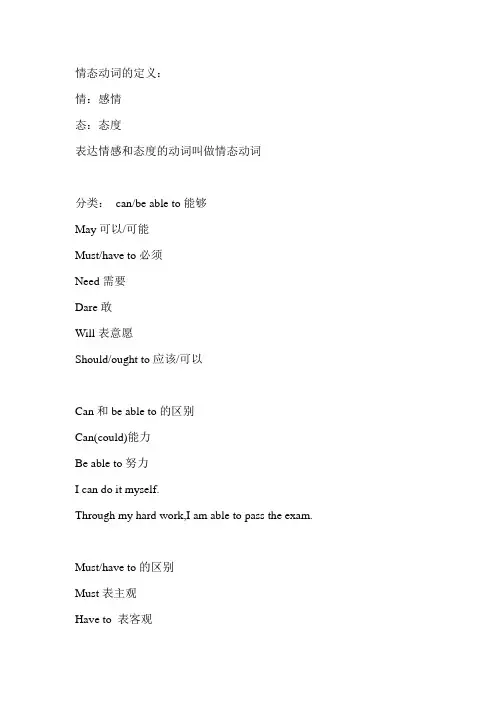
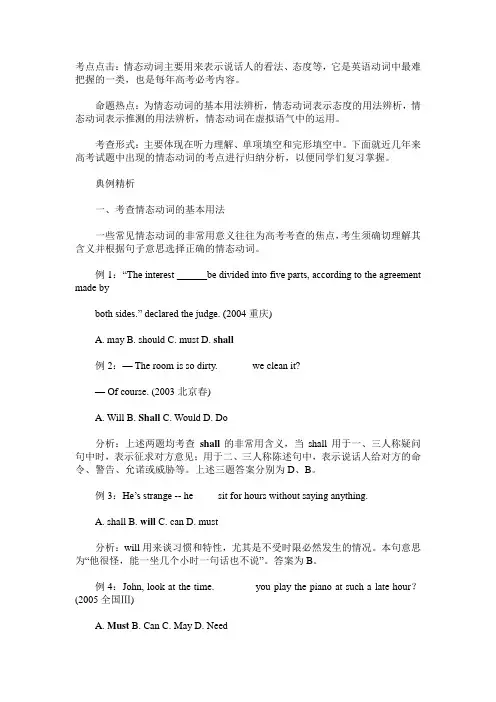
2 高考情态动词重点讲解
一、 情态动词的特征和形式
A. 情态动词表推测
1. 形式
肯定的推测:must
否定的推测:can’t couldn’t
可能的推测:may might can could
疑问的推测:can could
2. 时间
对过去:情态动词+完成式(have done\have been done)
对正在进行:情态动词+be doing
对现在或将来:情态动词+do
不同的“肯定”程度可按下列层次排列:
He is at home. (事实)
He must be at home.(非常肯定的推断)
He could be at home.(很可能)
He ought to be at home.(很可能)
He may be at home.(仅仅可能而已)
He might be at home.(或许, 非常不确定)
He might not be at home.(也许不在家)
He may not be at home. (比might可能)
He couldn’t be at home.(很可能不在家)
He can’t be at home.(一定不在家)
He isn't at home.(事实)
B.情态动词除ought to, used to等外,后面只接不带to的不定式。
1.情态动词+do
You shouldn't be so careless. 你不该这样粗心大意。
Jessica told him yesterday she might not go on the trip.
杰西卡昨天告诉他,她可能不去旅行了。
Difficulties can and must be overcome. 困难能够而且必须克服。
2.情态动词+be doing
She must be listening to pop music. 她肯定在听流行音乐
You should be reviewing your lessons. 你应该在复习功课
My mother maymight be cooking now. 妈可能正在做饭。
3.情态动词+have done
They might have visited the Great Wall. 他们可能参观过长城了。
He must have got up very early to catch the train. 他一定起得很早去赶火车了。
You ought to have come earlier. 你本该早一点儿来。 4.情态动词+be done
This word can also be used as a verb. 这个词也可以用作动词。
Something must be done to stop pollution. 必须采取措施来制止污染。
The work ought to have been finished long ago. 这工作早就该完成了。
C. 情态动词第三人称单数一般现在时没有词形变化。
You ought to wear a raincoat. 你应该穿件雨衣。
She ought to wear a raincoat. 她应该穿件雨衣。
Plants must have oxygen in order to live. 为了存活植物必须有氧气。
A plant must have oxygen in order to live. 为了存活植物必须有氧气。
D. 情态动词的时态并不是区分时间的主要标志。在一些场合中,情态动词的现在式和过去式都可以表示现在时间、过去时间或将来时间。
I'm afraid it might rain tonight. 我看今晚可能要下雨。
Could I borrow your thermos?我可以借用你的暖水吗?
It's a nice day today. We could go for a walk. 今天天气不错,我们可以出去散散步。
E. 情态动词是互相排斥的,一般不允许两个意义相近的情态动词连用。
【误】Soldiers must have to obey orders.
【正】Soldiers have to obey orders. 军人必须服从命令
【正】Soldiers must obey orders. 军人必须服从命令。
【误】Can I be able to borrow two books at a time?
【正】Can I borrow two books at a time? 我能一次借两本
【正】Will I be able to borrow two books at a time ?
我能一次借两本书吗?
二、 情态动词的意义和用法
A. may和might
1.表示请求、许可,常译为“可以”。
在口语中可用can, could代替may,但在正式场合用may。表示允许时,也可用might代替,might不表示过去时,而是表示口气比较婉转。
You may take this seat if you like. 如果你喜欢可以坐这个位置。
May/Can /Could/ Might I have a talk with you ? 我可以和你谈谈吗?
--- May/Might I come into the room to see my mother? 我可以进房间看我母亲吗?