IGMP协议
- 格式:pdf
- 大小:261.63 KB
- 文档页数:9
IGMP
协议概述
TheInternetGroupManagementProtocol(IGMP)isanetwork‑layerprotocolusedbyhostsandad‑
jacentroutersonanInternetProtocol(IP)networktoreporttheirmulticastgroupmemberships.It
isanessentialcomponentofIPmulticast,whichenablesefficientdeliveryofdatatomultiplehosts
simultaneously.
Background
IntraditionalIPnetworks,datapacketsaretypicallysenttoaunicastaddress,whichmeanstheyare
deliveredtoaspecificdestinationhost.However,inscenarioswheredataneedstobesenttomultiple
recipientssimultaneously,suchasmultimediastreamingorreal‑timecollaborationapplications,the
unicastapproachbecomesinefficientandresource‑consuming.Thisiswheremulticastcomesinto
play.
WhatisMulticast?
Multicastisacommunicationmethodthatallowsasinglesendertotransmitdatapacketstoagroup
ofreceivers.Insteadofsendingseparatecopiesofthedatatoeachreceiver,thesendermulticaststhe
dataonce,anditisthenreplicatedanddeliveredonlytothemembersofthemulticastgroupwho
haveexpressedinterestinreceivingthedata.
RoleofIGMP
IGMPplaysacrucialroleinenablinghoststojoinandleavemulticastgroupsdynamically.Itallows
routerstolearnwhichhostsareinterestedinreceivingmulticasttrafficforspecificgroupsandeffi‑
cientlyforwardthedataonlytothoseinterestedhosts.
HowIGMPWorks
1.HostJoinsaMulticastGroup:Whenahostwantstoreceivemulticasttrafficforaspecificgroup,
itsendsanIGMPjoinmessagetoitslocalrouter,indicatingitsinterestinjoiningthegroup.
2.RouterMembershipQuery:RoutersperiodicallysendIGMPmembershipqueriesonthenetwork
todiscoverwhichhostsbelongtomulticastgroups.ThesequerieselicitIGMPmembershipre‑
portsfromthehosts.1
3.HostMembershipReports:Uponreceivingaquery,hostsrespondwithIGMPmembershipre‑
ports,indicatingthemulticastgroupstheyareinterestedin.
4.RouterForwarding:Routersmaintainalistofactivemulticastgroupsandtheirassociatedhosts.
Theyusethisinformationtoforwardmulticasttrafficonlytothehoststhathavejoinedthere‑
spectivegroups.
BenefitsandApplications
IGMPenablesefficientdistributionofmulticasttraffic,reducingnetworkcongestionandbandwidth
consumption.Itfindsapplicationsinvariousscenarios,including:
•VideostreamingandIPTV
•Onlinegamingandinteractiveapplications
•Software‑definednetworking(SDN)
•Contentdeliverynetworks(CDNs)
•Collaborativetoolsandvirtualclassrooms
SecurityandLimitations
WhileIGMPfacilitatesmulticastcommunication,it
’simportanttoconsidersecurityaspectsandim‑
plementappropriatemeasurestopreventunauthorizedaccessormaliciousactivities.Additionally,
IGMPhassomelimitations,suchasscalabilitychallengesinlargenetworksandpotentialissueswith
routerperformanceunderheavymulticasttraffic.
Inconclusion,IGMPisacriticalprotocolformanagingmulticastgroupmembershipsinIPnetworks.
Byallowinghoststojoinandleavemulticastgroupsdynamically,IGMPenablesefficientandscalable
deliveryofmulticasttraffic,cateringtovariousapplicationsandimprovingnetworkperformance.
IGMP
协议的工作原理
IGMP
(InternetGroupManagementProtocol
)是一种网络层协议,用于在Internet
协议(IP
)网络上的主机
和相邻路由器之间报告它们的组播组成员关系。IGMP
协议是IP
组播的重要组成部分,能够实现将数据有效地同时传
输给多个主机。2
背景
在传统的IP
网络中,数据包通常被发送到单播地址,也就是只传输给特定的目标主机。然而,在需要将数据同时发送给
多个接收方的场景下(比如多媒体流媒体或实时协作应用),单播方式变得低效且资源消耗大。这时就需要使用组播。
什么是组播
组播是一种通信方法,允许一个发送方将数据包发送给一组接收方。发送方只需发送一次数据,数据会被复制并仅传输
给对该组播组表达了兴趣的成员。
IGMP
的作用
IGMP
在使主机能够动态加入和离开组播组方面起着关键作用。它允许路由器了解哪些主机对特定组播组的数据感兴
趣,并仅将数据转发给那些感兴趣的主机。
IGMP
的工作原理
1.
主机加入组播组:当主机希望接收特定组播组的数据时,它向本地路由器发送一个IGMP
加入消息,表示它希望
加入该组。
2.
路由器成员查询:路由器定期在网络上发送IGMP
成员查询,以发现哪些主机属于组播组。这些查询将引发主机
发送IGMP
成员报告。
3.
主机成员报告:在收到查询后,主机会回复一个IGMP
成员报告,指示它们感兴趣的组播组。
4.
路由器转发:路由器维护一个活动组播组列表及其关联的主机信息。它们使用这些信息仅将组播流量转发给已加
入相应组的主机。
相关应用及好处
IGMP
能够实现组播流量的高效分发,减少网络拥塞和带宽消耗。它在多种场景中得到应用,包括:
•
视频流媒体和IPTV
•
在线游戏和互动应用
•
软件定义网络(SDN
)
•
内容分发网络(CDN
)
•
协作工具和虚拟教室3
安全性和限制
尽管IGMP
促进了组播通信,但需要考虑安全性,并采取适当的措施防止未经授权的访问或恶意活动。此外,IGMP
也
有一些限制,例如在大型网络中的可扩展性挑战以及在大量组播流量下可能影响路由器性能的问题。
总结起来,IGMP
是在IP
网络中管理组播组成员关系的重要协议。通过允许主机动态加入和离开组播组,IGMP
实现
了组播流量的高效传输,适用于各种应用,并提高了网络性能。
IGMP
协议的消息格式
IGMP
(InternetGroupManagementProtocol
)使用不同类型的消息来支持组播组成员的管理和通信。这些消息
在主机和路由器之间传递,以实现加入组播组、离开组播组和查询组播成员等功能。下面是IGMP
协议中常见的消息格
式:
IGMP
查询消息格式
IGMP
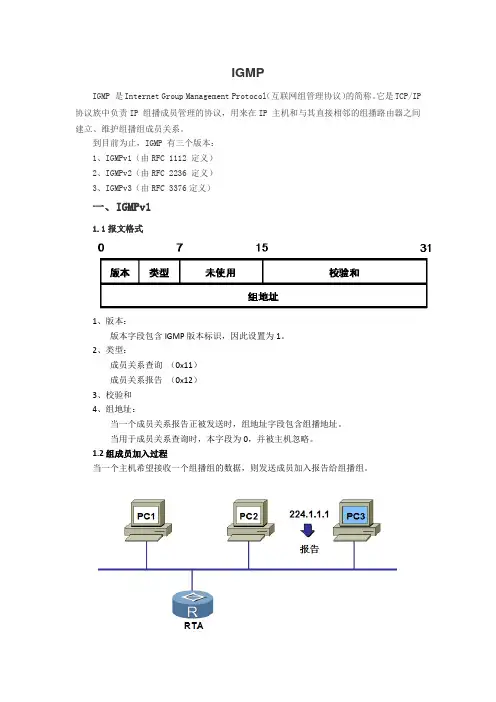
查询消息由路由器发送到本地网络上的主机,以了解哪些主机属于特定的组播组。查询消息的格式如下:10123
201234567890123456789012345678901
3+-+-+-+-+-+-+-+-+-+-+-+-+-+-+-+-+-+-+-+-+-+-+-+-+-+-+-+-+-+-+-+-+
4|Type=0x11|MaxRespTime|Checksum|
5+-+-+-+-+-+-+-+-+-+-+-+-+-+-+-+-+-+-+-+-+-+-+-+-+-+-+-+-+-+-+-+-+
6|GroupAddress|
7+-+-+-+-+-+-+-+-+-+-+-+-+-+-+-+-+-+-+-+-+-+-+-+-+-+-+-+-+-+-+-+-+
•Type
(类型):指示消息类型,查询消息的类型为0x11
。
•MaxRespTime
(最大响应时间):指示主机在收到查询后的最大响应时间,以毫秒为单位。
•Checksum
(校验和):用于校验消息的完整性。
•GroupAddress
(组播组地址):指示查询消息的目标组播组地址。
IGMP
成员报告消息格式IGMP成员报告消息由主机发送给路由器,以表明它们对特定组播组的兴趣。成员报告消息的格式如下:
10123
201234567890123456789012345678901
3+-+-+-+-+-+-+-+-+-+-+-+-+-+-+-+-+-+-+-+-+-+-+-+-+-+-+-+-+-+-+-+-+
4|Type=0x16|Reserved|Checksum
|
5+-+-+-+-+-+-+-+-+-+-+-+-+-+-+-+-+-+-+-+-+-+-+-+-+-+-+-+-+-+-+-+-+
6|GroupAddress|
4