
初中英语语法专题复习:被动语态
- 格式:pptx
- 大小:131.99 KB
- 文档页数:33


1 / 13
初中英语语法被动语态专练(附习题和答案)1被动语态中谓语动词的基本构成:
be + done
2八种时态的被动语态:(变be的时态即可,done不动)
1)一般现在时:am / is / are + done
①People grow rice in the south of the country.
Rice is grown in the south of the country.
②The school doesn't allow us to enter the chemistry lab without a teacher.We
are not allowed to enter the chemistry lab without a teacher.
2)一般过去时:was / were + done
①They agreed on the building of a new car factory last month.
The building of a new car factory was agreed on last month.
②The students didn't forget his lessons easily.
His lessons were not easily forgotten
3)一般将来时:will + be done
①They will send cars abroad by sea.
Cars will be sent abroad by sea.
②They will give plenty of jobs to school-leavers.
Plenty of jobs will be given to school-leavers.
4)一般过去将来时:would + be done
①The manager said they would complete the project by the end of the

初中英语语法——被动语态
(1)被动语态定义:被动语态是动词的一种特殊形式,用来说明主语与谓语动词之间的关系。如果主语是 动作的执行者(即某人做某事),便叫主动语态;如果主语是动作的承受者(即某事被做),便叫被动语态。主动与被动的区别不是词序的区别,而是主语与谓语意义上的区别。在英语中只有及物动词和一些相当于及物动词的词组才有被动语态的形式。
(2)英语中被动语态由“助动词be +动词的过去分词”构成。助动词be有时态、人称和数的变化。被动语态后的by短语有时可省去。具体结构见下表:
现在时态 一般现在时 现在进行时 一 般 将 来 时 现在完成时
谓语动词构 成 am
is +p.p.
are am
is
+being+p.p.
are will + be+p.p.
am
is +going to+ be +
p.p.
are have(has)
+been+p.p.
过去时态 一般过去时 过 去 进 行 时 过 去 将 来 时 过去完成时
谓语动词构 成 was
+p.p.
were was
+being+p.p.
were would +be+p.p.
was +going
to+be+p.p.
were had
+been+p.p.
[注] p.p.表示过去分词。
(1) 被动语态的用法:
① 不知道谁是动作的执行者(即不知道谁做)时用被动语态,省略by短语。如:A man was killed
in the accident.(一个人死于事故)/ This window was broken yesterday.(这扇窗子是昨天被打破的)
②不说或者众所周知是谁做时,用被动语态,省略by短语。如:Rice is also grown in this place.(这个地方也种水稻)/ A railroad will be built here in three years.(三年之后这里将要修建一条铁路)
1 初中英语语法:被动语态
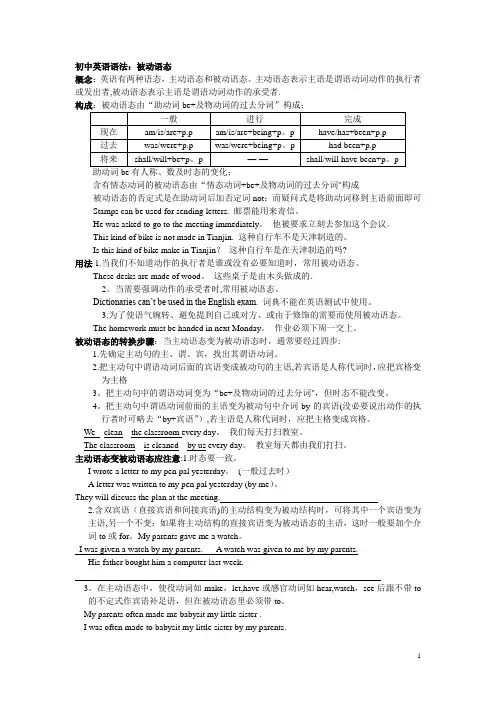
概念:英语有两种语态,主动语态和被动语态。主动语态表示主语是谓语动词动作的执行者或发出者,被动语态表示主语是谓语动词动作的承受者.
构成:被动语态由“助动词be+及物动词的过去分词”构成;
一般 进行 完成
现在 am/is/are+p.p am/is/are+being+p。p have/has+been+p.p
过去 was/were+p.p was/were+being+p。p had been+p.p
将来 shall/will+be+p。p ---—-—- shall/will have been+p。p
助动词be有人称、数及时态的变化;
含有情态动词的被动语态由“情态动词+be+及物动词的过去分词"构成
被动语态的否定式是在助动词后加否定词not;而疑问式是将助动词移到主语前面即可
Stamps can be used for sending letters.
邮票能用来寄信。
He was asked to go to the meeting immediately。 他被要求立刻去参加这个会议。
This kind of bike is not made in Tianjin. 这种自行车不是天津制造的。
Is this kind of bike make in Tianjin? 这种自行车是在天津制造的吗?
用法1.当我们不知道动作的执行者是谁或没有必要知道时,常用被动语态。
These desks are made of wood。 这些桌子是由木头做成的.
2。当需要强调动作的承受者时,常用被动语态。
Dictionaries can’t be used in the English exam. 词典不能在英语测试中使用。
3.为了使语气婉转、避免提到自己或对方、或由于修饰的需要而使用被动语态。
The homework must be handed in next Monday。 作业必须下周一交上。

动词的被动语态
【用法讲解】
考试要求:
中考要求掌握:动词的主动语态和被动语态区别与使用,不同时态的被动语态形式及情态动词的被动语态形式。英语动词有两种语态:主动语态和被动语态,主动语态表示句子的主语是谓语动作的执行者;被动语态是表示句子的主语是谓语动作的承受者。
如:We often clean the blackboard.(我们是擦黑板的执行者即主动语态)
The blackboard is often cleaned by us. (黑板是clean的承受者即被动语态)。
1. 被动语态的结构
一般现在时:am / is / are + 及物动词的过去分词
一般过去时:was / were + 及物动词的过去分词
一般将来时:will / shall be + 及物动词的过去分词
现在完成时:have / has been + 及物动词的过去分词
现在进行时:am / is / are being + 及物动词的过去分词
过去完成时:had been + 及物动词的过去分词
如:You are wanted on the phone. 有你的电话。
China was liberated in 1949. 1949年中国解放。
The problem will be discussed tomorrow.
明天将对这个问题进行讨论。
Not a book in the library has been taken away.
图书馆里没有一本书被人拿走。
My bike is being repaired.我的自行车正在修理。
The book had been borrowed when I got to the library.
我到了图书馆时,那本书已经借出去了。
2. 主动语态与被动语态的转换
(1)把主动语态的宾语变为被动语态的主语。