
国际贸易学(英)第1章 Introduction to International Trade
- 格式:ppt
- 大小:515.50 KB
- 文档页数:13


Unit 1 A brief introduction to international trade KeyI. Answer my questions1. International trade is business whose activities involve the crossing of national borders. It includes not only international trade and foreign manufacturing but also encompasses the growing services industry in areas such as transportation, tourism, banking, advertising, construction, retailing, wholesaling, and mass communications. It includes all business transactions that involve two or more countries. Such business relationship may be private or governmental.2. Sales expansion, resource acquisition anddiversification of sales and supplies.3. To gain profit.4. To seek out foreign markets and procurement.5. There are four major forms as follows: Merchandise exports and Imports, Service Exports andImports, Investment, and Multinational Enterprise.6. It is the account which is a summary statement of the flow of all international economic and financial transactions between one nation (eg.the United States ) and the rest of the world over some period of time, usually one year.7. Merchandise Exporting and Importing.8. Yes. There are great differences between them.1) direct investment takes place when control follows the investment. It usually means high commitment of capital, personnel, and technology abroad. It aims at gaining of foreign resources and foreign markets. Direct investment may often get higher foreign sales than exporting. And sometimes it involves two or more parties.2) While portfolio investments are not under control. And they are used primarily for financial purposes. Treasures of companies, for example, routinely more funds from one country to another to get a higher yield on short term investments.9. MNE is the abbreviation of the multinational enterprise. Its synonyms are NNC (the multinational corporation) and TNC (transnational corporation).10. Examples are travel, transport, fee, royalties, dividends and interest.11. The choice of forms is influenced by the objective being pursued and the environments in which the company must operate.12. It is limited by the number of people interested ina firm’s products and services and by customers’ capacity to make purchase.13. This is because at an early stage of international involvement these operations usually take the least commitment and least risk of a firm’s resources.14. Royalties means the payment for use of assets from abroad, such as for trademarks patens, copyrights, or other expertise under contract known as licencing agreements.Royalties are also paid franchising.15. It is a way of doing business in which one party (the franchiser) the use of a trademark that is an essential asset for the franchisers’ business.II Match each one on the left with its correct meaning on the right1. J2.A3.E4.B5.C6.D7.I8.G9.F 10.HIII Translate the following terms and phrases into Chinese1 购买力11经济复苏;恢复2潜在销售量12 经济衰退3加价,涨价13间接投资4国内市场14有形货物5制成品15有形进出口6边际利润16收入及支出;岁入及岁出7市场占有率17超额能力8贸易歧视18贸易中间人(商);经纪人9时机选择19全部包建的工程承包方式10经销周期20许可证协定IV Case Study1 [Answer]:Batteries called "white elephant" exported from China were very popular in Southeast Asia, because "white elephant" was a lucky thing in Southeast Asia, but no one was interested in it in the market of Europe and the United States. The boss of the company was very strange that the quality of the battery or the price of。
国际贸易第1章(经济全球化英文版)International Trade Chapter I. Globalization LEARNING OBJECTIVES After you have read this chapter you should: LO1 Understand what is meant by the term globalization. LO2 Be familiar with the main drivers of globalization. LO3 Appreciate the changing nature of the global economy. LO4 Understand the main arguments in the debate over the impact of globalization. LO5 Appreciate have the process of globalization is creating opportunities and challenges far business managers. Flat Panel Televisions and the Global Economy They begin as glass panels that are manufactured in high-technology fabrication centers in South Korea, Taiwan, and Japan.Operating sophisticated tooling in environments that must be kept absolutely clean, these factories produce sheets of glass twice as large as king size beds to exacting specifications. From there, the glass panels travel to Mexican plants located alongside the border. There they are cut to size, combined with electronic components shipped in from Asia and the United States, assembled into finished TVs, and loaded onto trucks bound for retail stores in the United States. It’s a huge business. In 2006, consumers spent some $ billion on flat panel TVs, a 63 percent increase over the amount spent in 2005. Projections call for sales to hit $37 billion by 2008-despite the fact that due to intense competition, prices for flat panel displays have been tumbling and are projected to continue doing so. During 2006 alone, prices for 40-inch flat panel TVs fell from $3,000 to $1,600, bringingthem within the reach of many more consumers. In 200? half of all TVs sold in the United States will be flat panel TVs. The underlying technology for flat panel displays was invented in the United States in the late 1960s by RCA. But after RCA and rivals Westinghouse and Xerox opted not to pursue the technology, the Japanese company Sharp made aggressive investments in flat panel displays. By the early 1990s Sharp was selling the first flat panel screens, but as the Japanese economy plunged into a decade-long recession, investment leadership shifted to South Korean companies such as Samsung. Then the 1997 Asian crisis hit Korea hard, and Taiwanese companies seized leadership. Today, Chinese companies are starting to elbow their way into the flat panel display manufacturing business. As production for flat panel displays migrates its way around the globe tolow-cost locations, clear winners and losers have emerged. One obvious winner has been U. S. consumers, who have benefited from the falling prices of flat panel TVs and are snapping them up Other winners include efficient manufacturers who have taken advantage of globally dispersed supply chains to make and sell low-cost, high-quality flat panel TVs. Foremost among these has been the California-based company, Vizio. Founded by a Taiwanese immigrant, in just four years sales of Vizio flat panel TVs ballooned from nothing to $700 million in 2006. The company is forecasting sales as high as $2 billion for 2007. Vizio, however, has only 75 employees. These employees focus on final product design, sales. and customer service, while Vizio outsources most of its engineering work, all of its manufacturing, and much of its logistics. For each of its models, Vizio assembles ateam of supplier partners strung across the globe. Its 42-inch flat panel TV, for example, contains a panel from South Korea, electronic components from China, and processors from the United States, and it is assembled in Mexico. Vizio’s managers scour the globe continually for the cheapest manufacturers of flat panel displays and electronic components. They sell most of their TVs to large discount retailers such as Costco and Sam’s Clu b. Good order visibility from retailers, coupled with tight management of global logistics, allows Vizio to turn over its inventory every three weeks, twice as fast as many of its competitors which is a major source of cost saving in a business where prices are falling continually. If Vizio exemplifies the winners in this global industry, the losers include the employees of manufacturers who make traditional cathode ray TVs in high-costlocations. In 2006, for example, Japanese electronics manufacturer Sanyo laid off 300 employees at its factory, and another Japanese company, Hitachi, closed its TV manufacturing plant in South Carolina, laying off 200 employees. Both Sony and Hitachi, of course, still make TVs, but they are flat panel TVs assembled in Mexico from components manufactured in Asia. Introduction A fundamental shift is occurring, in the world economy. We are moving away from a world in which national economies were relatively self-contained entities, isolated from each other by barriers to cross-border trade and investment; by distance, time zones, and language; ard by national differences in government regulation, culture, and business systems. And we are moving toward a world in which harriers to cross-border trade and investment are declining; perceived distance is shrinking,due to advances in transportation and telecommunications technology; material culture is starting to look similar the world over; and national economies are merging into an interdependent, integrated global economic system. The process by which this is occurring is commonly referred to as globalization. What is happening, in the fiat panel TV Industry, which was profiled in the Opening Case, is a classic illustration of the impact of globalization. Production of flat panel TVs is migrating around the globe to low-cost locations. TVs that Vizio sells in the United States, for example, ale assembled in Mexico from flat panels manufactured in South Korea, electronic components made in China, and microprocessors made in the United States. By dispersing different activities around the globe to where they can be performed most efficiently, and then coordinating, the entire productionprocess, companies like Vizio can deliver flat panel TVs to American consumers at much lower prices than would otherwise be possible. American consumers benefit from the lower price, as doe; Vizio and its strategic partners in South Korea, China, the United States. and Mexico. The process of globalization also has losers, however, and the losers in this case are workers in high cost locations who have lost their jobs. As we will see in this bookwhether globalization benefits or harms national economies. We will look at what economic theory has to say about the outsourcing of manufacturing and service jobs to places such as India and China and at the benefits and costs of outsourcing, not just to business firms and their employees, but also to entire economies. First, though, weneed to get a better overview of the nature and process o f globalization, and that is the function of the current chapter. What Is Globalization? As used in this book, globalization refers to the shift toward a more integrated and interdependent world economy. Globalization has several facets, including the globalization of markets and the globalization of production. THE GLOBALIZATION OF MARKETS The globalization of markets refers to the merging of historically distinct and separate national markets into one huge global marketplace. Falling barriers to cross-border trade have made it easier to sell internationally. It has been argued for some time that the tastes and preferences o f consumers in different nations are beginning to converge on some global norm, thereby helping to create a global market. Consumer products such asCitigroup credit cards, Coca-Cola soft drinks. Sony PlayStation video games, McDonald’s hamburgers, Starbucks coffee, and IKEA furniture are frequently identified as prototypical examples of this trend. Firms such as these are more than just benefactors of this trend: they are also facilitators of it. By offering the same basic product worldwide, they help to create a global market. A company does not have to be the size of these multinational giants to facilitate and benefit from the globalization of markets. In the United States, for example, nearly 90 percent of firms that export are small businesses employing less than 100 people, and their share of total US exports has grown steadily over the last decade to now exceed 20 percent. Firms with less than 500 employees accounted for 97 percent of all US exporters and almost 30 percent of all exports by value. Typical of these isHytech, a New York based manufacturer of solar panels that generates 40 percent of its $3 million in annual sales from exports to five countries, or B&S Aircraft Alloys, another New York company whose exports account for 40 percent of its $8 million annual revenues. The situation is similar in several other nations. In Germany, for example, which is the world’s largest exporter, a staggering 98 percent of small and mid-sized companies have exposure to international markets, either via exports or international production. Despite the global prevalence of Citigroup credit cards, McDonald’s hamburgers, Starbucks coffee, and IKEA stores, it is important not to push too far the view that national markets are giving way to the global market. As we shall see in later chapters, significant differences still exist among national markets along many relevant dimensions, including consumertastes and preferences, distribution channels, culturally embedded value systems, business systems, and legal regulations. These differences frequently require companies to customize marketing strategies, product features, and operating practices to best match conditions in a particular country. The most global markets currently are not markets for consumer products-where national differences in tastes and preferences are still often important enough to act as a brake on globalization-but markets for industrial goods and materials that serve a universal need the world over. These include the markets for commodities such as aluminum, oil, and wheat. For industrial products such as microprocessors, DRAMs(computer memory chips), and commercial jet aircraft, for computer software, and for financial assets from US. Treasury bills toEurobonds and futures and futures on the Nikkei index or the Mexican peso. In many global markets, the same firms frequently confront each other as competitors in nation after nation. Coca-Coca’s rivalry with PepsiCo is a global one, as are the rivalries between General Motors and Toyota, Boeing and Airbus, Caterpillar and Komatsu in earthmoving equipment, and Sony, Nintendo, and Microsoft in video games. If a film moves into a nation not currently serves by its rivals, many of those rivals are sure to follow to prevent their competitor from gaining an advantage. As firms follow each other around the world, they bring with them many of the assets that served them well in other national markets-including their products, operating strategies, marketing strategies, and brand names-creating some homogeneity acrossmarkets. Thus, greater uniformity replaces diversity. In an increasing number of industries, it is no longer meaningful to talk about the German market, the American market the Brazilian market, or the Japanese market, for many firms there is only the global market. THE GLOBALIZATION OF PRODUCTION The globalization of production refers to the sourcing of goods and services from locations around the globe to take advantage of national differences in the cost and quality of factors of production (such as labor, energy, land, and capital). By doing this, companies hope to lower their overall cost structure or improve the quality or functionality of their product offering, thereby allowing them to compete more effectively. Consider the Boeing 777, a commercial jet airliner. Eight Japanese suppliers make parts for the fuselage, doors and wings, a supplier inSingapore makes the doors for the nose landing gear, three suppliers in Italy manufacture wing flaps, and so on. In total, some 30 percent of the 777, by value, is built by foreign companies. For its most recent jet airliner, the 787 Boeing has pushed this trend even further, with some 65 percent of the total value of the aircraft scheduled to be outsourced to foreign companies, 35percent of which will go to three major Japanese companies. Part of Boeing’s rationale for outsourcing so much production to foreign suppliers is that these suppliers are the best in the world at their particular activity. A global web of suppliers yields a better final product, which enhances the chances of Boeing winning a greater share of total orders for aircraft than its global rival Airbus Industries. Boeing also outsources some production to foreign countries to increase the chance that it will winsignificant orders from airline based in that country. For another example of a global web of activities, consideragain the example of Vizio given in the Opening Case. Vizio, an American company with just 75 employees, has become one of the largest sellers of flat panel TVs in the United States in just four years by coordinating a global web of activities, bringing together components manufactured in South Korea, China and the United States, arranging for their assembly in Mexico, and then selling them in the United States. Early outsourcing efforts were primarily confined to manufacturing activities, such as those undertaken by Boeing and Vizio, increasingly, however, companies are taking advantage of modern communications technology, particularly the Internet, to outsource service activitiesto low-cost producers in other nations. Many software companies, including IBM, now use Indian engineers to perform maintenance functions on software designed in the United States. The time difference allows Indian engineers to run debugging tests on software written in the United States when US engineers sleep, and the corrected code is transmitted back to the United States over secure Internet connections so it is ready for us engineers to work on the following day. Dispersing value-creation activities in this way can compress the time and lower the costs required to develop new software programs. Other companies, from computer makes to banks, are outsourcing customer service functions, such as customer call centers, to developing nations where labor is cheaper. Robert Reich, who served as secretary of labor in the Clinton administration, hasargued that as a consequence of the trend exemplified by companies such as Boeing, IBM, and Vizio, in many cases it is becoming irrelevant to talk about American products, Japanese products, German products, or Korean products. Increasingly, according to Reich, outsourcing productive activities to different suppliers’results in the creation of products that are global in nature, that is global products, but as with the globalization of markers, companies must be careful not to push the globalization of production too far. As we will see in later chapters, substantial impediments still make it difficult for firms to achieve the optimal dispersion of their productive activities to locations around the globe. These impediments include formal and informal barriers to trade between countries, barriers to foreign direct investment, transportation costs, and issuesassociated with economic and political risk. For example, government regulations ultimately limit the ability of hospitals to outsource the process of interpreting MRI scans to developing nations where radiologists are cheaper.Nevertheless, the globalization of markets and production will continue. Modern firms are important actors in this trend, their very actions fostering increased globalization. These firms, however, are merely responding in an efficient manner to changing conditions in their operating environment-as well they should. The Emergence of Global Institutions As markets globalize and an increasing proportion of business activity transcends national borders, institutions are needed to help manage, regulate, and police the global marketplace and to promote the establishment of multinational treaties to govern the global business system. Overthe past half century, a number of important global institutions have been created to help perform these functions, including the General Agreement on Tariffs and Trade(GATT) and its successor, the World Trade Organization(WTO),the International Monetary Fund(IMF) and its sister institution, the World Bank and the United Nations. All these institutions were created by voluntary agreement between individual nation-states, and their functions are enshrined in international treaties. The World Trade Organization(like the GATT before it) is primarily responsible for policing the world trading system and making sure nation-states adhere to the rules laid down in trade treaties signed by WTO member states. As of 2007,150 nations that collectively accounted for 97 percent of world trade were WTO members, therebygiving the organization enormous scope and influence. The WTO is also responsible for facilitating the establishment of additional multinational agreements between WTO member states. Over its entire history, and that of the GATT before it, the WTO has promoted lowering barriers to cross-border trade and investment. In doing so, the WTO has been the instrument of its member states, which have sought to create a more open global business system unencumbered by barriers to trade and investment between countries. Without an institution such as the WTO, the globalization of markets and production is unlikely to have proceeded as far as it has. However, as we shall see in this chapter and in Chapter 6 when we look closely at the WTO, critics charge that the organization is usurping the national sovereignty of individual nation-states. The InternationalMonetary Fund and the World Bank were both created in 1944 by 44 nations that met at Bretton Woods, New Hampshire. The IMF was established to maintain order in the international monetary system; the World Bank was set up to promote economic development. In the 65 years since their creation, both institutions have emerged as significant players in the global economy. The World Bank is the less controversial of the two sister institutions. It has focused on making low-interest loans to cash-strapped governments in poor nations that wish to undertake significant infrastructure investments (such as building dams or roads). The IMF is often seen as the lender of last resort to nation-states whose economic are in turmoil and currencies are losing value against those of other nations. Repeatedly during the past decade, for example, the IMF has lent money to thegovernments of troubled states, including Argentina, Indonesia, Mexico, Russia, South Korea, Thailand, and Turkey. IMF loans come with strings attached, however, in return for loans, the IMF requires nation-states to adopt specific economic policies at returning their troubled economies to stability and growth. These requirements have sparked controversy. Some critics charge that the IMF’s policy recommendations are often inappropriate, others maintain that by telling national governments what economic policies they must adopt the IMF, like the WTO, is usurping the sovereignty of nation-states. We shall look at the debate over the role of the IMF in Chapter 10. The United Nations was established October 24 1945 by 51 countries committed to preserving peace through international cooperation and collective security. Today nearly every nation in theinternational phone call is rapidly plummeting toward just a few cents per minute. The Internet and World Wide Web The rapid growth of the World Wide Web is the latest expression of this development. In 1990, fewer than 1 million users were connected to the Internet. By 1995, the figure had risen to 50 million. By 2006, the Internet had 747 million users. The WWW has developed into the information backbone of the global economy. In the alone, some $250 billion of goods and services are expected to be sold online to retail customers in 2007, up from almost nothing in 1997. Viewed globally, the Web is emerging as an equalizer. It rolls back some of the constraints of location scale, and time zones. The Web makes it mucheasier for buyers and sellers to find each other, wherever they may be located global presence at a lower cost than ever before. Transportation technology In addition to developments in communication technology, several major innovations in transportation technology have occurred since World War Ⅱ. In economic terms, the most important are probably the development of commercial jet aircraft and super freighters and introduction of containerization, which simplifies transshipment from one mode of transport to another. The advent of commercial jet travel, by reducing the time needed to get from one location to another, has effectively shrunk the globe. In terms of travel time, New York is now “closer” to Tokyo than it was to Philadelphia in the Colonial days. Containerization has revolutionized the transportation business, significantly lowering the cost of shippinggoods over long distances. Before the advent of containerization, moving goods from one mode of transport to another was vary labor intensive, lengthy, and costly. It could take days and several hundred longshoremen to unload a ship and reload goods onto trucks and trains. With the advent of widespread containerization in the 1970s and 1980s, the whole process can now be executed by a handful of longshoremen in a couple of days. Since 1980, the world’s containership fleet has more than quadrupled, reflecting in part the growing volume of international trade and in part the switch to this mode of transportation. As a result of the efficiency gains associated with containerization, transportation costs have plummeted, making it much more economical to ship goods around the globe, thereby helping to drive the globalization of markets and productions. Between 1920 and 1990, theaverage ocean freight and port charges per ton of export and import cargo fell from $95 to $29(in 1990 dollar). The cost of shipping freight per ton-mile on railroads in the United State fell from cents in 1985 to cents in 2000, largely as a result of efficiency gains from the widespread use of containers. An increased share of cargo now goes by air. Between 1955 and 1999, average air transportation revenue per ton-kilometer fell by more than 80 percent. Reflecting the falling cost of airfreight, by the early 2000s air shipments accounted for 28 percent of the value of trade, up from 7 percent in 1965. Implications for the Globalization of Production As transportation costs associated with the globalization of production declined, dispersal of production to geographically separate locations become more economical. As a result of the technological innovationsdiscussed above, the real costs of information processing and communication have fallen dramatically in the past two decades. These developments make it possible for a firm to create and then manage a globally dispersed production system, further facilitating the globalization of production. A worldwide communications network has become essential for many international businesses. For example, Dell uses the Internet to coordinate and control a globally dispersed production system to such an extent that it holds only three days’worth of inventory at its assembly location. Dell’s Internet-based system records orders for computer equipment as they are submitted by customers via the company’s Web site, then immediately transmits the resulting orders for components to various suppliers around the world, which have a real-time look at Dell’s order flow and can adjusttheir production schedules accordingly. Given the low cost of airfreight, Dell can use air transportation to speed up the delivery of critical components to meet unanticipated demand shifts without delaying the shipment of final product to customers. Dell also has used modern communications technology to outsource its customer service operations to India. When customers call Dell with a service inquiry, they are routed to Bangalore in India, where English-speaking service personnel handle the call. The Internet has been a major force facilitating international trade in services. It is the Web that allows hospitals in Chicago to send MRI scans to India for analysis, accounting offices in San Francisco to outsource routine tax preparation work to accountants living in the Philippines, and software testers in India to debug code written by developers in Redmond,Washington, the headquarters of Microsoft. We are probably still in the early stages of this development. As Moore’s Law continues to advance and telecommunications bandwidth continues to increase, almost any work processes that can be digitalized will be, and this will allow that work to be performed wherever in the world it is most efficient and effective to do so. The development of commercial jet aircraft has also helped knit together the worldwide operations of many international businesses. Using jet travel, an American manager need spend a day at most traveling to his or her firm’s Europe or Asian operations. This enables the manager to oversee a globally dispersed production system. Implications for the Globalization of Markets In addition to the globalization of production, technological innovations have also facilitated theglobalization of markets. Low-cost global communications network such as the World Wide Web are helping to create electronic global marketplaces. As noted above, low-cost transportation has made shipping products around the world more economical, thereby helping to create global markets. For example, due to the tumbling costs of shipping goods by air, roses grown in Ecuador can be sold in New York two days later while they still fresh. This has given rise to an industry inEcuador that did not exist 20 years ago and that now supplies a global market for roses. In addition, low-cost jet travel has resulted in the mass movement of people between countries. This has reduced the cultural distance between countries and is bringing about some convergence of customer tastes and preferences. At the same time, globalcommunication networks and global media are creating a worldwide culture. Many countries now receive television networks such as CNN, MTV, and HBO, and Hollywood films are shown the world over. In any society, the media are primary conveyors of culture; as global media develop, we must expect the evolution of something akin to a global culture. A logical result of this evolution is the emergency of global markets for consumer products. The first signs of this are already apparent. It is now as easy to find a McDonald’s restaurant in Tokyo as it is in New York, to buy an iPod in Rio as it is in Berlin, and to buy Gap jeans in Paris as it is in San Francisco. Despite these trends, we must be careful not to overemphasize their importance. While modern communication and transportation technologies are ushering in the “global village,” significant national differencesremain in culture, customer preference, and business practices. A firm that ignores differences between countries does so at its peril. We shall stress this point repeatedly throughout this book and elaborate on it in later chapters. The Changing Demographics of the Global Economy Hand in hand with the trend toward globalization has been a fairly dramatic change in the demographics of the global economy over the past 30 years. As late as the 1960s, four trends described the demographics of the global economy. The first was dominance in the world economic and world trade picture. The second was dominance in world foreign direct investment. Related to this, the third fact was the dominance of large, multinational firms on the international business scene. The fourth was that roughly half the globe -the centrally planned economies of the。
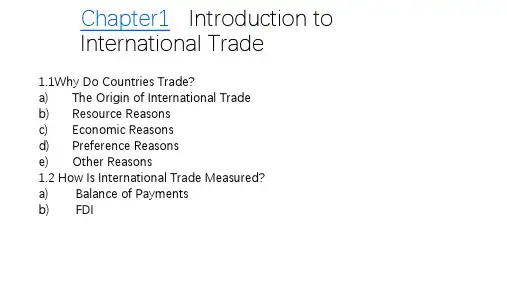
International Trade TheoriesChapter 1 Benefits of International TradeIn this chapter, we first explain the meaning of international trade, and then turn our attention to benefits from international trade.Definition of International TradeInternational trade, sometimes also called international business or simply foreign trade, occurs when a firm exports goods or services to consumers in another country. Nowadays when talking about international trade we do not just mean selling and buying goods on an international scale but also cross-border trade in services and carrying out of investment activities abroad.The Benefits or Gains from International TradeWhy do nations trade with each other? The answer is simple: Because we can receive benefits or make gains from it.Now let’s have a look at the chief benefits from international trade.(1) Helping to raise the living standards of the peopleTake the United States. A great deal of its high standard of living depends on international trade. Without international trade the United States cannot become a kingdom of automobiles because most of its oil is imported from abroad. Without international trade the United States can not have enough tin, tungsten and chromium for certain industrial process because the United States has no deposits of them. Remember no country is able to produce everything it needs. That is an important reason for trade.(2) Helping to upgrade a country’s modernizationForeign trade can help a nation make money in the form of foreign exchange which can be used to finance its purchases of high technology needed for upgrading its modernization and speeding up its industrialization process.(3) Helping to solve a country’s shortage of capitalA lot of world’s enterprises, esp. those of the developing nations, are in desperate need of capital, for their expansion, for employing workers, for buying raw materials, for purchasing advanced equipment and carrying out the R & D programes. Such a problem can be solved by attracting foreign investment through forming joint ventures.(4) Helping to solve unemployment problemsFor both developed nations and developing nations export trade can provide more employment opportunities. Without foreign trade some people will lose their jobs.(5) Helping to promote mutual understanding and friendship between tradingThrough foreign trade a country can know more about a country’s economic situation, legal system, culture and customs. Businessmen or foreign trade workers of different countries become friends by trading with one another.(6) Helping to boost a country’s competitiveness in the world marketIf a country’s business wants to gain market access to a foreign country, it must be able to compete with its rivals with high quality goods, attractive designing, and better after-sales service.(7) Helping a country to accelerate its overall economic growthHere is a case in point. In 1970 living standards in Ghana (well-known for its cocoa) and South Korea were roughly comparable. Ghana’s GNP per capita was $250, and South Korea’s was$260. By 1995, the situation had dramatically changed. South Korea had a GNP per capita of $ 9,700 while Ghana’s only $390, reflecting a vastly different economic growth rate. Between 1968 and 1995, the average annual growth rate in Ghana’s GNP was under 1.4%. In contrast, South Korea achieved a growth rate of about 9% annually in the same period of time. Why the sharp difference? Of course there is no easy answer because many factors affect a country’s growth. But one thing is certain, that is, The South Korean government implemented policies that encouraged companies to engage in international trade, while the actions of the Ghanaian government discouraged domestic producers from becoming involved in international trade. That is why some economists say foreign trade can be compared to the engine of economic growth.New Words1. cross-border 跨国境的2. tin 锡3. tungsten 铬4. chromium 钨5. deposit(s) 贮藏量6. to finance 为……提供资金7. to upgrade 使升级,提升8. vastly 巨大地9. industrialization 工业化10. firm 公司,企业11. modernization 现代化12. automobiles (美)汽车(常用auto)13. to boost 增加14. competitiveness 竞争力15. to accelerate 加快16. to implement 执行(政策等)Useful Phrases and Idiomatic Expressions1. on an international scale 在国际范围内2. a case in point 恰当的例子,例证3. to engage in 从事与4. to discourage sb. from doing sth. 不鼓励某人做某事,劝阻某人不做某事5. to be compared to 将……比作6. in the form of 以……形式,用……方式7. in contrast 相形之下8. to turn one’s attention to 将某人注意力转向ExercisesI. Answer the following questions:1. What is meant by international trade?2. What are the chief benefits from international trade?3. Give examples to show that no country is able to produce everything it needs.4. Does international trade have negative effects on a country’s economic development?II. Translate the following into English:1. 对外贸易可以给一国带来以下七个方面的好处:(1)通过对外贸易可以充分利用国外资源,协调发展它的国民经济;(2)通过与其他国家的贸易可以引进先进的技术设备,促进生产率的提高;(3)可以帮助它扩大资本的积累;(4)帮助一个国家进口国内无法生产的产品,更好满足国内人民的需求;(5)通过国际贸易可使一国参加国际分工;(6)通过国际贸易带动一国经济发展;(7)通过国际贸易发展对外经贸关系和扩大影响力。
Chapter 1 An Overview of International Trade1.1 International Trade1.1.1 Definition of International Trade1 International TradeInternational Trade refers to the exchange of goods and services between nations. It is also known as foreign trade or overseas trade.2 Difference between international trade and domestic tradeThe fundamental characteristic making international trade different from domestic trade is that international trade involves transactions that take place across national borders. Special problems may arise in international trade, which are not normally experienced in domestic trade.These problems are listed as follows:·International trade usually has to be conducted in foreign languages and under foreign laws and regulations.·It is difficult to obtain information about the credit and financial standing of the possible dealing partners.·It is often unavoidable to use foreign currency in international trade and exchange rate variations can be risky to international traders.·Numerous culture differences may have to be taken into account in international trade.·Risks levels might be higher in foreign market. The risks include political risks, commercial risks, financial risks and transportation risks.1.1.2 Why Nations TradeAlmost every nation of the world export goods to other countries. Likewise, almost every nation import goods from other nations. Why do countries of the world engage in international trade? Why are thy not self-sufficient, capable of living exclusively on the goods and services produced within their own borders? Various answers can be cited. In general, the reasons for international trade can be classified as resource reasons, economic reasons, and political reasons.Resources ReasonsSome nations of the world have certain conditions or resources that provide them with a basisfor international trade. Illustrations include the following:·Favorable climate conditions and terrain. For example, Colombia and Brazil have just the right climate for growing coffee beans.·Natural resources. If a country has an abundance of natural resources, it is common to find some of these resources being exported. Tin from Bolivia and oil from the Middle East countries are examples. On the other hand, among highly industrialized nations, the raw materials are often sold in finished form. For example, the United States sells its own iron ore in the form of steal products.·Skilled workers. If a nation has a great many skilled workers, it can produce sophisticated equipment and machinery such as computers, jet aircraft, electric generators, etc.·Capital resources, Another important factor in international trade is that of capital resources. These include things such as plant, machinery, and equipment. Poor countries, of course, lack these capital resources and must rely heavily on manual labor in making goods for both domestic consumption and international trade.·Favorable geographic location and transportation costs. Nations located near each other tend to do more trading than those located thousands of miles apart.Economic ReasonsAnother reason why nations engage in international trade is to secure some kind of economic benefit. However, this gain will be obtained only if they produce and sell the right goods. In determining which goods these are, the business people of the country must understand two important principles: 1) absolute advantage, and 2) comparative advantage, which will be discussed in chapter 2 trade theories.Political ReasonsSome nations of the world trade with others for basically political reasons. For example, the former Soviet Union had trade with Cuba for two decades. Why? Because the Soviet wanted to support a government in the country that was in basic agreement with their political doctrine. The United States has traded with South Korea for a long time for similar reasons. In both cases, political objectives have outweighed economic consideration. The reverse is also true: nations often refuse to trade with others because of political disagreements.1.1.3 History of International TradeTrade between the peoples and countries of the world is as old as human history.Land and sea routes connected the first civilizations in Mesopotamia and around the Mediterranean:and thePhoenicians of the eastern Mediterranean traded metals,cedar wood,cloth,and animals across the sea as early as 3,000 BC.One of the most important land routes was the Silk Road, connecting China in the east with the Roman Empire in the west.Silks,gemstones,perfumes,and other luxury goods were carried along this route from 300 BC onwards,providing a direct link between two of the major civilizations of the world.The European end of this route was controlled first by Constantinople (Istanbul) and then by the cities of northern Italy,particularly Venice,which grew rich on the proceeds of this trade.In the 15th and 16th centuries,the development of sea-going vessels and advances in navigation by the Portuguese and Spanish led to a vast increase in world trade, as European merchants sought out new markets in Africa and Asia and brought back rare spices and other exotic goods.All of the major European nations set up trading posts around the world which grew into colonies and eventually,between the 16th and 19th centuries,developed into land-based empires many times the size of their parent countries.During the 18th and 19th centuries,the Industrial Revolution transformed the British economy into the richest in the world.New factories manufacturing cotton and other goods sprung up throughout the country,requiring raw materials from overseas to keep them supplied.This led to a vast increase in world trade and established Britain as the world’S largest trading nation.The development of railways and steam ships enabled goods to be transported around the world in a fraction of the time achieved by sailing ships.A century later,most of Europe and North America were industrialized,leading to the dominance of the world economy by a few key nations.Until the mid-20th century,trade was mainly in primary products,but today it is dominated by the import and export of secondary and tertiary products between industrialized nations.The pattern of world trade has shifted in the 20th century as developed nations have set up their own manufacturing plants in developing countries,where labor and manufacturing costs are much cheaper.This situation can be both helpful and harmful to the developing country.For example,the new industry can create employment for the people living there,develop the infrastructure,and boost the economy.However,such a set-up can also be seen as explorative because wages are often very low,the majority of profits go to the manufacturer,and the situation often prevents the host country from developing its own manufacturing base,thereby increasing its reliance on expensive imports.Today,tourism is all increasingly important service industry in developing nations whose economies would otherwise be solely dependent on one or two primary products.As these poorer countries become more profitable,they will have more money to invest in their own industries,and so the balance of trade will shift again,as it continues to reflect the fluctuating fortunes and needs of the nations of the world.1.2 Basic Concepts of International Trade1.2.1 International Trade Classification1. Import vs. exportAs everyone knows, there are imports and exports in international trade, classified by the directions of the movement of commodity traded. Buy in commodities from another country is import and sell out commodities to another country is export. Normally, every nation's foreign trade comprises both imports and exports.2. Tangible trade vs. intangible tradeInternational trade could be classified into the two types of tangible trade and intangible trade by nature of the commodity traded.1) Tangible tradeTangible trade, also referred to as visible trade, is the international exchange of tangible goods. There are many varieties of goods being traded internationally. According to SITC (Standard International Trade Classification), the international trade commodities could be classified into 10 categories as follows: food stuffs ( 0 ) ; beverages and tobacco ( 1 ) ; non-food items ( not including fuels ) ( 2 ) ; mineral fuel, lubricating oil and related raw material (3) ; animal and vegetable oils and fats and wax (4) ; chemical industrial products and related products (5) ; finished products classified by raw materials (6) ; machinery and transportation equipment (7) ; other products (8) ; items of unclassified commodities (9).When we import/export the above goods, we have to carry out importing/exporting customs formalities and the goods should be checked by the customs. Therefore, such transactions are observable, i.e. visible. These tangible commodities have to be shipped from the exporting country to the importing country.In the history of international trade, the tangible trade has taken the dominate role for a long time. Nowadays, tangible trade still represents a major share in international trade.2) Intangible tradeIntangible trade is the international exchange of intangible goods, such as service and intellectual property right. Such transactions can not be observed and recorded by the customs, which is the reason why they are also termed invisible trade. Intangible trade is far more complicated than tangible trade and very much different from it.General Agreement on Trade in Services (GATS) defines the trade in services as: (1) services supplied from the territory of one party to the territory of another (for example, TV shows); (2) services supplied in the territory of one party to the consumers of any other ( for example, tourism) ; (3) services provided through the presence of service providing entities of one party inthe territory of any other ( for example, banking) ; (4) services provided by nationals of one party in the territory of any other ( for example, construction projects or consultancies) Agreement on Trade Related Aspects of Intellectual Property Rights (TRIPs) defines the scope of the intellectual property rights as follows: copyright, trademark/service mark, patent, trade secret and know-how, geographical indication, industrial design, layout design of integrated circuit, etc.3. Direct trade vs. indirect tradeDirect trade means that the producing country sells the goods directly to the consuming country. To the producing country, it exports the goods directly and to the consuming country it imports directly. However, the goods may be shipped directly or indirectly from the producing country to the consuming country. If the goods are shipped through a third country, the third country is referred to as a transit country. To the transit country, such a transaction is transit trade and may be imposed a transit duty. In practice, transit trade will exist when inland countries trade with non-adjoining countries, for example, Mongolia trades with the United States.Indirect trade means that the producing country sell the goods to a third country first and then the third country resells them to the consuming country. Respectively, to the producing country and the consuming country, such a transaction is indirect export and indirect import. To the third country, this is entrepot trade. Entrepot trade is usually carried out by a middleman in the third country but the goods are shipped directly from the producing country to the consuming country in normal cases.1.2.2 Important Terms about International Trade1. Favorable balance of trade vs. unfavorable balance of tradeWhen a country exports more than it imports within a certain period (normally a year), it is said to have a favourable balance of trade (trade surplus). On the contrary, when it imports more than it exports, an unfavourable balance of trade (trade deficit) exists. Generally, most nations hope to have favourable balances of trade.Balance of trade is one of the most important compositions of current account of a nation’s balance of payment.2. General trade system vs. special trade systemThere are two systems of recording merchandise exports and imports in common use. They are referred to as general trade system and special trade system.General trade system is a system under which statistic figures are collected based on the country territory. It covers all types of inward and outward movements of goods cross the country border.Special trade system is a system under which statistic figures are collected based on the customs territory. It covers all types of inward and outward movements of goods through the customs territory.The two systems differ because of the difference between the country territory and the customs territory. Normally, the two territories are the same. But sometimes, the former may be larger than the latter. Many countries set up bonded warehouses and free trade zones which are in the country territory but out of the customs territory. Thus the customs territory is not as large as the country territory. In other special cases, the country territory may be smaller than the customs territory. For instance, as to the members of EU, such as France, German, Italy, and etc, they all have the uniform customs territory of EU which is much larger than their individual country territories.At present, more than 90 countries or regions adopt the general system, including Japan, Britain, Canada, USA, Australia, China, etc. About 83countries or regions adopt the special system, including Germany, Italy, France, etc.3. Value of international trade vs. quantum of international tradeValue of international trade refers to the sum of the exports based on FOB prices of all nations within a certain period, and sometimes it may be also called the value of world trade. It shall be distinguished from the term "value of foreign trade" which means the total amount of the import and export of a nation within a certain period.Quantum of international trade is the value of international trade without the influence of the factor of price fluctuations. It is calculated on the basis of the value of international trade within the same period by a statistical method. For example: in 1997, the value of international trade is $ 5,450 billion. Take 1990 as the base period, the price index in 1997 is 200%. Then the quantum of international trade is 5440/200% = $ 2720 billion.In the same way, the quantum of foreign trade is to be calculated on the basis of the value of foreign trade of the certain nation.4. The commodity composition of international tradeThe commodity composition of international trade is the constitution of all kinds of goods in world trade. As for an individual nation, the constitution of all kinds of goods in its foreign trade is termed "the commodity composition of foreign trade''. Here, generally speaking, the traded goods shall be classified according to SITC.5. The geographical composition of international tradeThe geographical composition of international trade indicates that which country is the biggest trader in the world and which is the second and so on. As far as an individual nation is concerned, the term "geographical composition of foreign trade'' shows that which country is its most important trade partner.6. The degree of dependence on foreign tradeThe degree of dependence on foreign trade indicates the role of foreign trade in a nation's economy. It is the ratio of the total value of foreign trade to the GDP.The following two indices are also used commonly ~ the degree of dependence on import (ratio of the total amount of import to the GDP) and the degree of dependence on export ( ratio of the total amount of export to the GDP).For the purpose of promoting economic development, all the three ratios should be at a moderate level, not be too big or too small.。