【教育资料】人教版七年级下英语Unit3Unit4复习教案学习专用
- 格式:pdf
- 大小:284.16 KB
- 文档页数:22
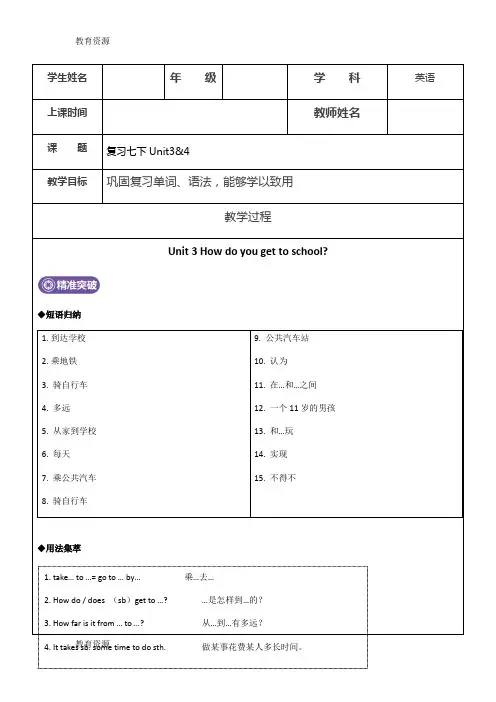
学生姓名年级学科英语上课时间教师姓名课题复习七下Unit3&4教学目标巩固复习单词、语法,能够学以致用教学过程Unit 3 How do you get to school?◆短语归纳1.到达学校2.乘地铁3. 骑自行车4. 多远5. 从家到学校6. 每天7. 乘公共汽车8. 骑自行车9. 公共汽车站10. 认为11. 在…和…之间12. 一个11岁的男孩13. 和…玩14. 实现15. 不得不◆用法集萃1. take… to …= go to … by… 乘…去…2. How do / does (sb)get to …? …是怎样到…的?3. How far is it from … to …? 从…到…有多远?◆典句必背1. How do you get to school? I ride my bike.2. How far is it from your home to school?3. How long does it take you to get to school?4. For many students, it is easy to get to school.5. There is a very big river between their school and the village.◆单词详解【重点词汇1】take固定句型It takes sb. some time to do sth. 意为:“花费某人多长时间做某事”。
it是形式主语,不定式to do sth.是真正的主语。
对some time提问时,用how long。
例如:It took me ten minutes to find the book.辨析:cost, take, pay 和spendcost意为“花费(钱)”,主语一般是表示所买东西的名词。
如:This watch costs me eight dollars.pay 作“花费,付”解,只用于钱,用“人”作主语,后跟“钱”作宾语。
常以pay…for形式出现。
如:I paid 120 dollars for this camera.spend作“花费”解时,常用于时间和钱。
主语常常是“人”。
它有spend…on…和spend…(in)doing两种形式,spend…on…常用于花钱,spend…(in)doing常用于花时间。
如:I spent 60 dollars on the recorder.He spent two hours (in) reading the novel.【练一练】1. It Mike twenty minutes to walk to school every day.A. spendsB. paysC. takes2. —does it take you to walk to school?—About ten minutes.A. How farB. How longC. How soonD. How much3. It takes two hours English every day.A. I; readB. me; readC. me; to readD. my; to read4. He spent two hours doing his homework yesterday. (同义句转换)It him two hours his homework yesterday.【重点词汇2】worryworry 意为“担心,担忧,焦虑”,常用作不及物动词,后面常跟介词about,表示“为……担心”。
worried是形容词,意为“担心的”,构成短语be worried about与worry about 意义相同。
如:1. Children usually worry about their parents’ health.短语worry about及形容词worried形容词worried的用法be/feel worried about【练一练】When I have an exam, I feel (worry) if I don’t prepare well enough.【重点词汇3】get toget表示“到达”,是不及物动词,若加宾语,后需接介词to。
get后接副词时,不需要加to。
1. How can I get to the train station?2. I usually get home at 6.get, arrive和reach的辨析arrive 是不及物动词,到达大地方用arrive in,到达小地方用arrive at。
reach是及物动词,后面直接接名词或副词。
如:They arrived in Shanghai yesterday.He will arrive at the bus stop.They reached home together.get与get to【练一练】1.Who was the first one ?A.to reachB. to arriveC. to get toD. to arrive at2.Liu Xiang Beijing the day before yesterday.A. gotB. get toC. arrived atD. arrived in.【重点词汇4】depend ondepend on意为“依靠,依赖;视……而定”。
后面通常接名词、代词等。
如:1. The price depends on the quality.2. Almost everything in the world depends on the sun to live.【练一练】Try to guess its meaning when you meet a new word. Don’t your dictionary all the time.A. work onB. take onC. keep onD. depend on【重点词汇5】a number ofa number of意为“许多;大量”。
通常修饰复数名词,修饰主语时,谓语动词要用复数形式。
a small number of 表示“少量的”。
如:1. A number of students go to the net bar every day.2. A number of people walk on the street.辨析:a number of 与the number ofthe number of+ 名词,中心词是number,意为“……的数目”,修饰主语时,谓语动词用第三人称单数形式。
The number of students in our school is about 2019.【练一练】—How many students are there in your school?—students in our school over two thousand.A.The number of, isB. The number of, areC. A number of, is◆句型详解【重点句式1】What do you think of the transportation in your town?意为“你觉得……怎么样?”,相当于How do you like…?What do you think of …?What do you think of the play?【练一练】How do you like China? (同义句转换)do you China?【拓展】—How does Bob get to school? —He takes the train.⑴询问去某地的交通方式,用how提问。
how作疑问副词,还可表示“如何,怎样,以何种方式或手段”。
⑵take(乘)+冠词+交通工具,如:take the subway, take the bus如:1. How did you spend your summer holiday?【考查点】乘交通工具的表示方式:1)by+交通工具by bus, by plane, by ship, by boat, by train, by taxi, on foot.2)in/on +冠词/形容词性物主代词+交通工具on my bike;on the bus;in a car3)动词+to+地点名词动词walk, ride, drive, fly等词可直接表示交通方式,后接to再接地点名词。
以上四种表达方式可以互换。
He will take a plane to Spain.=He will go to Spain by plane.=He will go to Spain in the plane.=He will fly to Spain.【练一练】1.—do you usually go to school? —By bus.A. WhereB. HowC. WhichD. What2.The boy usually goes to school on foot. (改为同义句)The boy usually school.【重点句式2】How far is it from his home to school?how far用来对两地间的距离提问。
回答时常用It’s +表示长度的词,如kilometer, mile等。
具体有以下两种情形:(1)有具体数字时,应与away from连用,表示具体距离的计算,口语中away可省去。
(2)没有具体数字时,应用far或near作答。
如:1.—How far is it from Beijing to Shanghai?—It’s about several thousand kilometers.2. The moon is 380, 000 kilometers away from the earth.辨析:how far与how long, how often, how soon【练一练】1. —is it from your home to school? —About two kilometers.A. How farB. How longC. How soonD. How often2. My hometown is the city.A. far fromB. near fromC. farD. far away注意:“离……远”用far(away) from,此时away可省去。