
body talk 期末课件
- 格式:ppt
- 大小:1.09 MB
- 文档页数:10



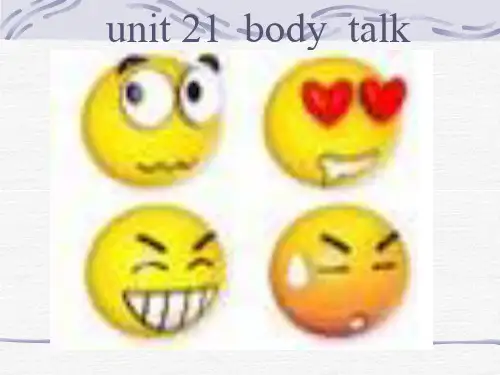
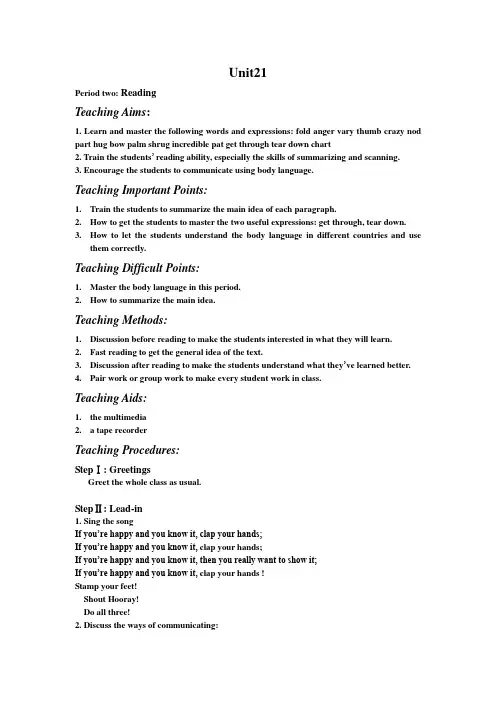
Unit21Period two: ReadingTeaching Aims:1. Learn and master the following words and expressions: fold anger vary thumb crazy nod part hug bow palm shrug incredible pat get through tear down chart2. Train the students’ reading ability, especially the skills of summarizing and scanning.3. Encourage the students to communicate using body language.Teaching Important Points:1.Train the students to summarize the main idea of each paragraph.2.How to get the students to master the two useful expressions: get through, tear down.3.How to let the students understand the body language in different countries and usethem correctly.Teaching Difficult Points:1.Master the body language in this period.2.How to summarize the main idea.Teaching Methods:1.Discussion before reading to make the students interested in what they will learn.2.Fast reading to get the general idea of the text.3.Discussion after reading to make the students understand what they’ve learned better.4.Pair work or group work to make every student work in class.Teaching Aids:1.the multimedia2. a tape recorderTeaching Procedures:StepⅠ: GreetingsGreet the whole class as usual.StepⅡ: Lead-in1. Sing the songIf you’re happy and you know it, clap your hands;If you’re happy and you know it, clap your hands;If you’re happy and you know it, then you really want to show it;If you’re happy and you know it, clap your hands !Stamp your feet!Shout Hooray!Do all three!2. Discuss the ways of communicating:speakingringingwritingtypingSpoken language Written languageBody language Ways of communicatingwelcome gesturingToday we’ll learn more about the body language.Step Ⅲ: ReadingNow turn to page . I’ll give you eight minutes to read the whole text. Meanwhile you must get the topic sentence of each paragraph.Para 1: Both words and body language can express our thoughts and opinionsPara 2: Just like spoken language, body language varies from culture to culturePara 3: The same body language has different meanings in some different countries. Para 4: Some gestures, however, seem to be universalPara 5: The smile is the best example of universally understood body language(A few minutes later, call some students to answer the questions about the topic sentence of each paragraph.)OK! Very good! Let ’s learn the text paragraph by paragraph.para1:(First let ’s look at two questions)Do people communicate with others only by words? What other ways can be used? wordsbody movements ( the way they stand, fold their arms or move their hands) para2:(First let ’s look at two questions)1. How many kinds of body language are talked in the paragraph?2. What are they? (read this part again)Eye contact, gesture for OK, thumps-up gesture, “crazy” gesture (call some students to answer the question)(Very good!) Look at them one by one:Firstly, look at the eye contact (show a picture )(look directly into one ’s eyes.)Show interestEye contactBe rude and disrespectful.Secondly, look at the gesture For OK (show a picture)(make a circ le with one’s thumb and index finger )This gesture in different countries has different meanings:in Japan It means moneyin France It means zeroin Brazil and Germany The gesture is rude Next, look at the thumbs-up gesture. (show a picture)It also different meanings in different countries:in the US It means “great” or “good job”.in Nigeria It is rude, impolite.in Germany and Japan It means the number oneLast one; look at the “crazy” gesture. (show a picture)(moving the index finger in a circle in front of the ear)It also has different meanings in different countries:in the US It means “ crazy ” gesturein Brazil It means having a phone callpara3:(First look at the questions)1. In which countries does nodding the head mean “No”?(In Bulgaria, parts of Greece, and Iran.)2. How do people from different countries greet their friends when they meet each other?how often we touch each other, howclose we stand to people, and how weact when we meet or part.In different countries, people use different gestures to express the same meaning.In France and Russia a visiting friend is greeted with a kiss on the check.In other countries people greet eachother with a firm handshake.para4:(look at the questions) universal gesturesI am tired I am full I am hungrypress one ’s palms and rest one ’s head on the back of it/eyes closed move hand in circle pat stomachpara5: What is the best example of universally understood body language?(smile)Now read the text (the last paragraph) again, then find the functions of the smile. Fiddly, fill in the form on the screen.smileget through difficult situations find friendsopen doorstear down wallsexpress any emotion apologise greet someoneask for help start a conversation make ourselves feel happier and stronger when smiling in the mirror don ’t feel down and lonely when seeing a smiling face of a good friendis a bridge to the worldWe use both words and body language to communicate with people, but just like spoken language, it varies from culture to culture . In Japan, the gesture for OK means money , but in France it means zero , and in Brazil and Germany it is rude. While there are many different interpretations of body language, some gestures seem to be universal . Perhaps the best example of widely used body language is the smile .Step Ⅳ: Summary Para 1Para 2Para 3Para4Para5 summaryIntroduction to body language Different interpretations of same gesture Different gestures to communicate the same idea Some universal gestures Smiling can be accepted anywhe rein the world Body language in different parts ofthe world Some universal gesturesStep Ⅴ: Homework1. Read our text loudly and recite it.2. Review the grammar.3. Write a short passage about animal body language which you are familiar with. (such as dogs ,cats ,pigs etc.)Proverb: when in Rome, do as the Romans do.。