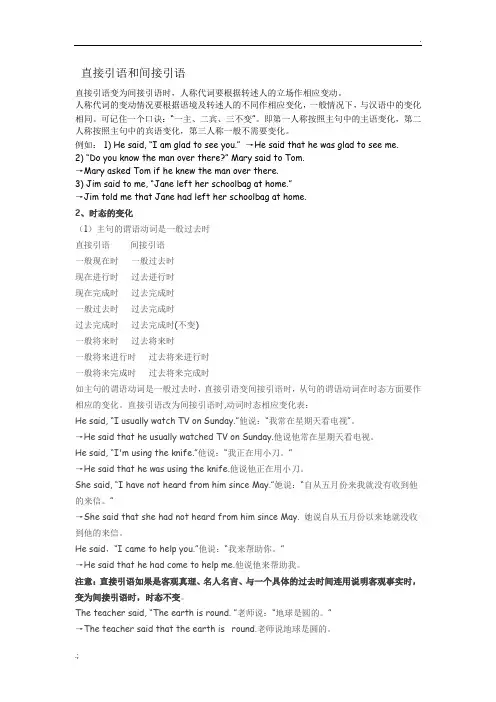
直接引语和间接引语专项练习(一)Ⅰ、单项填空1.He said, "I am living with my brother."He said that __ was living with his brother.A. IB. youC. heD. they2.He said, "You are sure to get a warm welcome there."He said that we __ sure to get a warm welcome there.A. amB. wasC. wereD. are3.She says, "Something is wrong with my bike."She says that something is wrong with __ bike.A. myB.aC. hisD. her4.He said, "I will not do so again."He said that he __ not do so again.A. willB. mustC. wouldD. do5.The teacher said, "My son had the same experience as the little boy." The teacher said that his son had __ the same experience as the little boy.A. beenB. haveC. hadD. done6.She said to me, "My mother took me to an exhibition yesterday."She told me that her mother had taken __ to an exhibition the day before.A. sheB. meC. herD. you7.You said to me, "I saw the film two days ago."You told me that you had seen the film __A. two daysB. two days beforeC. two days agoD. yesterday8.He said to his younger sister, "You may come with me."He told his younger sister that __ with him.A. you may comeB. you might comeC. she might comeD. she might go9.The student said to me, "She has made a close study of the problem." The student told me that she __ a close study of the problem.A. has makeB. have madeC. had makeD. had made10.He said, "I live here."He said that he lived____.A. thereB. hereC. in thereD. at thereⅡ、. 将下列句子变为间接引语:1. “You should be more careful next time,” his father said to him.2. Mr. Wang said, “I will leave for Shanghai on business next month, children.”3. “I haven’t heard from my parents these days,” said Mary.4. The geography teacher said to us, “The moon moves around the earth and the earth goes round the sun.”5. She said to him, “It’s time that you left here.”6. Zhang Hong said to me, “Doctor Wang passed away in 1948.”7. John said to his parents, “I had learned 500 Chinese words by the end of last term.”8. The history teacher said to them, “The Chinese Communist Party was founded on July 1st , 1921.”9. He said, “Are you a student?”10. “Have you anything interesting I can read, George?” she said.11. “She’s here to ask for help, isn’t she?” he asked.12. “Where are you going?” the father asked his son.13. “Are you sorry for what you have done?” the mother asked the naughty boy.14. She said, “Did you meet this man at the station two hours ago, Mr. Li?”15. “Write your names on your papers first,” the teacher said to us.16. “Please come here again tomorrow,” her friend said to her.17. “Let me pack the parcel for you,” he said.18. “Don’t make so much noise in class, boys and girls,” said the teacher.19. “What a lovely day it is!”20. “Happy New Year to you!” he said.III. 把下列句子变为直接引语:1. I told him that I had lost my money and that I would find it.2. She asked whether I would be free the next day or not.3. I asked her where she was going and what she was going to do the next day.4. His father told him not to climb that high tree in his new coat.5. The stranger asked me what my name was.6. The teacher asked if we could do it.最佳答案1C 2C 3D 4C 5C 6C 7B 8D 9D 10AII. 1. His father told him that he should be more careful the next time.2. Mr. Wang told the children that he would leave for Shanghai on business the next month.3. Mary said that she hadn’t heard from her parents those days.4. The geography teacher told us that the moon moves around the earth and the earth goes round the sun.5. She told him that it was time that he left there.6. Zhang Hong told me that Doctor Wang passed away in 1948.7. John told his parents that he had learned 500 Chinese words by the end of last term.8. The history teacher told them that the Chinese Communist Party was founded on July 1st, 1921.9. He asked whether I was a student.10. She asked George if he had anything interesting she could read.11. He asked whether she was there to ask for help or not.12. The father asked his son where he was going.13. The mother asked the naughty boy if he was sorry for what he had done.14. She asked Mr. Li whether he had met that man at the station two hours before.15. The teacher told us to write our names on our papers first.16. Her friend asked her to go there again the next/ following day.17. He offered to pack the parcel for me.18. The teacher told the boys and girls not to make so much noise in class.19. He/ She exclaimed that it was really a lovely day.20. He wished me a Happy New Year.III. 1. I said to him, “I have lost my money . I will find it.”2. She asked , “ You will be free tomorrow, won’t you?”3. I asked her, “Where are you going and what are you going to do tomorrow?”4. His father said, “Don’t climb this high tree in your new coat.”5. The stranger asked, “ What’s your name?”6. “I’ll finish my work tomorrow,” she said.7. The teacher asked, “Can you do it ?”8. The commander ordered his men, “Don’t cross the river before dawn.”9. My teacher asked, “Is he coming?”10. The scientist asked me, “What are you doing?”直接引语和间接引语专项练习(二)1. “You’ve already got well, haven’t you?” she asked.→She asked ________.A. if I have already got well, hadn’t youB. whether I had already got wellC. have I already got wellD. had I already got well.2. He asked , “ Are you a Party member or a League member?”→He asked me _________.A. am I a Party member or a League memberB. was I a Party member or a League memberC. if I was a Party member or a League memberD. whether was I a Party member or a League member.3. He asked, “How are you getting along?”→He asked _______.A. how am I getting alongB. how are you getting alongC. how I was getting alongD. how was I getting along4. He asked me ________ with me.A. what the matter isB. what the mater wasC. what’s the matterD. what was the matter5. He said, “Don’t do that again.” He _____ me _______ that again.A. said to me; not to doB. said to me; don’t doC. told me; don’t doD. told me; not to do6. Can you make sure ___________?A. that he will come here todayB. when he will come here todayC. will he come here todayD. whether will he come here today7. Do you happen to know ________?A. where is her addressB. in which place is her addressC. what her address isD. the place her address is8. Excuse me, but can you tell me ___________?A. where can I get to the libraryB. where I can get to the libraryC. how can I get to the libraryD. how I can get to the library9. John asked me _______ to visit his uncle’s farm with him.A. how would I likeB. if or not would I likeC. whether I would likeD. which I would like10. I’d like to know ________ Chinese.A. when he began to learnB. when did he begin to learnC. when did he begin learningD. for how long he began to learnII. 将下列句子变为间接引语:1. “You should be more careful next time,” his father said to him.2. Mr. Wang said, “I will leave for Shanghai on business next month, children”3. “I haven’t heard from my parents these days,” said Mary.4. The geography teacher said to us, “The moon moves around the earth and the earth goes round the sun.”5. She said to him, “It’s time that you left here.”6. Zhang Hong said to me, “Doctor Wang passed away in 1948.”7. John said to his parents, “I had learned 500 Chinese words by the end oflast term.”8. The history teacher said to them, “The Chinese Communist Party was founded on July 1st ,1921.”9. He said, “Are you a student?”10. “Have you anything interesting I can read, George?” she said.11. “She’s here to ask for help, isn’t she?” he asked.12. “Where are you going?” the father asked his son.13. “Are you sorry for what you have done?” the mother asked the naughty boy.14. She said, “Did you meet this man at the station two hours ago, Mr. Li?”15. “Write your names on your papers first,” the teacher said to us.16. “Please come here again tomorrow,” her friend said to her.17. “Let me pack the parcel for you,” he said.18. “Don’t make so much noise in class, boys and girls,” said the teacher.19. “What a lovely day it is!”20. “Happy New Year to you!” he said.III. 把下列句子变为直接引语:1. I told him that I had lost my money and that I would find it.2. She asked whether I would be free the next day or not.3. I asked her where she was going and what she was going to do the next day.4. His father told him not to climb that high tree in his new coat.5. The stranger asked me what my name was.6. She said that she would finish her work the next day.7. The teacher asked if we could do it.8. The commander ordered his men not to cross the river before dawn.9. My teacher asked whether he was coming.10. The scientist asked me what I was doing.答案I. 1~5 B C C D D 6~10 A C D C AII.1. His father told him that he should be more careful the next time.2. Mr. Wang told the children that he would leave for Shanghai on business the next month.3. Mary said that she hadn’t heard from her parents those days.4. The geography teacher told us that the moon moves around the earth and the earth goes round the sun.5. She told him that it was time that he left there.6. Zhang Hong told me that Doctor Wang passed away in 1948.7. John told his parents that he had learned 500 Chinese words by the end of last term.8. The history teacher told them that the Chinese Communist Party was founded on July 1st, 1929. He asked whether I was a student.10. She asked George if he had anything interesting she could read.11. He asked whether she was there to ask for help or not.12. The father asked his son where he was going.13. The mother asked the naughty boy if he was sorry for what he had done.14. She asked Mr. Li whether he had met that man at the station two hours before.15. The teacher told us to write our names on our papers first.16. Her friend asked her to go there again the next/ following day.17. He offered to pack the parcel for me.18. The teacher told the boys and girls not to make so much noise in class.19. He/ She exclaimed that it was really a lovely day.20. He wished me a Happy New Year.III.1. I said to him, “I have lost my money . I will find it.”2. She asked , “ You will be free tomorrow, won’t you?”3. I asked her, “Where are you going and what are you going to do tomorrow?”4. His father said, “Don’t climb this high tree in your new coat.”5. The stranger asked, “ What’s your name?”6. “I’ll finish my work tomorrow,” she said.7. The teacher asked, “Can you do it ?”8. The commander ordered his men, “Don’t cross the river before dawn.”9. My teacher asked, “Is he coming?”10. The scientist asked me, “What are you doing?”直接引语和间接引语专项练习(三)1 He said , “Mother, the boy is very naughty.”2 He said to me, “I have left my book in your room.”3 Kitty said “I’ll call again after supper this evening.”4 She said, “I will come here again tonight.”5 He said, “I arrived yesterday morning.”6 She said , “My sister will be back tomorrow morning.”7 “The children had better go to bed early,” she said.8 He said , “I have lost my umbrella.”9 Paul said, “I’m trying to get a taxi.”10 “I never eat meat.” He explained.11 “Have you been here for ages?” she said.12 “I took the dictionary home with me,” he said.13 “Frank, I came to return you the book,” Henry said.14 He asked, “Are you sure your mother will come?’15 He asked, “Are you a teacher or a student?”16 He said to me, “Please come again tomorrow.”17 He said to me, “Don’t do that again.”18 He said, “Where is she going?”19 “Who lives next door?” she asked.20 “What’s happened?” he asked.21 “Where is the airport?” he asked.22.”What have you got in your bag?” the asked .23 “Mary, when is the next train?” he asked.24 “Why did you stop the car, Tom? ” she asked.25 “Is there anyone here?” he asked.26 “Do you know Mrs Green?” he asked me.27 “Shall I wait for them or shall I go on?” the man asked.28 “Shall I lock the car or leave it unlocked?” she asked.29 “Will you be here tomorrow?” he asked me.30 “Would you like to come in for a drink?” she asked Bill.31 “Could me give me a hand?” Mr Black asked Tom.32 “You’ll be back tonight, won’t you?” my wife asked me.33 “Don’t swim out too far, children,” mother said.34 “Please let me have a try.” Jane said to the teacher.35 “Do sit down, everybody.” said the hostess.36 “Please don’t take any risks,” said his wife.37 “Don’t forget to take your pills,” said mother to his daughter.38 “Put down your gun, man!” said the inspector.39 “Be quiet, girls.” said the old man.40 “Bring your textbook with you tomorrow, please.” The teacher said to her.41 I asked Wang Dong “Are there any spelling mistakes in my exercises?”直接引语和间接引语专项练习(四)将所给直接引语变为间接引语,每空一词:1. “I never eat meat.” he said.He said that ______ never ______ meat.2. “I’ve found my wallet.” he said to me.He ______ me that he ______ ______ ______ wallet.3. “I took it home with me.” she said.She said that ______ ______ _______ it home with her.4. The teacher said, “The sun rises in the east and goes down in the west.”The teacher said that the sun ______ in the east and ______ down in the west.5. “I met her yesterday.” he said to me.He ______ me that he ______ met the day ______.6. “You must come here before five.” he said.He said that I ______ to go ______ before five.7. “I bought the house 10 years ago.” he said.He said that he _______ bought the house 10 years _______.8. “Did you see her last week?” he said.He ______ ______ I had seen her the week _______.9. He said, “You can sit here, Jim.”He ______ Jim that he ______ sit there10. He asked, “How did you find it, mother?”He asked her mother ______ ______ ______ found it.11. “Where have you been these days?” he asked.He asked me _______ _______ _______been _______ days.12. “Do you know where she lives?” he asked.He asked ______ ______ knew where she ______.13. “Stop making so much noise, children.” he said.He ______ the children ______ ______ making so much noise.14. “Don’t tell him the news.” she said.She told me _______ ______ ______ him the news.15. “Are you intested in this?” he said.He ______ ______ I was interestd in ______.【参考答案】1. he, ate2. told, had, found, his3. she, had, taken4. rise, goes5. told, had, before6. had, there7. had, before 8. asked, if [whether], before9. told, could 10. how, she, had11. where, I, had, those 12. if [whether], I, lived13. told, to, stop 14. not, to, tell15. asked, if [whether], that直接引语和间接引语专项练习(五)将所给直接引语变为间接引语1.He said: “I’ve left my book in my room.”2.She said: “He will be busy.”3.She said to Tom, “Can you help me?”4.She asked, “Is this book yours or his?”5.The teacher asked, “how did you repair it?”6.The teacher said to the students, “Don’t waste your time.”7.The mother said, “Tom, get up early, please.”8.The teacher said, “The earth goes round the sun.”9.My father said, “Practice makes perfect.”10.The boy said to us, “ I usually get up at six every day.”11.He said, “We are still students.’12.He said to me, “I was born in 1978.13.The engineer said, “I was at college in 1967.”14.He said, “I have studied English since I was a boy.”15.She said, “I read the book while I was waiting for a bus.16.Mr. Green said to them, “Joe told me all about his story when he asked for a job.”17.He said, “We insisted that she start immediately.18.She said, “He demanded that the girl leave at once.”19.I said to him, “I have finished it.”20.She said to us,“ I’ll come here tomorrow.”21.“Where does your chemistry teacher live, Karen?” the young man asked.22.“I have gained the first place in the mathematics competition,” the little boy said happily.23.“Light travels faster than sound,” the physics teacher said to the boys and girls.24.“Will you go to the concert with me this evening?” Mary asked me.25.“What did you do here yesterday?” the old man asked my brother.附答案:【参考答案1】1. he, ate2. told, had, found, his3. she, had, taken4. rise, goes5. told, had, before6. had, there7. had, before 8. asked, if [whether], before9. told, could 10. how, she, had11. where, I, had, those 12. if [whether], I, lived13. told, to, stop 14. not, to, tell15. asked, if [whether], that附答案:【参考答案2】1.He told me that he had left his book in his room.2.She said that he would be busy.3.She asked Tom if /whether he could help her.4.She asked me whether that book was mine or his.5.The teacher asked me how I had repaired it.6.The teacher told the students not to waste their time.7.The mother asked Tom to get up early.8.The teacher said that the earth goes round the sun.9.My father said practice makes perfect.10.The boy told us he usually gets up at six every day.11.He said they are still students.12.He told me that he was born in 1978.13.The engineer said he was at college in 1967.14.He said he had studied English since he was a boy.15.She said she had read the book while she was waiting for a bus.16.Mr. Green told them Joe had told him all about his story when he asked for a job.17.He said they (had) insisted that she start immediately.18.She said he demanded that the girl leave at once.19.I told him I had finished it.20.She told us she would come here tomorrow21.The young man asked Karen where her chemistry teacher lived.22.The little boy said happily that he had gained the first place in the mathematics competition. 23.The physics teacher told the boys and girls that light travels faster than sound.24.Mary asked me if / whether I would go to the concert with her that evening.25.The old man asked my brother what he had done there the day before.直接引语和间接引语专项练习(六)1. Our teacher asked us _____ our dictionaries to school.A. bringB. broughtC. bringD. to bring2. The teacher told the boy students ______ football on the grass.A. not playB. not to playC. playedD. playing3. ____ Tom didn’t go to school?A. Do you know howB. Why do you knowC. How you know whyD. Do you know why4. She looks sad. Could you please tell me _____ that prevents her from being as happy as before?A. what it isB. it is whatC. how it isD. it is how5. Betty asked her sister ____ to the railway station to see her off.A. not to comeB. not to goC. to not comeD. to not go6. The pupil asked his teacher _____ round the earth.A. weather the moon goesB. that the moon wentC. whether the moon goesD. whether the moon went7. Mr. Li ____ Wang Ling ____ a taxi to the airport.A. asked; takeB. asked; takingC. told; takeD. told; to take8. She asked him ____.A. whose dictionary this isB. whose dictionary that wasC. whose dictionary is thisD. whose dictionary that is9. Mary’s mother asked her _____.A. that whether she had finished her homeworkB. if she has finished her homeworkC. if she had finished her homeworkD. that if she had finished her homework10. Do you know ____?A. what is he doingB. what he doingC. what he is doingD. what does he do now11. I don’t know ____ to learn English.A. when did he beginB. when he beganC. he when beganD. when he begins12. He asked me ____.A. how would the weather be like tomorrowB. what the weather would be like the next dayC. how the weather would be like tomorrowD. what would the weather be like the next day13. You can’t imagine ____ when they received these nice Spring Festival presents.A. how excited they wereB. how excited were theyC. how they were excitedD. they were how excited14. She told me that she ____ by her relatives at the bus stop.A. had been seen offB. have seen offC. have been seen offD. had seen off15. Do you remember how many times ____ to Australia?A. had you beenB. did you goC. have you beenD. you have been16. Can you guess ____?A. what is that manB. who that man isC. whom that man isD. who is that man17. More and more students and teachers have began to know ____.A. how important the foreign language areB. how the foreign language is importantC. how important the foreign language isD. how important is the foreign language18. The hostess said that it ___ time that they ___ supper.A. was; hadB. was; had hadC. is; haveD. is; have had19. The boss asked his secretary ____ he had finished typing the report ____.A. if; or notB. if; notC. whether; or notD. whether; not20. I wonder how much _____.A. does he spend on his carB. did he spend on his carC. he spent on his carD. he spent in his car直接引语和间接引语专项练习(七)1."My mother took me to an exhibition yesterday."she said.2."We are going to study in Australia next month."they said.3."I'm checking your home work now."his mother said.4."Can you tell me how to get to the nearest restaurant?"the man asked the policeman5."Is your son going to Shanghai today or tomorrow?"he asked.6."Do you remember what your aunt told you last night?"Li ping's father asked him.7."Where shall i get off to change to a No.3 bus?"he asked the conductor.8."How many car factories have been built in your country?"he asked me.9."What did Edison do to help the doctor operate on his mother ?"the teacher asked.10." Go to the front at once!"the officer said to the soldiers.直接引语变间接引语专项练习题三巩固练习答案:1—5DBDAB; 6—10CDBCC;11—15BBAAD;16—20BCACC练习题四答案:1.She said her mother had took her to an exhibition the day before .2.They said they were going to study in Australia the next month.3.His mother said she was checking his homework then .4.The man asked the policeman if he could tell him how to get to the nearest restaurant.5.He asked whether my son was going to Shanghai that day or the next day.6.Li ping's father asked him if he rememberred what his aunt had told him the night before.7.He asked the conductor where he could get off to change to a No.3 bus.8.He asked me how many car factories had been built in my country.9.The teacher asked what Edison had do to help the doctor operate on his mother.10.The officer asked the soldiers to go to the front at once.直接引语变间接引语专项练习题五一、将所给直接引语变为间接引语,每空一词:1. “I am having supper,” he said.He said that _______ _______ having supper.2. “I’ve seen the film,” Gina said to me.Gina _______ me that she _______ _______ the film.3. “I went home with my sister,” she said.She said that _______ _______ _______ home with her sister.4. The teacher said, “The sun is bigger than the moon.”The teacher said that the sun _______ bigger than the moon.5. “I met her yesterday,” he said to me.He told me that he _______ met her the day _______.6. “You must come here before five,” he said.He said that I _______ to go _______ before five.7. “I bought the computer two weeks ago,” she said.She said that she _______ bought the computer two weeks _______.8. “Did you read the book last week?” he said.He _______ _______ I had read the book the week _______.9. He said, “You can sit here, Jim.”He _______ Jim that he _______ sit there10. He asked, “How did you find it, mother?”He asked her mother _______ _______ _______ found it.11. “Where have you been these days?” he asked.He asked me _______ _______ _______ been _______ days.12 “Do you know where she lives?” he asked.He asked _______ _______ knew where she _______.13. “Keep quiet, children.” he said.He _______ the children _______ _______ quiet.14. “Don’t look out of the window,” she said.She told me _______ _______ _______ out of the window.15. “Are you interested in this?” he said.He _______ _______ I was interested in _______.【练习5答案详解】1. he, was。