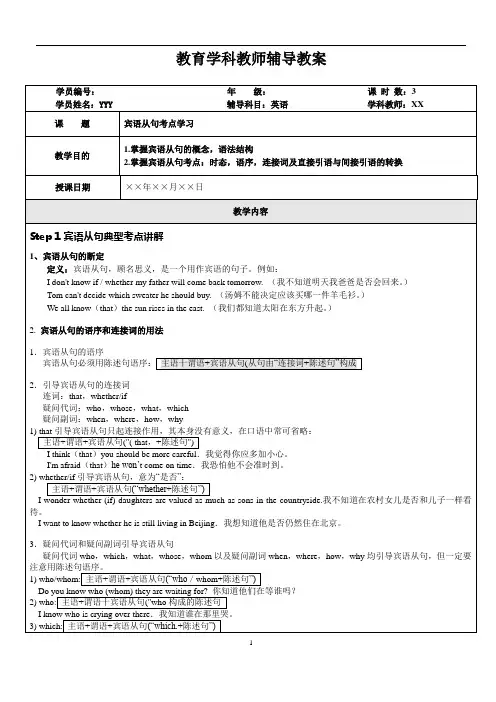
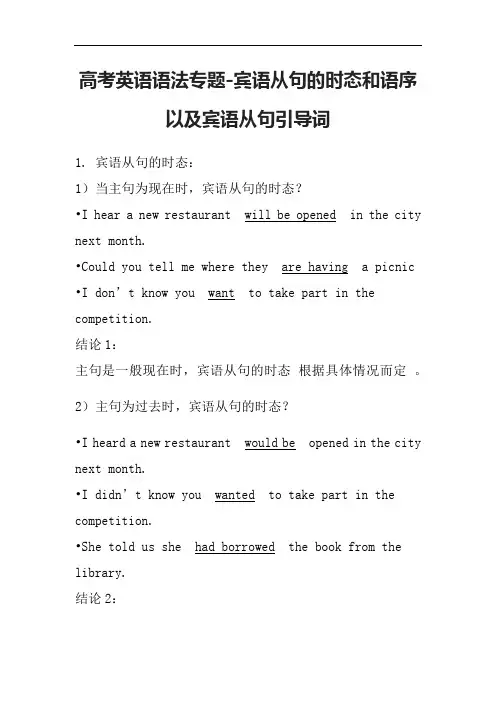
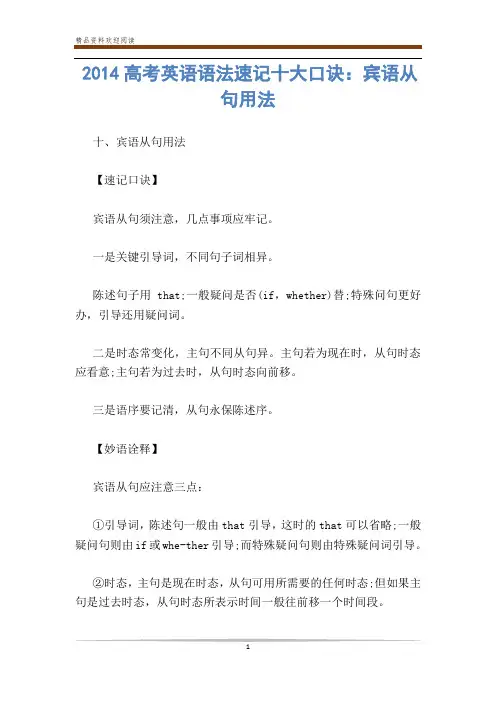
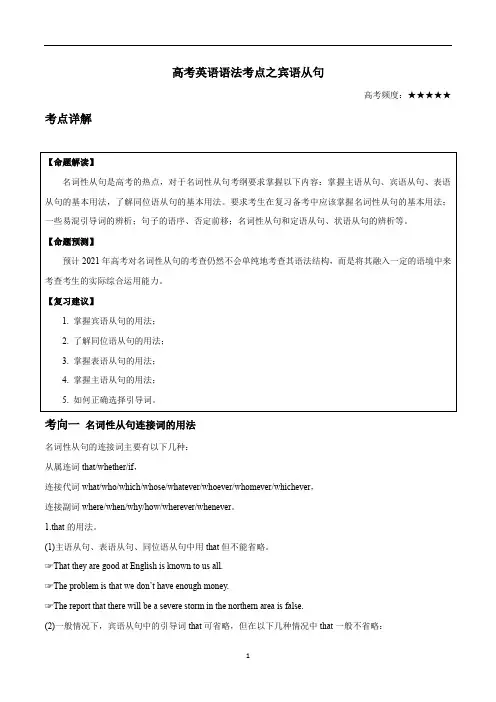
高考英语宾语从句知识点
- 格式:pdf
- 大小:164.22 KB
- 文档页数:16
【 导语】备考是⼀种经历,也是⼀种体验。每天进步⼀点点,基础扎实⼀点点,通过考试就会更容易⼀点点。⽆忧考为您提供⾼考英语宾语从句知识点,快来看看吧!
【篇⼀】⾼考英语宾语从句知识点 1. 宾语从句名⾔:
(1) that引导的宾语从句
Sometimes we need to remind ourselves that thankfulness is indeed a virtue.
有时我们需要提醒⾃⼰,感激是真正的美德。
Health is the thing that makes you feel that now is the best time of the year.
健康使你感到现在是⼀年中的时光。
(2)what引导的宾语从句
If you can’t have the best, make the best of what you have.
没有的,就充分利⽤现有的。
If you don’t have what you like,you must like what you have.
没有你喜欢的东西,就喜欢你现有的东西。
2. 宾语从句定义:
在主从复合句⼦中,充当宾语,位于及物动词、介词或复合谓语之后的从句称为宾语从句。 宾语可分为三类:动词的宾语从句、介词的宾语从句、形容词的宾语从句。
【篇⼆】⾼考英语宾语从句知识点 1. 宾语从句的引导词 在复合句⼦中,作宾语的从句叫宾语从句。例如:
I want to know whose book this is.
我想知道这是谁的书。
宾语从句的引导词有三种:
1)that;2)whether/ if;3)特殊疑问词what/ when/ where/ who等。例如:
He said that he could help me. 他说他能够帮助我。
Your mother asked if you could finish your work this week.
你妈妈问这个星期你能否完成⼯作。
Can you tell me when the sports meeting will begin?
你能告诉我运动会将在什么时候开始吗?
(1) 以that引导的宾语从句:
that引导的宾语从句⼀般都是由陈述句充当,引导词that没有实际意义,不在从句中作任何成分,that可以省略,⽽且从句成分齐全,句意完整。
Do you think (that) it will rain? 你认为天会下⾬吗?
He said (that) he could come on time. 他说他会准时来的。
(2) 以whether或if引导的宾语从句:
从属连词if, whether引导的名词从句是由⼀般疑问句或选择疑问句转化⽽来的,变成从句后,语序由原来的倒装语序变成陈述语序。whether和if意为“是否”。
Let us know whether / if you can finish the work before Friday. 请让我们知道你是否能在星期五以前把⼯作做完。
I don’t care whether you like the story or not.
我不在乎你是否喜欢这个故事。
注意:
以下情况⼀般只⽤whether不⽤if。
1) 接带to的动词不定式。
She doesn’t know whether to go to the zoo.
她不知道是不是去动物园。
2)与or not连⽤时。
I’m not sure whether or not he will come on time.
他能否准时来,我说不准。
(3) 特殊疑问词what/ when/ where/ who等引导的宾语从句:
此类宾语从句原来是特殊疑问句,变成宾语从句后要⽤陈述语序,由wh-开头的疑问词引导。包括who, whom, whose,what, which等连接代词和where, when, how, why等连接副词,这些引导词有各⾃的意思,在从句中要作相应的成分,不能省略。例如:
Could you tell me which gate we have to go to?
请问我们得⾛哪个门?
He didn’t tell me how long he would stay here.
他没有告诉我他要在这⾥呆多长时间。 2. 宾语从句的语序
由whether/ if和特殊疑问词引导的宾语从句要⽤陈述语序,原来的倒装语序改成陈述语序时注意相应的助动词和动词的变化等。
Where does your father work? Can you tell us? →
Can you tell us where your father works?
你能告诉我们你爸爸在哪⾥⼯作吗?
Did you get home very late? He asked me. →
He asked me if I got home very late. 他问我是否到家很晚。
3. 宾语从句的时态对应
(1) 如果主句是⼀般现在时,宾语从句根据实际情况⽤各种时态。
例如:
My teacher says he will be back in a week. (⼀般将来时)
我的⽼师说他将在⼀个星期后回来。
My teacher says he is watching TV. (现在进⾏时)
我的⽼师说他正在看电视。
My teacher says he has seen the movie. (现在完成时)
我的⽼师说他已经看过这部电影了。
(2)如果主句是⼀般过去时,宾语从句⽤相应的过去时态。 例如:
My father said he was watching TV at that time.(过去进⾏时)
我爸爸说在那个时候他在看电视。
My father said the he had already seen the movie. (过去完成时)
我爸爸说他已经看过那部电影了。
注意:如果宾语从句是表⽰客观真理和规律的句⼦时,⽤⼀般现在时。
例如:
Our teacher told us the sun is much bigger than the earth. (⼀般现在时)
我们的⽼师告诉我们太阳⽐地球⼤多了。
4. 宾语从句的否定转移
主句如果是I think/ believe/ imagine/ suppose/ guess/ expect等,从句的否定⼀般要转移到主句中,其反意疑问句与从句⼀致。例如:
I don’t think they’ll wait to the last minute,will they?
我认为他们不会等到最后⼀分钟,他们会吗?
I don’t believe he did this, did he?
我相信他不会做这样的事,他会吗?
【篇三】⾼考英语宾语从句知识点 I.单项选择。
1.—Do you know ______ the Capital Museum? — Next Friday.
A. when will they visit
B.when they will visit
C. when did they visit
D.when they visited
2.He wanted to know _______ the English party.
A.when will we have
B.when we will have
C.when would we have
D.when we should have
3.I want to know ________.
A.when we should arrive at the airport
B.when should we arrive at the airport
C.when the airport we should arrive at
D.when the airport should we arrive at
4.—David, look at the man in white over there. Can you tell me ______?
—He is a doctor. A.Who is he B.who he is
C.what is he D.what he is
5. I don’t know when _____.
A. will the train leave
B. the train will leave
C. would the train leave
D. the train leave
6. Do you know what _____ with Jim?
A. is wrong B. wrong is
C. wrong was D. the matter is
7.-I want to know _____.
-Why not go to the park?
A. where I can go for a picnic
B. where can I go for a picnic
C. what I can go for a picnic
D. what can I go for a picnic
8. I don’t think he is right, ______?
A. do I B. isn’t he C. is he D. don’t I
9. The teacher didn’t say you would come, _____?
A. would you B. wouldn’t you
C. did she D. didn’t you
10. Do you know______ daughter she is?
A. whose B. whom C. what D. who
11. They wondered if the teacher ______them some English songs the next week.
A. would teach B. had taught
C. will teach D. taught
12. He asked me if I knew______.
A. whose pen was it
B. whose pen it was
C. whose pen it is
D. whose pen is it
13. He told me ______ Paris is the capital ofFrance.
A. which B. the C. that D. what
14. He asked me ______ during the summer holiday.