
M3M4复习
- 格式:ppt
- 大小:1.35 MB
- 文档页数:18

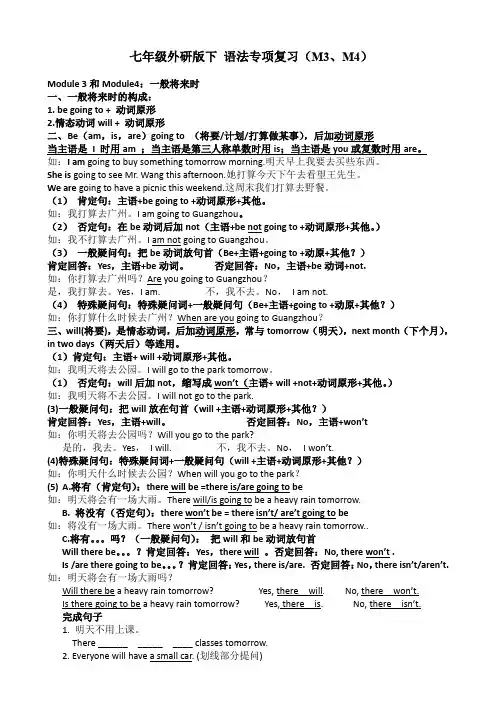
七年级外研版下语法专项复习(M3、M4)Module 3和Module4:一般将来时一、一般将来时的构成:1. be going to + 动词原形2.情态动词will + 动词原形二、Be(am,is,are)going to (将要/计划/打算做某事),后加动词原形当主语是I 时用am ;当主语是第三人称单数时用is;当主语是you或复数时用are。
如:I am going to buy something tomorrow morning.明天早上我要去买些东西。
She is going to see Mr. Wang this afternoon.她打算今天下午去看望王先生。
We are going to have a picnic this weekend.这周末我们打算去野餐。
(1)肯定句:主语+be going to +动词原形+其他。
如:我打算去广州。
I am going to Guangzhou。
(2)否定句:在be动词后加not(主语+be not going to +动词原形+其他。
)如:我不打算去广州。
I am not going to Guangzhou。
(3)一般疑问句:把be动词放句首(Be+主语+going to +动原+其他?)肯定回答:Yes,主语+be动词。
否定回答:No,主语+be动词+not.如:你打算去广州吗?Are you going to Guangzhou?是,我打算去。
Yes,I am. 不,我不去。
No,I am not.(4)特殊疑问句:特殊疑问词+一般疑问句(Be+主语+going to +动原+其他?)如:你打算什么时候去广州?When are you going to Guangzhou?三、will(将要),是情态动词,后加动词原形,常与tomorrow(明天),next month(下个月),in two days(两天后)等连用。
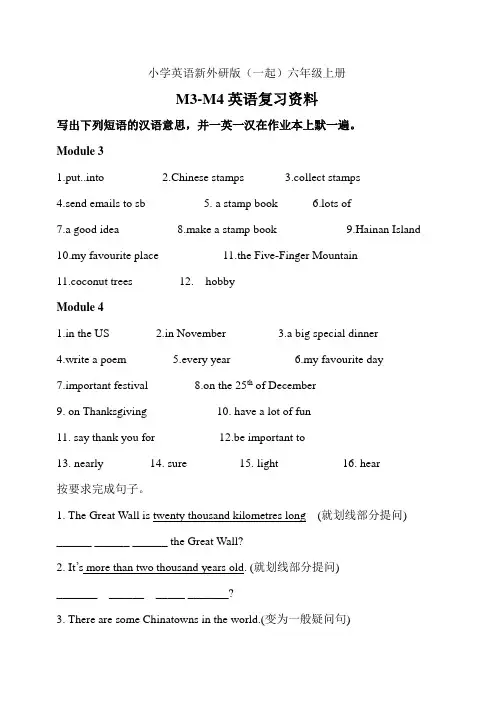
小学英语新外研版(一起)六年级上册M3-M4英语复习资料写出下列短语的汉语意思,并一英一汉在作业本上默一遍。
Module 31.put..into2.Chinese stamps3.collect stamps4.send emails to sb5. a stamp book6.lots of7.a good idea 8.make a stamp book 9.Hainan Island10.my favourite place 11.the Five-Finger Mountain11.coconut trees 12. hobbyModule 41.in the US2.in November3.a big special dinner4.write a poem5.every year6.my favourite day7.important festival 8.on the 25th of December9. on Thanksgiving 10. have a lot of fun11. say thank you for 12.be important to13. nearly 14. sure 15. light 16. hear按要求完成句子。
1. The Great Wall is twenty thousand kilometres long (就划线部分提问) ______ ______ ______ the Great Wall?2. It’s more than two thousand years old. (就划线部分提问)_______ ______ _____ _______?3. There are some Chinatowns in the world.(变为一般疑问句)_______ ______ _______ Chinatowns in the world?4. We ate in a Chinese restaurant. (变为一般疑问句)_____ you _____ in a Chinese restaurant?5. We saw a lion dance in the street. (就划线部分提问)______ ______ you ________ in the street?6. James went to a library yesterday. (就划线部分提问)_______ ______ James _____ yesterday?7. I’m putting my new books into my bag. (就划线部分提问) ______ ______ ______ ________ ?8. There are some apples on the table. (一般疑问句)_____ _______ ______ _______ on the table?9. I have got some stamps from England. (就划线部分提问) _____ _______ you _______ ?10 Have you got any kites? (做否定回答)______, ______ ______11. Can you tell me about Christmas? (做肯定回答)______, _____ _______。

外研五英上M3--M4知识归纳1教学目标知识目标:1.能听懂、会说、认读单词who、then、hair、so、grandparents.2.能理解并使用was ,were来谈论过去的事情和情况。
3.能听懂、会读、理解课文并答复相关的问题。
技能目标:能够运用was和were来描述过去,介绍自己或他人过去的事情。
情感目标:培养学生的观察能力,发现人物和事物过去与现在的变化,保持他们对学习英语的热情。
2学情分析本课的教学对象是四年级学生,他们已经掌握了一定的英语词汇,具有一定的英语学习的积极性,具备一定的英语语言运用能力。
因此,教师应在教学过程中为学生提供适当真实的语言环境,让学生明白本课学习的句型在真实情况下应如何使用。
本节课的语言点对学生的学习有些难度,因此教师要在教学过程中时刻注意学生的接受情况,对学生多加以鼓励,及时调整教学节奏,让学生在听说读写的过程中体验、感知、理解目标语句。
3重点难点重点:词汇:grandparent, then, hair, was, were;句型:I was …… They were ……难点:1、使用“was〞“were〞描述从过去到现在发生的变化。
2、was与were的区分运用及then 的正确发音。
4教学过程活动1【导入】Step1.Warm up1、Greetings2、Count numbers【设计意图:复习数字,并提问与数字有关的问题,让学生更好的理解和参与到后面的教学活动中。
】Step2:Leading1、Revise some wordsBefore our class, let’s play a game和老师唱反调。
I say “long〞and you say “short〞. OK?Ss: OK.T:bigSs: smallT: longSs: shortT: tallSs: short2、L ook at the screen, who is that girl? Can you guess? Ss: It’s….Ss: It’s you.T: Ye s. You are right. It’s me.Then(在那时)I was 2. Now I am 26.(then和now)Then my hair(头发)was short. Now my hair is long.(教授hair)3、Show your photos and introduce your character, and say "I was..."4、出示grandparents年轻时与现在的照片。
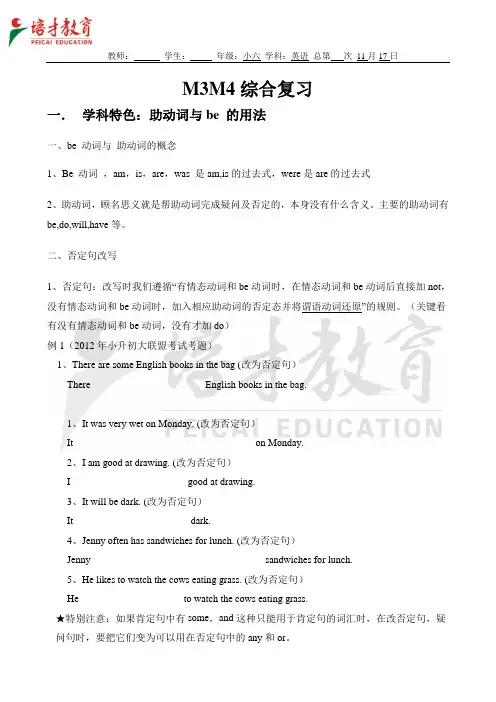
M3M4综合复习一.学科特色:助动词与be 的用法一、be 动词与助动词的概念1、Be 动词,am,is,are,was 是am,is的过去式,were是are的过去式2、助动词,顾名思义就是帮助动词完成疑问及否定的,本身没有什么含义。
主要的助动词有be,do,will,have等。
二、否定句改写1、否定句:改写时我们遵循“有情态动词和be动词时,在情态动词和be动词后直接加not,没有情态动词和be动词时,加入相应助动词的否定态并将谓语动词还原”的规则。
(关键看有没有情态动词和be动词,没有才加do)例1(2012年小升初大联盟考试考题)1、There are some English books in the bag (改为否定句)There ________ ___________ English books in the bag.1、It was very wet on Monday. (改为否定句)It ________ __________ __________ on Monday.2、I am good at drawing. (改为否定句)I ________ __________ good at drawing.3、It will be dark. (改为否定句)It ________ __________ dark.4、Jenny often has sandwiches for lunch. (改为否定句)Jenny ________ __________ __________ sandwiches for lunch.5、He likes to watch the cows eating grass. (改为否定句)He ________ __________ to watch the cows eating grass.★特别注意:如果肯定句中有some,and这种只能用于肯定句的词汇时,在改否定句,疑2、一般疑问句问句的改写遵循“有情态动词和be动词时,将情态动词和be动词提前,没有情态动词和be动词时,句首加入相应助动词并将谓语动词还原”的规则。