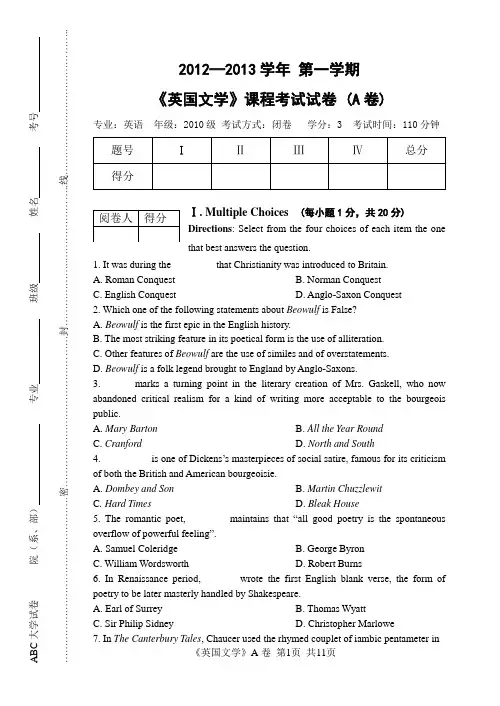
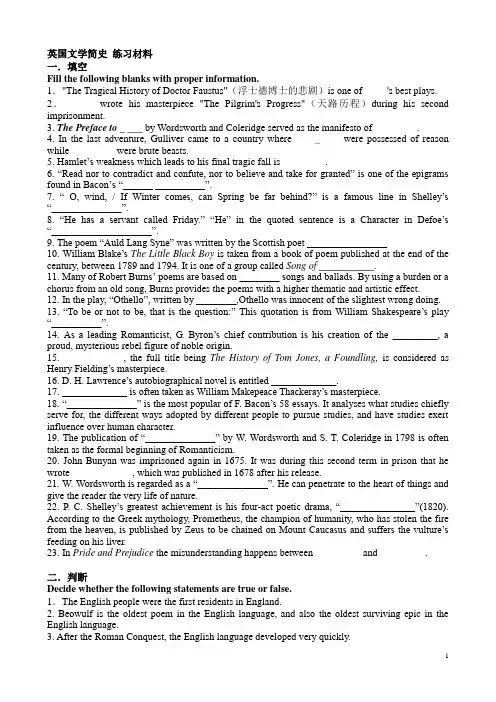
《英国文学》课程考试试卷 (A卷)专业:英语年级:2010级考试方式:闭卷学分:3 考试时间:110分钟Ⅰ. Multiple Choices (每小题1分,共20分)that best answers the question.1. It was during the ________ that Christianity was introduced to Britain.A. Roman ConquestB. Norman ConquestC. English ConquestD. Anglo-Saxon Conquest2. Which one of the following statements about Beowulf is False?A. Beowulf is the first epic in the English history.B. The most striking feature in its poetical form is the use of alliteration.C. Other features of Beowulf are the use of similes and of overstatements.D. Beowulf is a folk legend brought to England by Anglo-Saxons.3. _____ marks a turning point in the literary creation of Mrs. Gaskell, who now abandoned critical realism for a kind of writing more acceptable to the bourgeois public.A. Mary BartonB. All the Year RoundC. CranfordD. North and South4. _________ is one of Dickens’s masterpieces of social satire, famous for its criticism of both the British and American bourgeoisie.A. Dombey and SonB. Martin ChuzzlewitC. Hard TimesD. Bleak House5. The romantic poet, _______ maintains that “all good poetry is the spontaneous overflow of powerful feeling”.A. Samuel ColeridgeB. George ByronC. William WordsworthD. Robert Burns6. In Renaissance period, ______ wrote the first English blank verse, the form of poetry to be later masterly handled by Shakespeare.A. Earl of SurreyB. Thomas WyattC. Sir Philip SidneyD. Christopher Marlowe7. In The Canterbury Tales, Chaucer used the rhymed couplet of iambic pentameter inEnglish, which is to be called later _________.A. the Spenserian StanzaB. the heroic coupletC. the blank verseD. the free verse8. Dr. Faustus is a play based on the _______ legend of a magician aspiring for knowledge and finally meeting his tragic end as a result of selling his soul to the Devil. A. British B. DanishC. GermanD. French9. _________ has been regarded by some as “Father of the English novel”for its contribution to the establishment of the form of the modern novel.A. Daniel DefoeB. Jonathan SwiftC. GermanD. Henry Fielding10. The poem “Elegy Written in a Country Churchyard”is regarded as the most representative work of _______.A. the Metaphysical SchoolB. the Gothic SchoolC. the Romantic SchoolD. The Graveyard School11. Jonathan Swift is a master of satire. He satirizes philosophers and projectors and also makes a reference to the relationship between Ireland and England. It is obvious in _______ in Gulliver’s Travels.A. LilliputB. BrobdingnagC. Flying IslandD. Horse Island12. The two major novelists of the English Romantic Period are ________ and Walter Scott.A. Washington IrvingB. Jane AustenC. Charles DickensD. George Eliot13. Shelley’s greatest achievement is his four-act poetic drama, ________.A. Childe Harold’s PilgrimageB. The Revolt of IslamC. Prometheus UnboundD. Ode to the West Wind14. Most of Hardy’s novels are set in _______, the fictional primitive and crude region which is really the home place he both loves and hates.A. LondonB. ParisC. YoknapatawphaD. Wessex15. John Galsworthy’s masterpiece, The Forsyte Saga includes the following except ________.A. The White MonkeyB. T he Man of PropertyC. In ChanceryD. To Let16. In his famous essay “Tradition and Individual Talent,” ________ puts great emphasis on the importance of tradition both in creative writing and in criticism.A. D.H. LawrenceB. James JoyceC. George Bernard ShawD. T.S. Eliot17. “And where are they? And where art thou,My country? On thy voiceless shoreThe heroic lay is tuneless nowThe heroic bosom beats no more!” (George Gordon Byron, Don Juan)In the above stanza, “art thou” literally means ________.A. art thoughB. are thoughC. are youD. art you18. G.B. Shaw’s play, Mrs. Warren’s Profession, is a realistic exposure of the ______ in the English society.A. inequality between men and womenB. slum landlordismC. economic exploitation of womenD. political corruption19. We can perhaps describe the west wind in Shelley’s poem “Ode to the West Wind”with all the following terms except _______.A. swiftB. tamedC. proudD. wild20. The enlighteners of the 18th century believed that _______ should be usedas the yardstick for the measurement of all human activities and relations.A. educationB. scienceC. emotionD. reasonⅡ.Identification of Fragments (每小题10分,共30分)Directions: please give the name of the author and the title of the literary work from which it is taken and then briefly comment on it. Please writedown the answers on the Answer Sheet.21. “Now might I do it pat, now he is praying:And now I’ll do it: and so he goes to heaven:And so am I revenged. That would be scanned.”22. “It is a truth universally acknowledged, that a single man in possession of a good fortune must be in want of a wife.However little known the feelings or views of views of such a man may be on his first entering a neighborhood, this truth is so well fixed in the minds of the surrounding families, that he is considered as the rightful property of some one or other of their daughters.”23. “All is not lost; the unconquerable will,And study of revenge, immortal hate,And courage never to submit or yield,And what is else not to be overcome;That glory never shall his wrath or might extort (夺取) from me.”Ⅲ.Short Essay Questions (每小题10分,共30分) Directions: Please write down the answers on the Answer Sheet .24. Write a short essay on Byron ’s Don Juan .25. Please comment on Charles Dickens ’ literary achievements .26. Why is Jane Eyre a successful novel?Ⅳ.Appreciating a Literary Work (共20分) Directions : In this part, you are required to write a commentarypaper in no less than 150 words.27. The Rocking-Horse Winner (by D.H. Lawrence)There was a woman who was beautiful, who started with all the advantages, yet she had no luck. She married for love, and the love turned to dust. She had bonny (漂亮的) children, but she did not love them. They looked at her coldly, as if they were finding fault with her. Nevertheless, when her children were present, she was all the more gentle and anxious for her children, as if she loved them very much. Only she herself knew that at the centre of her heart was a hard little place that could not feel love, no, not for anybody. Everybody else said of her: “She is such a good mother. She adores her children.” Only she herself, and her children themselves, knew it was not so. They read it in each other ’s eyes.There were a boy and two little girls. They lived in a pleasant house, with a garden, and they had servants, and felt themselves superior to anyone in the neighborhood. Although they lived in style, they felt always an anxiety in the house. There was never enough money. The mother had a small income, and the father had a small income, but not nearly enough for the social position which they had to keep up. There was always the grinding sense of the shortage of money, though the style was always kept up.The children were growing up, they would have to go to school. There must be more money. The father, who was always very handsome and expensive in his tastes, seemed as if he never would be able to do anything worth doing. And the mother, who had a great belief in herself, did not succeed any better, and her tastes were just as expensive.And so the house came to be haunted by the unspoken phrase: There must be more money! There must be more money! The children could hear it all the time though nobody said it aloud. They heard it at Christmas, when the expensive and splendid toysfilled the nursery. Yet nobody ever said it aloud. The whisper was everywhere, and therefore no one spoke it. Just as no one ever says: “We are breathing!” in spite of the fact that breath is coming and going all the time.“Mother,” said the boy Paul one day, “why don’t we keep a car of our own? Why do we always use uncle’s, or else a taxi?”“Because we’re the poor members of the family,” said the mother.“But why are we, mother?”“Well - I suppose,”she said slowly and bitterly, “it’s because your father has no luck.”“Oh!” said the boy. “Then what is luck, mother?”“It’s what c auses you to have money. If you’re lucky you have money. That’s why it’s better to be born lucky than rich. If you’re rich, you may lose your money. But if you’re lucky, you will al ways get more money.’“Well, anyhow,” he said stoutly, “I’m a lucky person.”“Why?” said his mother, with a sudden laugh.He stared at her. He didn't even know why he had said it. “God told me,” he asserted. “I hope He did, dear!”, she said, again with a laugh, but rather bitter.“He did, mother!” Paul assertedHe went off by himself, and in his room he would sit on his big rocking-horse, driving madly. “Now!”he would silently command the horse. “Now take me to where there is luck! Now take me!” He knew the horse could take him to where there was luck, if only he forced it. At last he stopped forcing his horse and slid down. “Well, I got there!”he announced fiercely, his blue eyes still flaring. “Where did you get?” asked his uncle, “Could you know its name?”“Well, he has different names. He was called Sa nsovino last week.”“Sansovino, eh? Won the Ascot horse-racing. How did you know this name?” asked his uncle.“My horse told me and now I have won 300 pounds by betting the race already. You won’t tell others, right?” answered the boy.“Now, son,” Uncle Oscar said doubtedly, “Let’s check it. There will be a race today. I’m putting twenty on Mirza, and I’ll put five on any horse you fancy. What’s your pick?”“Daffodil this time, uncle.”At last, Daffodil came in first, Lancelot second, Mirza third. His uncle brought himfour five-pound notes, four to one. (四比一的胜率)“What am I to do with these?” the uncle cried, waving the money before boys’ eyes.“I suppose we’ll talk to Bassett, our gardener and he is also my partner in horse-racing,” said the boy. “I expect I have had fifteen hundred now.”Uncle Oscar turned to Bassett and asked how they wined in horse racing. “It’s Master Paul, sir,” said Bassett in a secret, religious voice. “It’s as if he had the news from heaven.” Later, his uncle joined them and Paul even had made ten thousand in a race.“But what are you going to do with your money?” asked the uncle.The boy said, “I started it for mother. She said she had no luck, because father is unlucky, so I thought if I was l ucky, it might stop whispering.”“What might stop whispering?”“Our house. I hate our house for whispering.”“What does it whisper?”The boy answered: “I don't know. But it’s always short of money, you know, uncle. The house whispers, like people laughing at you behind your back. It's awful, that is! I thought if I was lucky,…”“You might stop it,” added the uncle.“Well, then!” said the uncle. “What are we doing?”“I shouldn't like mother to know I was lucky,” said the boy.“All right, son! We’ll manage it without her knowing.”They managed it very easily. Paul, at the other’s suggestion, handed over five thousand pounds to his uncle, who deposited (存入) it with the family lawyer, who was then to inform Paul's mother that a relative had put five thousand pounds into his hands, which sum was to be paid out a thousand pounds at a time, on the mother’s birthday, for the next five years.“So she’ll have a birthday present of a thousand pounds for five succes sive years,”said Uncle Oscar. “I hope it won’t make it all the harder for her later.”Paul’s mother had her birthday in November. The house had been “whispering”worse than ever lately, and, even in spite of his luck. She was down to breakfast on the morning of her birthday. Paul watched her face as she read her letters. He knew the lawyer’s letter. As his mother read it, her face hardened and became more expressionless. Then a cold, determined look came on her mouth. She hid the letter under the pile of others, and said not a word about it.But in the afternoon Uncle Oscar appeared. H e said Paul’s mother had had a longinterview with the lawyer, asking if the whole five thousand could not be advanced at once, as she was in debt.“What do you think, uncle?” said the boy. The uncle said, “I leave it to you, son.”“Oh, let her have it, then! We can get some more with the other,” said the boy.So Uncle Oscar signed the agreement, and Paul’s mother touched the whole five thousand. Then something very curious happened. The voices in the house suddenly went mad, like a chorus of frogs on a spring evening. “There must be more money! Oh-h-h; there must be more money. More than ever! More than eve r!”“I’ve got to know the result for the Derby horse-racing! I’ve got to know for the Derby!” the child reiterated (反复说), his big blue eyes blazing with a sort of madness.Paul’s secret of secrets was his wooden horse, that which had no name. To keep it, he had his rocking-horse removed to his own bedroom at the top of the house.“Surely you’re too big for a rocking-horse!” his mother had remonstrated.(告诫)“Well, you see, mother, till I can have a real horse, I like to have some sort of animal about,” had been his answer.The Derby was drawing near, and the boy grew more and more tense. He hardly heard what was spoken to him, he was very frail, and his eyes were really strange.Two nights before the Derby, she was at a big party in town. But an unrest was so strong that she had to leave the dance and go downstairs to telephone her house. “Are the c hildren all right, Miss Wilmot?”“Oh yes, they are quite all right.”Paul’s mother said: “It's all right. Don’t sit up. We shall be home fairly soon.”It was about one o’clock when Paul’s mother and father drove up to their house. All was still. Pau l’s mother went to her room and slipped off her white fur cloak. She had told her maid not to wait up for her. She heard her husband downstairs, mixing a whisky and soda.And then, because of the strange anxiety at her heart, she stole upstairs to her son’s room. Noiselessly she went along the upper corridor. Was there a faint noise?Then suddenly she switched on the light, and saw her son, in his green pajamas, madly surging on the rocking-horse. The blaze of light suddenly lit him up, as he urged the wooden horse, and lit her up, as she stood, blonde, in her dress of pale green and crystal, in the doorway.“Paul!” she cried. “Whatever are you doing?”“It’s Malabar!” he screamed in a powerful, strange voice. “It’s Malabar!”“What does he mean by Malabar?” asked the heart-frozen mother.“I don’t know,” said the father stonily. “What does he mean by Malabar?” she asked her brother Oscar, who came here as soon as he heard Paul was ill.“It’s one of the horses running for the Derby,” was the answer.The third day of the illness was critical: they were waiting for a change. The boy, with his rather long, curly hair, was tossing ceaselessly on the pillow. He neither slept nor regained consciousness, and his eyes were like blue stones. His mother sat, feeling her heart had gone, turned actually into a stone.The gardener tiptoed into the room and stole to the bedside, staring with glittering, smallish eyes at the tossing, dying child.“Master Paul!” he whispered. “Master Paul! Malabar came in first all right, a clean win. I did as you told me. You've made over seventy thousand pounds, you have; you’ve got over eighty thousand. Malabar c ame in all right, Master Paul.”“I never told you, mother, that if I can ride my horse, and get there, then I’m absolutely sure - oh, absolutely! Mother, did I ever tell you? I am lucky!”“No, you never did,” said his mother. But the boy died in the night.And even as he lay dea d, his mother heard her brother’s voice saying to her, “My God, Hester, you’re eighty thousand to the good, and a poor devil of a son to the bad. But, poor devil, poor devil, he’s best gone out of a life where he rides his rocking-horse to find a winner.”ABC大学2012-2013学年第一学期《英国文学》课程考试试卷答案适用班级:英语系2010级卷型:(A卷)Part I Multiple Choices (每小题 1分,共20分)Part II Identification of Fragments (每小题10分,共30分)21. From William Shakespeare’s Hamlet; (5分)Hamlet has a good chance to kill his uncle, but he hesitated. The reason Hamlet gives for his refusing to kill the king is that if he kills the villain now, he would send his soul to heaven; he would fain kill soul as well as body. What he considers now is no longer his personal wrong but the fate of his country.(5分)22. From Jane Austen’s Pride and Prejudice; (5分)This is the beginning sentences of the novel. During that time, girls’ marriage is the most important thing in a family, especially in those families whose daughters don’t have much pension. These sentences are ironical. It is not those single man who needs a wife but those young maids who are in need of a rich husband. 5分)23. From John Milton’s Paradise Lost; (5分)It’s through Satan’s mouth. Although defeated, he prevails. Since he has won from God the third part of his angels. Though wounded, he triumphs, for the thunder which hit upon his head left his heart invincible. (5分)Part III Short Essay Questions (每小题10分,共30分)24. Don Juan is Byron’s masterpiece, written in Italy during the years 1818-1823. (2分)It is 16,000 lines long, in 16 cantos, and written in ottava rima, each stanza containing 8 iambic pentameter lines rhymed abababcc.(2分)The story of the poem takes place in the latter part of the 18th century. Don Juan, its hero, is a Spanish youth of noble birth. The vicissitudes of his life and his adventures in many countries are described against varied social backgrounds, and he is seen to take part in different historical events, thus giving a broad panorama of contemporary life. (2分)Don Juan, a noble man, falls in love with Julia, a married woman. But the affair is soon discovered and Juan is sent abroad. Juan alone comes out alive and swims to a Greek island, where he is saved by Haidee. Haidee dies, heart-broken and Juan is sold as a slave to Turkey and then to St. Peterburg. The writer intended to let Don Juan go on a tour through Europe, take part in the French Revolution and die fighting against the reigning tyranny. He called this poem an “epic satire.” (4分)25. Charles Dickens is the greatest writer in critical realism. He wrote lots of novels. (2分)Dickens’s literary creation can be divided into three periods: in the first period, Dickens shows strong belief that social evils can be settled if only every employer reformed himself according to the model set by the benevolent gentlemen in his novels, such as The Pickwick Papers and Oliver Twist. In the second period, Dickens came back from America. His travel to America impressed him most there was the rule of dollars and the enormously corrupting influence of wealth and power, such as Martin Chuzzlewit and Dombey and Son. In the third period, Dickens became pessimistic and his major works include Bleak House and Hard Times etc. (4分)As a novelist, Dickens is remembered first of all for his character-portrayal. Another feature of Dickens’s fictional art is his humor and satire. In Dickens’s novels’’construction, the main plot is often interwoven with more than one sub-plot so that some interesting minor characters as well as a broader view of life may be introduced. (4分) 26. The work is one of the most popular and important novels of the Victorian age. It is noted for its sharp criticism of the existing society, e.g. the religious hypocrisy of charity institutions, the social discrimination and the false social convention as concerning love and marriage. At the same time, it is an intense moral fable. (4分)Jane, like Mr. Rochester, has to undergo a series of physical and moral tests to grow up and achieve her final happiness. The success of the novel is also due to its introduction to the English novel the first governess heroine. (2分)Jane Eyre is a completely new woman image. She represents those middle-class working women who are struggling for recognition of their rights and equality as a human being. The vivid description of her intense feelings and her thought and inner conflicts brings her to the heart of the audience. (4分)Part IV Appreciating a Literary Work (计20分)答题要点:Plot. Theme:desire for money causes alienation of human relationship, 3rd person point of view, repletion, language features, short conversations, character analysis, your personal ideas about luck.《英国文学》A卷第11页共11页。