英语各大从句知识点总结
- 格式:docx
- 大小:24.11 KB
- 文档页数:2
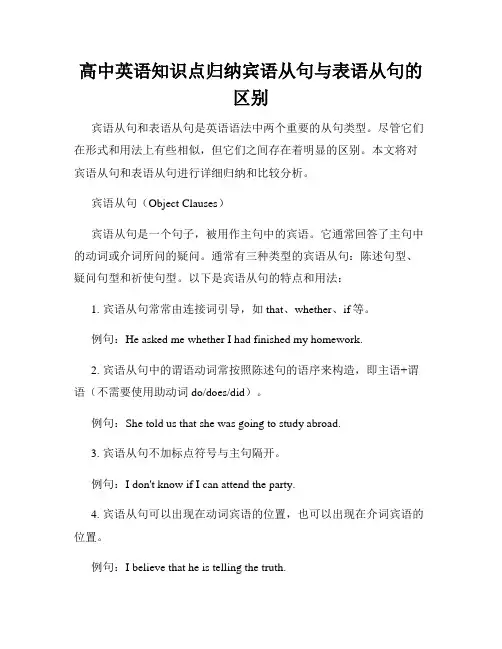
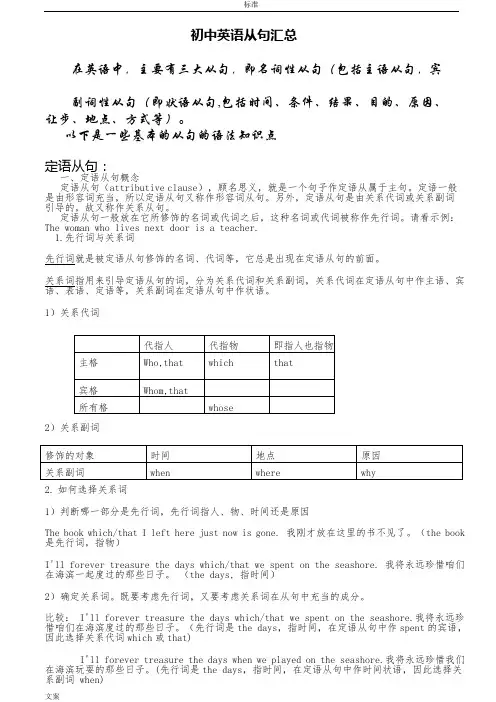
英语各大从句知识点总结
Subordinate Clause: A subordinate clause also contains a subject and a verb, but it does not
express a complete thought and cannot stand alone as a sentence.
Types of Subordinate Clauses:
1. Adverbial Clauses: An adverbial clause functions as an adverb and modifies a verb,
adjective, or adverb in the main clause. It often answers questions such as when, where,
how, why, or to what extent. For example:
- When the sun sets (time), the sky turns orange.
- Because she was tired (reason), she went to bed early.
- Although she studied hard (contrast), she failed the test.
2. Adjectival Clauses: An adjectival clause functions as an adjective and modifies a noun in
the main clause. It often provides more information about the noun. For example:
- The book that I borrowed from the library (identifying), is due next week.
- The car, which my friend drives (non-identifying), is very expensive.
3. Noun Clauses: A noun clause functions as a noun and can act as a subject, object, or
complement in the main clause. For example:
- Whatever she decides (subject), will affect us all.
- I know who stole the money (object).
- The problem is whether we should go ahead with the project (complement).
Relative Clauses: Relative clauses are a type of adjectival clause that uses a relative pronoun
(who, whom, whose, which, that) to connect the clause to the noun it modifies. For example:
- The person (antecedent) who called you (relative clause) wants to speak with you.
That vs. Which: "That" is used to introduce restrictive relative clauses that are essential to
the meaning of the sentence, and "which" is used to introduce non-restrictive relative
clauses that provide additional information. For example:
- The car that is parked in the driveway (restrictive) is mine.
- My car, which is parked in the driveway (non-restrictive), needs to be washed.
Comma Usage with Relative Clauses: Non-restrictive relative clauses are set off by commas,
while restrictive relative clauses are not. For example:
- The girl (antecedent) who is laughing (restrictive) is my friend. - The girl, who is laughing, (non-restrictive) is my friend.
Using "Wh-" Words in Noun Clauses: Noun clauses often begin with "wh-" words such as
"what," "who," "when," "where," "which," "why," and "how."
Example: I don't know who will be attending the meeting.
Using Subordinating Conjunctions: Adverbial clauses often begin with subordinating
conjunctions such as "because," "although," "when," "while," "before," "after," "if," "since,"
and "unless."
Example: Since it was raining, we decided to stay inside.
Incorporating Subordinate Clauses: Subordinate clauses can be incorporated into major
clauses to add complexity and variety to sentences. This can be done through subordination
(when the subordinate clause comes before the main clause) or coordination (when the
subordinate clause comes after the main clause).
Example of Subordination: Although he was tired, John continued working on the project.
Example of Coordination: John continued working on the project, even though he was tired.
Understanding the differences between major and subordinate clauses, as well as the
various types of subordinate clauses, can help improve the complexity and clarity of your
writing. By mastering the use of these clauses, you can create more sophisticated and
nuanced sentences.