
Auditory Processing of Dynamic 'Center-of-Gravity' Signals动态# 39听觉处理;重力# 39中心;信
- 格式:ppt
- 大小:7.25 MB
- 文档页数:51

一、名词解释1.Diachronic历时的It refers to say of the study of developing of language and languages over time.研究语言随时间发展变化的方法。
2.Arbitrariness任意性Saussure first refers to the fact that the forms of linguistic signs bear no natural relationship to their meaning.任意性是指语言符号的形式与所表达的意义之间没有天然或逻辑的联系。
It is refers to absence of any physical correspondence between linguistic signals and the entities to which they refer.任意性是指语言符号和这些符号所指的实体间不存在任何物质的联系。
3.Parole言语It refers to the concrete utterances of a speaker.指语言在实际使用中的实现。
4.Creativity创造性By creativity we mean language is resourceful because of its duality and its recursiveness, which enables human beings to produce and understand an infinitely large number of sentences including the sentences that were never heard before.创造性是指语言具有能产型,因为语言有双重性和递归性,也就是说话者能够结合各个语言单位形成无尽的句子,其中很多句子是以前没有的或者没有听说过的。
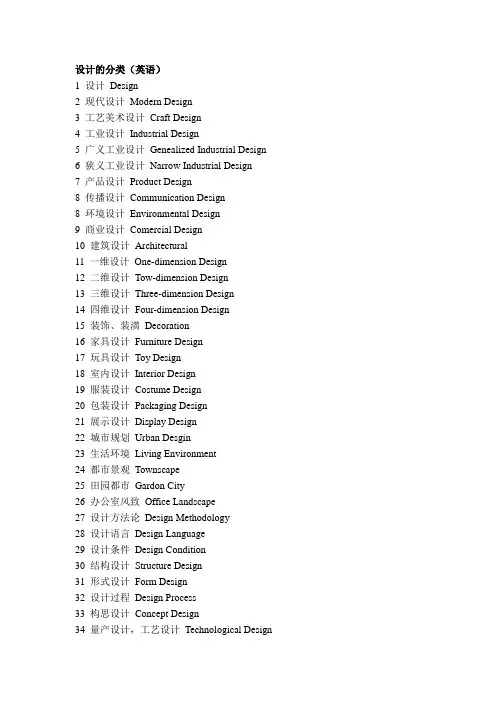
设计的分类(英语)1 设计Design2 现代设计Modern Design3 工艺美术设计Craft Design4 工业设计Industrial Design5 广义工业设计Genealized Industrial Design6 狭义工业设计Narrow Industrial Design7 产品设计Product Design8 传播设计Communication Design8 环境设计Environmental Design9 商业设计Comercial Design10 建筑设计Architectural11 一维设计One-dimension Design12 二维设计Tow-dimension Design13 三维设计Three-dimension Design14 四维设计Four-dimension Design15 装饰、装潢Decoration16 家具设计Furniture Design17 玩具设计Toy Design18 室内设计Interior Design19 服装设计Costume Design20 包装设计Packaging Design21 展示设计Display Design22 城市规划Urban Desgin23 生活环境Living Environment24 都市景观Townscape25 田园都市Gardon City26 办公室风致Office Landscape27 设计方法论Design Methodology28 设计语言Design Language29 设计条件Design Condition30 结构设计Structure Design31 形式设计Form Design32 设计过程Design Process33 构思设计Concept Design34 量产设计,工艺设计Technological Design35 改型设计Model Change36 设计调查Design Survey37 事前调查Prior Survey38 动态调查Dynamic Survey39 超小型设计Compact type40 袖珍型设计Pocktable Type41 便携型设计Protable type42 收纳型设计Selfcontainning Design43 装配式设计Knock Down Type44 集约化设计Stacking Type45 成套化设计Set (Design)46 家族化设计Family (Design)47 系列化设计Series (Design)48 组合式设计Unit Design49 仿生设计Bionics Design50 功能Function51 独创性Originality52 创造力Creative Power53 外装Facing54 创造性思维Creating Thinking55 等价变换思维Equivalent Transformationn Thought56 KJ法Method of K.J57 戈顿法Synectice58 集体创造性思维法Brain Storming59 设计决策(Design) Decision Making60 T-W-M体系T-W-M system61 O-R-M体系O-R-M system62 印象战略Image Stralegy63 AIDMA原则Law of AIDMA64 功能分化Functional Differentiation65 功能分析Functional Analysis66 生命周期Life Cycle67 照明设计Illumination Design设计色彩方法(英)1 色Color2 光谱Spectrum3 物体色Object Color4 固有色Propor Color5 色料Coloring Material6 色觉三色学说Three-Component Theary7 心理纯色Unique Color8 拮抗色学说Opponent Color Theory9 色觉的阶段模型Stage Model of the Color Perception10 色彩混合Color Mixing11 基本感觉曲线Trisimulus Valus Curves12 牛顿色环Newton's Color Cycle13 色矢量Color Vector14 三原色Three Primary Colors15 色空间Color Space16 色三角形Color Triangle17 测色Colourimetry18 色度Chromaticity19 XYZ表色系XYZ Color System20 实色与虚色Real Color and Imaginary Color21 色等式Color Equation22 等色实验Color Matching Experiment23 色温Color Temperature24 色问轨迹Color Temperature Locus25 色彩三属性Three Attribtes and Color26 色相Hue27 色相环Color Cycle28 明度Valve29 彩度Chroma30 环境色Environmetal Color31 有彩色Chromatic Color32 无彩色Achromatic Colors33 明色Light Color34 暗色Dark Color35 中明色Middle Light Color36 清色Clear Color37 浊色Dull Color38 补色Complementary Color39 类似色Analogous Color40 一次色Primary Color41 二次色Secondary Color42 色立体Color Solid43 色票Color Sample44 孟塞尔表色系Munsell's Color System45 奥斯特瓦德表色系Ostwald's Color System46 日本色研色体系Practical Color Co-ordinate System47 色彩工程Color Engineering48 色彩管理Color Control49 色彩再现Color Reproduction50 等色操作Color Matching51 色彩的可视度Visibility Color52 色彩恒常性Color Constancy53 色彩的对比Color Contrast54 色彩的同化Color Assimilation55 色彩的共感性Color Synesthesia56 暖色与冷色Warm Color and Cold Color57 前进色与后退色Advancing Color Receding Color58 膨胀色与收缩色Expansive Color and Contractile Color59 重色与轻色Heavy Color and Light Color60 色价Valeur61 色调Color Tone62 暗调Shade63 明调Tint64 中间调Halftone65 表面色Surface Color66 平面色Film Color67 色彩调和Color Harmony68 配色Color Combination69 孟塞尔色彩调和Munsell's Color Harmony70 奥斯特瓦德色彩调和Ostwald's Color Harmony71 孟.斯本瑟色彩调和Moon.Spencer's Color Harmony72 色彩的感情Feeling of Color73 色彩的象征性Color Symbolism74 色彩的嗜好Color Preference75 流行色Fashion Color76 色彩的功能性Color Functionalism77 色彩规划Color Planning78 色彩调节Color Conditioning79 色彩调整Color Coordinetion80 色彩设计Color Design材料与加工成型技术(英)1 材料Material2 材料规划Material Planning3 材料评价Material Appraisal4 金属材料Metal Materials5 无机材料Inorganic Materials6 有机材料Organic Materials7 复合材料Composite Materials8 天然材料Natural Materials9 加工材料Processing Materials10 人造材料Artificial Materials11 黑色金属Ferrous Metal12 有色金属Nonferrous Metal13 轻金属材料Light Metal Materials14 辅助非铁金属材料Byplayer Nonferrous Metal Materials15 高熔点金属材料High Melting Point Metal Materials16 贵金属材料Precions Metal Materials17 辅助非铁金属材料Byplayer Nonferrous Metal Materials18 高熔点金属材料High Melting Point Metal Materials19 贵金属材料Precions Metal Materials20 陶瓷Ceramics21 水泥Cement22 搪瓷、珐琅Enamel23 玻璃Glass24 微晶玻璃Glass Ceramics25 钢化玻璃Tuflite Glass26 感光玻璃Photosensitive Glass27 纤维玻璃Glass Fiber28 耐热玻璃Hear Resisting Glass29 塑料Plastics30 通用塑料Wide Plastics31 工程塑料Engineering Plastics32 热塑性树脂Thermoplastic Resin33 热固性树脂Thermosetting Resin34 橡胶Rubber35 粘接剂Adhesives36 涂料Paints37 树脂Resin38 聚合物Polymer39 聚丙烯树脂Polypropylene40 聚乙烯树脂Polyethylene Resin41 聚苯乙烯树脂Polystyrene Resin42 聚氯乙烯树脂Polyvinyl Chloride Resin43 丙烯酸树脂Methyl Methacrylate Resin44 聚烯胺树脂,尼龙Polyamide Resin45 氟化乙烯树脂Polyfurol Resin46 聚缩醛树脂Polyacetal Resin47 聚碳酸脂树脂Polycarbonate Resin48 聚偏二氯乙烯树脂Polyvinylidene Resin49 聚醋酸乙烯脂树脂Polyvinyl Acetate Resin50 聚烯亚胺树脂Polyimide Resin51 酚醛树脂Phenolic Formaldehyde Resin52 尿素树脂Urea Formaldehyde Resin53 聚酯树脂Polyester Resin54 环痒树脂Epoxy Resin55 烯丙基树脂Allyl Resin56 硅树脂Silicone Resin57 聚氨酯树脂Polyurethane Resin58 密胺Melamine Formaldehyde Resin59 ABS树脂Acrylonitrile Butadiene Styrene Redin60 感光树脂Photosensition Plastics61 纤维强化树脂Fiber Reinforced Plastic62 印刷油墨Printing Ink63 印刷用纸Printing Paper64 铜板纸Art Paper65 木材Wood66 竹材Bamboo67 树脂装饰板Decorative Sheet68 蜂窝机制板Honey Comb Core Panel69 胶合板Veneer70 曲木Bent Wood71 浸蜡纸Waxed Paper72 青铜Bronge73 薄壳结构Shell Construction74 技术Technic75 工具Tool76 金工Metal Work77 铸造Casting78 切削加工Cutting79 压力加工Plastic Working80 压力加工Plastic Working81 焊接Welding82 板金工Sheetmetal Woek83 马赛克Mosaic84 塑性成型Plastic Working85 灌浆成型Slip Casting86 挤出成型Sqeezing87 注压成型Injection Molding88 加压成型Pressing89 水压成型Cold Isostatic Pressing90 加压烧结法Hot Pressing91 HIP成型Hot Isostatic Pressing92 压缩成型Compression Molding Pressing93 气压成型Blow Molding94 压延成型Calendering95 转送成型Transfer Molding96 雌雄成型Slash Molding97 铸塑成型Casting98 喷涂成型Spray Up99 层积成型Laminating100 FW法Fillament Winding101 粘接与剥离Adhesion and Excoriation 102 木材工艺Woodcraft103 竹材工艺Bamboo Work104 表面技术Surface Technology105 镀饰Plating106 涂饰Coating107 电化铝Alumite108 烫金Hot Stamping109 预制作Prefabrication110 预制住宅Prefabricated House111 悬臂梁Cantilever112 金属模具Mold113 型板造型Modeling of Teplate114 染料Dyestuff115 颜料Artist Color传播与传媒设计(英)1 传播Communication2 大众传播Mass Communication3 媒体Media4 大众传播媒体Mass Media5 视觉传播Visual Communication6 听觉传播Hearing Communication7 信息Information8 符号Sign9 视觉符号Visual Sign10 图形符号Graphic Symbol11 符号论Semiotic12 象征Symbol13 象征标志Symbol Mark14 音响设计Acoustic Design15 听觉设计Auditory Design16 听觉传播设计Auditory Communication Design17 图象设计Visual Communication Design18 视觉设计Visual Design19 视觉传播设计Visual Communication Design20 图形设计Graphic Design21 编辑设计Editorial Design22 版面设计Layout23 字体设计Lettering24 CI设计Corporate Identity Design25 宣传Propaganda26 广告Advertising27 广告委托人Advertiser28 广告代理业Advertising Agency29 广告媒体Advertising Media30 广告目的Avertising Objectives31 广告伦理Morality of Advertising32 广告法规Law of Advertising33 广告计划Advertising Planing34 广告效果Advertising Effect35 广告文案Advertising Copy36 广告摄影Advertising Photography37 说明广告Informative Advertising38 招贴画海报Poster39 招牌Sign-board40 小型宣传册Pamphlet41 大型宣传册Portfolio42 商品目录Catalogue43 企业商报House Organ44 户外广告Outdoor Advertising45 POP广告Point of Purchase Advertising46 展示Display47 橱窗展示Window Display48 展示柜Cabinet49 博览会Exposition50 万国博览会World Exposition51 包装Packaging52 工业包装Industrial Packing53 标签Label54 企业形象Corporate Image55 企业色Company Color56 动画Animation57 插图Illustration58 书法Calligraphy59 印刷Initial60 设计费design fee61 标准standard62 注册商标registered trade mark设计美学与设计实验(英语)1 美Beauty2 现实美Acture Beauty3 自然美Natural Beauty4 社会美Social Beauty5 艺术美Artisitc Beauty6 内容与形式Content and Form7 形式美Formal Beauty8 形式原理Principles and Form9 技术美Beauty of Technology10 机械美Beauty of Machine11 功能美Functional Beauty12 材料美Beauty of Material13 美学Aesthetics14 技术美学Technology Aesthetics15 设计美学Design Aesthetics16 生产美学PAroduction Aesthetics17 商品美学Commodity Aedthetics18 艺术Art19 造型艺术Plastic Arts20 表演艺术Performance Art21 语言艺术Linguistic Art22 综合艺术Synthetic Arts23 实用艺术Practical Art24 时间艺术Time Art25 空间艺术Spatial Art26 时空艺术Time and Spatial Art27 一维艺术One Dimantional28 二维艺术two Dimantional29 三维艺术Three Dimantional30 四维艺术Four Dimantional31 舞台艺术Stagecraft32 影视艺术Arts of Mmovie and Television33 环境艺术Environmental Art34 美术Fine Arts35 戏剧Drama36 文学Literature37 意匠Idea38 图案Pattern39 构思Conception40 构图Composition41 造型Formation42 再现Representation43 表现Expression44 构成Composition45 平面构成Tow Dimentional Composition46 立体构成Three Dimentional Composition47 色彩构成Color Composition48 空间构成Composition of Space49 音响构成Composition and Sound50 多样与统一Unity of Multiplicity51 平衡Balance52 对称Symmetry53 调和、和声Harmony54 对比Contrast55 类似Similarity56 比例Proportion57 黄金分割Golden Section58 节奏Rhythm59 旋律Melody60 调子Tone61 变奏Variation62 纹样Pattern63 形态Form64 有机形态Organic Form65 抽象形态Abstract Form66 简化形态Simptified Form67 变形Deformation68 图学Graphics69 透视画法Perspective70 线透视Linear Perspective71 视点Eye on Picture Plane72 灭点Vanishing Point73 平行透视Parallel Persective74 成角透视Angular Perspective75 斜透视Obligue Perspective76 单点透视Single Paint Perdpective77 两点透视Tow-Point Perdpective78 三点透视Three-Point Perdpective79 鸟瞰图Bird's Eye View80 平面视图Ground Plain81 轴侧投影Axonometric Projection82 设计素描Design Sketch83 预想图Rendering84 模型Model85 粘土模型Clay Model86 石膏模型Plaster Model87 木制模型Wooden Model88 缩尺模型Scale Model89 原大模型Mock Up90 仿真模型Finished Model91 制造原形Prototype92 计算机图形学Computer Graphics93 框架模型Frame Model94 实体模型Solid Model95 计算机辅助设计COMPUTER AIDED DESIGN96 计算机辅助制造Computer Aided Manufacture97 计算机三维动画Computer Three Dimentional Animation98 计算机艺术Computer Arts99 计算机书法Computer Calligraphy100 计算机图象处理Computer Image Processing101 计算机音响构成Computer Sound Composition设计思潮与流派(英)1 学院派Academicism2 理性主义Rationalism3 非理性主义Irrationalism4 古典主义Classicism5 浪漫主义Romanticism6 现实主义Realism7 印象主义Impressionism8 后印象主义Postimpressionism9 新印象主义Neo-Impressionisme(法)10 那比派The Nabject11 表现主义Expressionism12 象征主义Symbolism13 野兽主义Fauvism14 立体主义Cubism15 未来主义Futurism16 奥弗斯主义Orphism17 达达主义Dadaisme(法)18 超现实主义Surrealism19 纯粹主义Purism20 抽象艺术Abstract Art21 绝对主义,至上主义Suprematism22 新造型主义Neo-plasticisme(法)23 风格派De Stiji24 青骑士Der Blaus Reiter25 抒情抽象主义Lyric Abstractionism26 抽象表现主义Abstract Expressionism27 行动绘画Action Painting28 塔希主义Tachisme(法)29 视幻艺术Op Art30 活动艺术、机动艺术Kinetic Art31 极少主义Minimalism32 概念主义Conceptualism33 波普艺术Pop Art34 芬克艺术、恐怖艺术Funk Art35 超级写实主义Super Realism36 人体艺术Body Art37 芝加哥学派Chicago School38 艺术与手工艺运动The Arts & Crafts Movement39 新艺术运动Art Nouveau40 分离派Secession41 构成主义Constructivism42 现代主义Modernism43 包豪斯Bauhaus44 阿姆斯特丹学派Amsterdam School45 功能主义Functionalism46 装饰艺术风格Art Deco(法)47 国际风格International Style48 流线型风格Streamlined Forms49 雅典宪章Athens Charter50 马丘比丘宪章Charter of Machupicchu51 斯堪的纳维亚风格Scandinavia Style52 新巴洛克风格New Baroque53 后现代主义Postmodernism54 曼菲斯Memphis55 高技风格High Tech56 解构主义Deconstructivism57 手工艺复兴Crafts Revival58 准高技风格Trans High Tech59 建筑风格Architecture60 微建筑风格Micro-Architecture61 微电子风格Micro-Electronics62 晚期现代主义Late Moddernism(英文版)Two regulations promulgated for implementation is in the party in power for a long time and the rule of law conditions, the implementation of comprehensive strictly strategic plan, implementation in accordance with the rules and discipline to manage the party, strengthen inner-party supervision of major initiatives. The two regulations supporting each other, the < code > adhere to a positive advocate, focusing on morality is of Party members and Party leading cadres can see, enough to get a high standard; < rule > around the party discipline, disciplinary ruler requirements, listed as "negative list, focusing on vertical gauge, draw the party organizations and Party members do not touch the" bottom line ". Here, the main from four square face two party rules of interpretation: the first part introduces two party Revised regulations the necessity and the revision process; the second part is the interpretation of the two fundamental principles of the revision of laws and regulations in the party; the third part introduces two party regulations modified the main changes and needs to grasp several key problems; the fourth part on how to grasp the implementation of the two regulations of the party. < code > and < Regulations > revised the necessity and revisedhistory of the CPC Central Committee the amendment to the Chinese Communist Party members and leading cadres honest politics several guidelines > and < Chinese Communist Party discipline and Punishment Regulations > column 1 by 2015 to strengthen party laws and regulations focus. Two party regulations revision work lasted a Years, pooling the wisdom of the whole party, ideological consensus, draw historical experience, respect for the wisdom of our predecessors, which reflects the unity of inheritance and innovation; follow the correct direction, grasp the limited goals, adhere to the party's leadership, to solve the masses of the people reflect a focus on the problem. The new revision of the < code > and < rule >, reflects the party's 18 and the eighth session of the third, the spirit of the fourth plenary session, reflecting the experience of studying and implementing the General Secretary Xi Jinping series of important speech, reflects the party's eighteen years comprehensive strictly practice. (a) revised two regulations of the party need of < the ICAC guidelines > in < in 1997 Leaders as members of the Communist Party of China clean politics certain criteria (Trial) > based on revised, the promulgation and implementation of January 2010, to strengthen the construction of the contingent of leading cadres play animportant role. But with the party to manage the party strictly administering the deepening, has not been able to fully meet the actual needs. Content is too complicated, "eight prohibition, 52 are not allowed to" hard to remember, and also difficult to put into practice; the second is concisely positive advocated by the lack of prohibited provisions excessive, no autonomy requirements; the third is banned terms and discipline law, both with the party discipline, disciplinary regulations repeat and Criminal law and other laws and regulations repeat; the fourth is to "clean" the theme is not prominent, not for the existing problems, and is narrow, only needle of county-level leading cadres above. < rule > is in 1997 < Chinese Communist Party disciplinary cases (Trial) > based on revision, in December 2003 the promulgation and implementation, to strengthen the construction of the party play very important role. Along with the development of the situation, which many provisions have been unable to fully meet the comprehensive strictly administering the practice needs. One is Ji law, more than half of the provisions and criminal law and other countries laws and regulations Repetition; two is the political discipline regulations is not prominent, not specific, for violation of the party constitution, damage theauthority of Party Constitution of misconduct lack necessary and serious responsibility to pursue; third is the main discipline for the leading cadres, does not cover all Party members. Based on the above situation, need to < the criterion of a clean and honest administration > and < rule > the two is likely to be more relevant regulations first amendment. By revising, really put the authority of Party discipline, the seriousness in the party tree and call up the majority of Party members and cadres of the party constitution of party compasses party consciousness. (II) two party regulations revision process the Central Committee of the Communist Party of China attaches great importance to two regulations revision . Xi Jinping, general books recorded in the Fifth Plenary Session of the eighth session of the Central Commission for Discipline Inspection, on the revised regulations < > made clear instructions. According to the central deployment, the Central Commission for Discipline Inspection from 2014 under six months begin study two regulations revision. The Standing Committee of the Central Commission for Discipline Inspection 4 review revised. Comrade Wang Qishan 14 times held a special meeting to study two regulations revision, amendment clarifies the direction, major issues of principle, path and target,respectively held a forum will listen to part of the province (area) secretary of the Party committee, Secretary of the Discipline Inspection Commission, part of the central ministries and state organs DepartmentThe first party committee is mainly responsible for people, views of experts and scholars and grassroots party organizations and Party members. Approved by the Central Committee of the Communist Party of China, on 7 September 2015, the general office of the Central Committee of the Party issued a notice to solicit the provinces (autonomous regions, municipalities) Party, the central ministries and commissions, state ministries and commissions of the Party (party), the General Political Department of the military, every 3 people organization of Party of two regulations revision opinion. Central Commission for Discipline Inspection of extensive solicitation of opinions, careful study, attracting, formed a revised sent reviewers. In October 8 and October 12, Central Committee Political Bureau Standing Committee and the Political Bureau of the Central Committee After consideration of the two regulations revised draft. On October 18, the Central Committee of the Communist Party of China formally issued two regulations. Can say, two laws amendment concentrated thewisdom of the whole party, embodies the party. Second, < code > and < Regulations > revision of the basic principles of two party regulations revision work and implement the party's eighteen, ten eight plenary, the spirit of the Fourth Plenary Session of the Eleventh Central Committee and General Secretary Xi Jinping important instructions on the revised < low political criterion > and < Regulations >, highlighting the ruling party characteristics, serious discipline, the discipline quite in front of the law, based on the current, a long-term, advance as a whole, with Bu Xiuding independent < rule > and < rule >. Main principle is: first, adhere to the party constitution to follow. The constitution about discipline and self-discipline required specific, awaken the party constitution of party compasses party consciousness, maintaining the authority of the constitution. General Secretary Xi Jinping pointed out that "no rules, no side round. Party constitution is the fundamental law, the party must follow the general rules. In early 2015 held the eighth session of the Central Commission for Discipline Inspection Fifth Plenary Session of the 16th Central Committee, Xi Jinping again pointed out that constitution is the party must follow the general rules, but also the general rules." the revision of the< code > and < rule > is Method in adhere to the regulations established for the purpose of combining rule of virtue is to adhere to the party constitution as a fundamental to follow, the constitution authority set up, wake up the party constitution and party rules the sense of discipline, the party constitution about discipline and self-discipline specific requirements. 4 second is to adhere to in accordance with the regulations governing the party and the party. The Party of rule of virtue "de", mainly refers to the party's ideals and beliefs, excellent traditional style. The revised the < code > closely linked to the "self-discipline", insisting on the positive initiative, for all members, highlight the "vital few", emphasized self-discipline, focusing on the morality, and the majority of Party members and the ideological and moral standards. The revised < > Ji method separately, Ji, Ji Yan to Method, as a "negative list", emphasizing the heteronomy, focusing on vertical gauge. Is this one high and one low, a positive reaction, the strict party discipline and practice results transformation for the integration of the whole party to observe moral and discipline requirements, for the majority of Party members and cadres provides benchmarking and ruler. Third, insist on to. In view of the problems existing in theparty at the present stage, the main problems of Party members and cadres in the aspect of self-discipline and abide by the discipline to make clearly defined, especially the party's eighteen years strict political discipline and political rules, organization and discipline and to implement the central eight provisions of the spirit against the four winds and other requirements into Disciplinary provisions. Not one pace reachs the designated position, focusing on in line with reality, pragmatic and effective. After the revision of major changes, major changes in the < code > and < rule > modified and needs to grasp several key problems (a) < code > < code > adhere to according to regulations governing the party and party with morals in combination, for at the present stage, the leadership of the party members and cadres and Party members in existing main problems of self-discipline, put forward principles, requirements and specifications, showing Communists noble moral pursuit, reflected at all times and in all over the world ethics from high from low 5 common requirements. One is closely linked to the "self-discipline", removal and no direct relation to the provisions of . the second is adhere to a positive advocate, "eight prohibition" 52 are not allowed to "about the content of the" negative list moved into synchronizationamendment < cases >. Three is for all the party members, will apply object from the leadership of the party members and cadres to expand to all Party members, fully embodies the comprehensive strictly required. The fourth is prominent key minority, seize the leadership of the party members and cadres is the key, and put forward higher requirements than the ordinary Party members. Five is to simplify, and strive to achieve concise, easy to understand, easy to remember. The revised < code > is the ruling Party since the first insists on a positive advocate forAll Party members and the self-discipline norms, moral declaration issued to all members of the party and the National People's solemn commitment. > < criterion of a clean and honest administration consists of 4 parts, 18, more than 3600 words. After the revision of the < code >, a total of eight, 281 words, including lead, specification and Party member cadre clean fingered self-discipline norms, etc. Part 3 members low-cost clean and self-discipline, the main contents can be summarized as "four must" "eight code". Lead part, reiterated on ideal and faith, fundamental purpose, the fine traditions and work style, noble sentiments, such as "four must" the principle of requirements, strong tone of self-discipline, The higher request for 6 andsupervised tenet, the foothold in permanent Bao the party's advanced nature and purity, to reflect the revised standards requirements. Members of self-discipline norms around the party members how to correctly treat and deal with the "public and private", "cheap and rot" thrifty and extravagance "bitter music", put forward the "four norms". Party leader cadre clean fingered self-discipline norms for the leadership of the party members and cadres of the "vital few", around the "clean politics", from civil servant of the color, the exercise of power, moral integrity, a good family tradition and other aspects of the leadership of the party members and cadres of the "four norms" < > < norm norm. "The Party member's self-discipline norms" and "party members and leading cadre clean fingered self-discipline norms," a total of eight, collectively referred to as the "eight". "Four must" and "eight" of the content from the party constitution and Party's several generation of leaders, especially Xi Jinping, general secretary of the important discussion, refer to the "three discipline and eight points for attention" statements, and reference some embody the Chinese nation excellent traditional culture essence of epigrams. (2) the revised regulations, the main changes in the revised Regulations > to fully adapt to thestrictly requirements, reflects the according to the regulations governing the law of recognition of deepening, the realization of the discipline construction and Jin Ju. < rule > is party a ruler, members of the basic line and follow. And the majority of Party members and cadres of Party organizations at all levels should adhere to the bottom line of thinking, fear discipline, hold the bottom line, as a preventive measure, to keep the party's advanced nature and purity. 1, respect for the constitution, refinement and discipline. Revised < rule > from comprehensive comb physical constitution began, the party constitution and other regulations of the Party of Party organizations and Party discipline requirements refinement, clearly defined in violation of the party constitution will be in accordance with regulations to give the corresponding disciplinary action. The original 10 categories of misconduct, integration specification for political discipline, discipline, honesty and discipline masses Ji Law and discipline and discipline and other six categories, the content of < rule > real return to Party discipline, for the majority of Party members and listed a "negative list. 7 2, highlighting the political discipline and political rules. > < Regulations according to the stage of the discipline of outstandingperformance, emphasizing political discipline and political rules, organization and discipline, in opposition to the party's leadership and the party's basic theory, basic line, basic program and basic experience, the basic requirement of behavior made prescribed punishment, increase the cliques, against the organization such as violation of the provisions, to ensure that the central government decrees and the Party of centralized and unified. 3, adhere to strict discipline in the law and discipline In front, Ji separated. Revised < Regulations > adhere to the problem oriented, do Ji separated. Any national law existing content, will not repeat the provisions, the total removal of 79 and criminal law, repeat the content of the public security management punishment law, and other laws and regulations. In the general reiterated that party organizations and Party members must conscientiously accept the party's discipline, die van comply with national laws and regulations; at the same time, to investigate violations of Party members and even criminal behavior of Party discipline and responsibility, > < Regulations distinguish five different conditions, with special provisions were made provisions, so as to realize the connection of Party discipline and state law. 4, reflect Wind building and anti-corruption。

剑桥雅思阅读9原文翻译及答案(test2)为了帮助大家备考雅思口语,店铺为大家整理收集了剑桥雅思阅读9真题:test2阅读原文翻译及答案解析,希望对各位考生的备考有所帮助,祝每位烤鸭考试顺利,都能取得好成绩!剑桥雅思阅读9原文(test2)READING PASSAGE 1You should spend about 20 minutes on Questions 1-13, which are based on Reading Passage 1 below.A. Hearing impairment or other auditory function deficit in young children can have a major impact on their development of speech and communication, resulting in a detrimental effect on their ability to learn at school. This is likely to have major consequences for the individual and the population as a whole. The New Zealand Ministry of Health has found from research carried out over two decades that 6-10% of children in that country are affected by hearing loss.B. A preliminary study in New Zealand has shown that classroom noise presents a major concern for teachers and pupils. Modern teaching practices, the organization of desks in the classroom, poor classroom acoustics, and mechanical means of ventilation such as air-conditioning units all contribute to the number of children unable to comprehend the teacher’s voice. Education researchers Nelson and Soli have also suggested that recent trends in learning often involve collaborative interaction of multiple minds and tools as much as individual possession of information. This all amounts to heightened activity and noise levels, which have the potential to be particularly serious for children experiencing auditory function deficit. Noise in classrooms can only exacerbate their difficulty in comprehendingand processing verbal communication with other children and instructions from the teacher.C. Children with auditory function deficit are potentially failing to learn to their maximum potential because of noise levels generated in classrooms. The effects of noise on the ability of children to learn effectively in typical classroom environments are now the subject of increasing concern. The International Institute of Noise Control Engineering (I-INCE), on the advice of the World Health Organization, has established an international working party, which includes New Zealand, to evaluate noise and reverberation control for school rooms.D. While the detrimental effects of noise in classroom situations are not limited to children experiencing disability, those with a disability that affects their processing of speech and verbal communication could be extremely vulnerable. The auditory function deficits in question include hearing impairment, autistic spectrum disorders (ASD) and attention deficit disorders (ADD/ADHD).E. Autism is considered a neurological and genetic life-long disorder that causes discrepancies in the way information is processed. This disorder is characterized by interlinking problems with social imagination, social communication and social interaction. According to Janzen, this affects the ability to understand and relate in typical ways to people, understand events and objects in the environment, and understand or respond to sensory stimuli. Autism does not allow learning or thinking in the same ways as in children who are developing normally. Autistic spectrum disorders often result in major difficulties in comprehending verbal information and speech processing. Those experiencing these disorders often findsounds such as crowd noise and the noise generated by machinery painful and distressing. This is difficult to scientifically quantify as such extra-sensory stimuli vary greatly from one autistic individual to another. But a child who finds any type of noise in their classroom or learning space intrusive is likely to be adversely affected in their ability to process information.F. The attention deficit disorders are indicative of neurological and genetic disorders and are characterized by difficulties with sustaining attention, effort and persistence, organization skills and disinhibition. Children experiencing these disorders find it difficult to screen out unimportant information, and focus on everything in the environment rather than attending to a single activity. Background noise in the classroom becomes a major distraction, which can affect their ability to concentrate.G. Children experiencing an auditory function deficit can often find speech and communication very difficult to isolate and process when set against high levels of background noise. These levels come from outside activities that penetrate the classroom structure, from teaching activities, and other noise generated inside, which can be exacerbated by room reverberation. Strategies are needed to obtain the optimum classroom construction and perhaps a change in classroom culture and methods of teaching. In particular, the effects of noisy classrooms and activities on those experiencing disabilities in the form of auditory function deficit need thorough investigation. It is probable that many undiagnosed children exist in the education system with ‘invisible’ disabilities. Their needs are less likely to be met than those of children with known disabilities.H. The New Zealand Government has developed a NewZealand Disability Strategy and has embarked on a wide-ranging consultation process. The strategy recognizes that people experiencing disability face significant barriers in achieving a full quality of life in areas such as attitude, education, employment and access to service. Objective 3 of the New Zealand Disability Strategy is to ‘Provide the Best Education for Disabled People’ by improving education so that all children, youth learners and adult learners will have equal opportunities to learn and develop within their already existing local school. For a successful education, the learning environment is vitally significant, so any effort to improve this is likely to be of great benefit to all children, but especially to those with auditory function disabilities.I. A number of countries are already in the process of formulating their own standards for the control and reduction of classroom noise. New Zealand will probably follow their example. The literature to date on noise in school rooms appears to focus on the effects on schoolchildren in general, their teachers and the hearing impaired. Only limited attention appears to have been given to those students experiencing the other disabilities involving auditory function deficit. It is imperative that the needs of these children are taken into account in the setting of appropriate international standards to be promulgated in future.Questions 1-6Reading Passage 1 has nine sections, A-I.Which section contains the following information?Write the correct letter, A-I, in boxes 1-6 on your answer sheet.1 an account of a national policy initiative2 a description of a global team effort3 a hypothesis as to one reason behind the growth inclassroom noise4 a demand for suitable worldwide regulations5 a list of medical conditions which place some children more at risk from noise than others6 the estimated proportion of children in New Zealand with auditory problemsQuestions 7-10Answer the questions below.Choose NO MORE THAN TWO WORDS AND/OR A NUMBER from the passage for each answer.Write your answers in boxes 7-10 on your answer sheet.7 For what period of time has hearing loss in schoolchildren been studied in New Zealand?8 In addition to machinery noise, what other type of noise can upset children with autism?9 What term is used to describe the hearing problems of schoolchildren which have not been diagnosed?10 What part of the New Zealand Disability Strategy aims to give schoolchildren equal opportunity?Questions 11 and 12Choose TWO letters, A-F.Write the correct letters in boxes 11 and 12 on your answer sheet.The list below includes factors contributing to classroom noise.Which TWO are mentioned by the writer of the passage?A current teaching methodsB echoing corridorsC cooling systemsD large class sizesE loud-voiced teachersF playground gamesQuestion 13Choose the correct letter, A, B, C or D.Write the correct letter in box 13 on your answer sheet.What is the writer’s overall purpose in writing this article?A to compare different methods of dealing with auditory problemsB to provide solutions for overly noisy learning environmentsC to increase awareness of the situation of children with auditory problemsD to promote New Zealand as a model for other countries to followREADING PASSAGE 2You should spend about 20 minutes on Questions 14-26, which are based on Reading Passage 2 below.Venus in transitJune 2004 saw the first passage, known as a ‘transit’, of the planet Venus across the face of the Sun in 122 years. Transits have helped shape our view of the whole Universe, as Heather Cooper and Nigel Henbest explainA. On 8 June 2004, more than half the population of the world were treated to a rare astronomical event. For over six hours, the planet Venus steadily inched its way over the surface of the Sun. This ‘transit’ of Venus was the first since 6 December 1882. On that occasion, the American astronomer Professor Simon Newcomb led a party to South Africa to observe the event. They were based a t girls’ school, where — it is alleged — the combined forces of three schoolmistresses outperformed the professionals with the accuracy of their observations.B. For centuries, transits of Venus have drawn explorers and astronomers alike to the four corners of the globe. And you can put it all down to the extraordinary polymath Edmond Halley. In November 1677, Halley observed a transit of the innermost planet, Mercury, from the desolate island of St Helena in the South Pacific. He realized that, from different latitudes, the passage of the planet across the Sun’s disc would appear to differ. By timing the transit from two widely-separated locations, teams of astronomers could calculate the parallax angle — the apparent difference in position of an astronomical body due to a difference in the observer’s position. Calculating this angle would allow astronomers to measure what was then the ultimate goal: the distance of the Earth from the Sun. This distance is known as the ‘astronomical unit’ or AU.C. Halley was aware that the AU was one of the most fundamental of all astronomical measurements. Johannes Kepler, in the early 17th century, had shown that the distances of the planets from the Sun governed their orbital speeds, which were easily measurable. But no-one had found a way to calculate accurate distances to the planets from the Earth. The goal was to measure the AU; then, knowing the orbital speeds of all the other planets round the Sun, the scale of the Solar System would fall into place. However, Halley realized that Mercury was so far away that its parallax angle would be very difficult to determine. As Venus was closer to the Earth, its parallax angle would be larger, and Halley worked out that by using Venus it would be possible to measure the Sun’s di stance to 1 part in 500. But there was a problem: transits of Venus, unlike those of Mercury, are rare, occurring in pairs roughly eight years apart every hundred or so years. Nevertheless, he accurately predicted that Venus wouldcross the face of the Sun in both 1761 and 1769 — though he didn’t survive to see either.D. Inspired by Halley’s suggestion of a way to pin down the scale of the Solar System, teams of British and French astronomers set out on expeditions to places as diverse as India and Siberia. But things weren’t helped by Britain and France being at war. The person who deserves most sympathy is the French astronomer Guillaume Le Gentil. He was thwarted by the fact that the British were besieging his observation site at Pondicherry in India. Fleeing on a French warship crossing the Indian Ocean, Le Gentil saw a wonderful transit —but the ship’s pitching and rolling ruled out any attempt at making accurate observations. Undaunted, he remained south of the equator, keeping himself busy by studying the islands of Maurtius and Madagascar before setting off to observe the next transit in the Philippines. Ironically after travelling nearly 50,000 kilometres, his view was clouded out at the last moment, a very dispirting experience.E. While the early transit timings were as precise as instruments would allow, the measurements were dogged by the ‘black drop’ effect. When Venus begins to cross the Sun’s disc, it looks smeared not circular — which makes it difficult to establish timings. This is due to diffraction of light. The second problem is that Venus exhibits a halo of light when it is seen just outside the sun’s disc. While this showed astronomers that Venus was surrounded by a thick layer of gases refracting sunlight around it, both effects made it impossible to obtain accurate timings.F. But astronomers laboured hard to analyse the results of these expeditions to observe Venus transits. Johann Franz Encke,Director of the Berlin Observatory, finally determined a value for the AU based on all these parallax measurements: 153,340,000 km. Reasonably accurate for the time, that is quite close to today’s value of 149,597,870 km, determined by radar, which has now superseded transits and all other methods in accuracy. The AU is a cosmic measuring rod, and the basis of how we scale the Universe today. The parallax principle can be extended to measure the distances to the stars. If we look at a star in January —when Earth is at one point in its orbit — it will seem to be in a different position from where it appears six months late. Knowing the width of Earth’s orbit, the parallax shift lets astronomers calculate the distance.G. June 2004’s transit of Venus was thus more of an astronomical spectacle than a scientifically important event. But such transits have paved the way for what might prove to be one of the most vital breakthroughs in the cosmos — detecting Earth-sized planets orbiting other stars.Questions 14-17Reading Passage 2 has seven paragraphs, A-G.Which paragraph contains the following information?Write the correct letter, A-G, in boxes 14-17 on your answer sheet.14 examples of different ways in which the parallax principle has been applied15 a description of an event which prevented a transit observation16 a statement about potential future discoveries leading on from transit observations17 a description of physical states connected with Venus which early astronomical instruments failed to overcomeQuestions 18-21Look at the following statements (Questions 18-21) and the list of people below.Match each statement with the correct person, A, B, C or D.Write the correct letter, A, B, C or D, in boxes 18-21 on your answer sheet.18 He calculated the distance of the Sun from the Earth based on observations of Venus with a fair degree of accuracy.19 He understood that the distance of the Sun from the Earth could be worked out by comparing obsevations of a transit.20 He realized that the time taken by a planet to go round the Sun depends on its distance from the Sun.21 He witnessed a Venus transit but was unable to make any calculations.List of PeopleA Edmond HalleyB Johannes KeplerC Guillaume Le GentilD Johann Franz EnckeQuestion 22-26Do the following statements agree with the information given in Reading Passage 2?In boxes 22-26 on your answer sheet, writeTRUE if the statement agrees with the informationFALSE if the statement contradicts the informationNOT GIVEN if there is no information on this22 Halley observed one transit of the planet Venus.23 Le Gentil managed to observe a second Venus transit.24 The shape of Venus appears distorted when it starts to pass in front of the Sun.25 Early astronomers suspected that the atmosphere on Venus was toxic.26 The parallax principle allows astronomers to work out how far away distant stars are from the Earth.READING PASSAGE 3You should spend about 20 minutes on Questions 27-40, which are based on Reading Passage 3 below.A neuroscientist revealshow to think differentlyIn the last decade a revolution has occurred in the way that scientists think about the brain. We now know that the decisions humans make can be traced to the firing patterns of neurons in specific part of the brain. These discoveries have led to the field know as neuroeconomics, which studies the brain’s secrets to success in an economic environment that demands innovation and being able to do things differently from competitors. A brain that can do this is an iconoclastic one. Briefly, an iconoclast is a person who does something that others say can’t be done.This definition implies that iconoclasts are different from other people, but more precisely, it is their brains that are different in three distinct ways: perception, fear response, and social intelligence. Each of these three functions utilizes a different circuit in the brain. Naysayers might suggest that the brain is irrelevant, that thinking in an original, even revolutionary, way is more a matter of personality than brain function. But the field of neuroeconomics was born out of the realization that the physical workings of the brain place limitations on the way we make decisions. By understanding these constraints, we begin to understand why some people march to a different drumbeat.The first thing to realize is that the brain suffers from limitedresources. It has a fixed energy budget, about the same as a 40 watt light bulb, so it has evolved to work as efficiently as possible. This is where most people are impeded from being an iconoclast. For example, when confronted with information streaming from the eyes, the brain will interpret this information in the quickest way possible. Thus it will draw on both past experience and any other source of information, such as what other people say, to make sense of what it is seeing. This happens all the time. The brain takes shortcuts that work so well we are hardly ever aware of them. We think our perceptions of the world are real, but they are only biological and electrical rumblings. Perception is not simply a product of what your eyes or ears transmit to your brain. More than the physical reality of photons or sound waves, perception is product of the brain.Perception is central to iconoclasm. Iconoclasts see things differently to other people. Their brains do not fall into efficiency pitfalls as much as the a verage person’s brain. Iconoclasts, either because they were born that way or through learning, have found ways to work around the perceptual shortcuts that plague most people. Perception is not something that is hardwired into the brain. It is a learned process, which is both a curse and an opportunity for change. The brain faces the fundamental problem of interpreting physical stimuli from the senses. Everything the brain sees, hears, or touches has multiple interpretations. The one that is ultimately chosen is simply the brain’s best theory. In technical terms, these conjectures have their basis in the statistical likelihood of one interpretation over another and are heavily influenced by past experience and, importantly for potential iconoclasts, what other people say.The best way to see things differently to other people is tobombard the brain with things it has never encountered before. Novelty releases the perceptual process from the chains of past experience and forces the brain to make new judgments. Successful iconoclasts have an extraordinary willingness to be exposed to what is fresh and different. Observation of iconoclasts shows that they embrace novelty while mot people avoid things that are different.The problem with novelty, however, is that it tends to trigger the brain’s fear system. Fear is a major impediment to thinking like an iconoclast and stops the average person in his tracks. There are many types of fear, but the two that inhibit iconoclastic thinking and people generally find difficult to deal with are fear of uncertainty and fear of public ridicule. These may seem like trivial phobias. But fear of public speaking, which everyone must do from time to time, afflicts one-thirds of the population. This makes it too common to be considered a mental disorder. It is simply a common variant of human nature, one which iconoclasts do not let inhibit their reactions.Finally, to be successful iconoclasts, individuals must sell their ideas to other people. This is where social intelligence comes in. Social intelligence is the ability to understand and manage people in a business setting. In the last decade there has been an explosion of knowledge about the social brain and how the brain works when groups coordinate decision making. Neuroscience has revealed which brain circuits are responsible for functions like understanding what other people think, empathy, fairness, and social identity. These brain regions play key roles in whether people convince others of their ideas. Perception is important in social cognition too. The perception of someone’s enthusiasm, or reputation, can make or break a deal.Understanding how perception becomes intertwined with social decision making shows why successful iconoclasts are so rare.Iconoclasts create new opportunities in every area from artistic expression to technology to business. They supply creativity and innovation not easily accomplished by committees. Rules aren’t important to them. Iconoclasts face alienation and failure, but can also be a major asset to any organization. It is crucial for success in any field to understand how the iconoclastic mind works.Questions 27-31Choose the correct letter, A, B, C or D.Write the correct letter in boxes 27-31 on your answer sheet.27 Neuroeconomics is a field of study which seeks toA cause a change in how scientists understand brain chemistry.B understand how good decisions are made in the brain.C understand how the brain is linked to achievement in competitive fields.D trace the specific firing patterns of neurons in different areas of the brain.28 According to the writer, iconoclasts are distinctive becauseA they create unusual brain circuits.B their brains function differently.C their personalities are distinctive.D they make decisions easily.29 According to the writer, the brain works efficiently becauseA it uses the eyes quickly.B it interprets data logically.C it generates its own energy.D it relies on previous events.30 The writer says that perception isA a combination of photons and sound waves.B a reliable product of what your senses transmit.C a result of brain processes.D a process we are usually conscious of.31 According to the writer, an iconoclastic thinkerA centralizes perceptual thinking in one part of the brain.B avoids cognitive traps.C has a brain that is hardwired for learning.D has more opportunities than the average person.Questions 32-37Do the following statements agree with the claims of the writer in Reading Passage 3?In boxes 32-37 on your answer sheet, writeYES if the statement agrees with the claims of the writerNO if the statement contradicts the claims of the writerNOT GIVEN if it is impossible to say what the writer thinks about this32 Exposure to different events forces the brain to think differently.33 Iconoclasts are unusually receptive to new experiences.34 Most people are too shy to try different things.35 If you think in an iconoclastic way, you can easily overcome fear.36 When concern about embarrassment matters less, other fears become irrelevant.37 Fear of public speaking is a psychological illness.Questions 38-40Complete each sentence with the correct ending, A-E, below.Write the correct letter, A-E, in boxes 38-40 on your answer sheet.38 Thinking like a successful iconoclast is demanding because it39 The concept of the social brain is useful to iconoclasts because it40 Iconoclasts are generally an asset because their way of thinkingA requires both perceptual and social intelligence skills.B focuses on how groups decide on an action.C works in many fields, both artistic and scientific.D leaves one open to criticism and rejection.E involves understanding how organizations manage people.剑桥雅思阅读9原文参考译文(test2)PASSAGE 1 参考译文:帮助新西兰听觉障碍儿童A儿童的听觉障碍或其他听觉功能的缺陷会对他们的言语与交流能力的发展产生重大的影响,导致他们在学校的学习能力也受到不利影响。

大脑的组成和各部分的作用英语作文全文共3篇示例,供读者参考篇1The human brain is one of the most complex and fascinating organs in the human body. It is responsible for controlling all of our thoughts, emotions, movements, and bodily functions. The brain is made up of many different parts, each with its own unique functions and roles. In this article, we will explore the various components of the brain and how they contribute to our overall cognitive functioning.The brain is typically divided into three main parts: the forebrain, the midbrain, and the hindbrain. Each of these parts is further divided into several smaller structures that work together to control different aspects of our behavior and cognition.The forebrain is the largest part of the brain and is responsible for higher-level functions such as thinking, reasoning, and problem-solving. It is divided into two main parts: the cerebrum and the diencephalon. The cerebrum is the outermost layer of the brain and is divided into two hemispheres, known as the left and right hemispheres. Each hemisphere isresponsible for controlling the opposite side of the body and is further divided into four lobes: the frontal lobe, the parietal lobe, the temporal lobe, and the occipital lobe. Each lobe is responsible for different functions, such as motor control, sensory perception, language processing, and visual processing.The diencephalon is located beneath the cerebrum and consists of several important structures, including the thalamus and the hypothalamus. The thalamus acts as a relay station for sensory information, sending signals to the appropriate areas of the brain for processing. The hypothalamus is responsible for regulating hormone production, body temperature, andsleep-wake cycles.The midbrain is located between the forebrain and the hindbrain and is responsible for coordinating sensory information and motor responses. It contains several important structures, including the tectum and the tegmentum. The tectum is responsible for processing visual and auditory information and coordinating reflex movements, while the tegmentum is involved in the regulation of arousal and attention.The hindbrain is located at the base of the brain and is responsible for controlling basic bodily functions such as breathing, heart rate, and balance. It is divided into three mainparts: the medulla oblongata, the pons, and the cerebellum. The medulla oblongata controls involuntary functions such as breathing and heart rate, while the pons acts as a bridge between the brain and the spinal cord. The cerebellum is responsible for coordinating movements, maintaining balance, and fine-tuning motor skills.In addition to these main structures, the brain also contains several other important components, such as the limbic system, the basal ganglia, and the brainstem. The limbic system is involved in processing emotions and forming memories, while the basal ganglia is responsible for coordinating movements and habits. The brainstem controls basic bodily functions such as breathing, heart rate, and swallowing.Overall, the human brain is a complex and intricate organ that plays a critical role in nearly every aspect of our lives. By understanding the different parts of the brain and how they work together, we can gain a greater appreciation for the incredible capabilities of this remarkable organ.篇2The brain is an incredibly complex organ that serves as the control center for the human body. It is made up of severaldifferent parts, each with its own unique functions. Understanding the structure and function of the brain is essential for understanding how it affects our thoughts, behaviors, and overall health.The brain is divided into several main parts, including the cerebrum, cerebellum, and brain stem. The cerebrum is the largest part of the brain and is responsible for many of our higher cognitive functions, such as reasoning, problem-solving, and language. It is divided into two hemispheres, the left and right, each of which controls different functions. The left hemisphere is typically associated with logical thinking and language, while the right hemisphere is more involved in creativity and spatial awareness.The cerebellum, located at the back of the brain, is responsible for coordinating movement and balance. It plays a vital role in ensuring that we can walk, run, and perform other physical activities smoothly and efficiently. The brain stem, located at the base of the brain, is responsible for controlling many of our basic bodily functions, such as breathing, heart rate, and digestion. It also serves as a relay station for messages traveling between the brain and the rest of the body.In addition to these main parts, the brain also contains several smaller structures that play important roles in various functions. The hippocampus, for example, is involved in forming and storing memories, while the amygdala is responsible for processing emotions and emotional memories. The hypothalamus helps regulate body temperature, hunger, and thirst, while the pituitary gland controls the release of hormones.Overall, the brain is a highly complex and interconnected organ that plays a critical role in nearly every aspect of our lives. By understanding its structure and function, we can gain valuable insights into how our brains work and how we can take care of them to maintain optimal health and function. It is important to remember that the brain is a delicate and vulnerable organ that requires proper care and attention to function at its best. By staying physically active, eating a healthy diet, getting enough sleep, and engaging in activities that challenge the brain, we can support its health and well-being for years to come.篇3The brain is the most complex organ in the human body, composed of various parts that work together to control our thoughts, emotions, movements, and bodily functions.Understanding the structure and functions of the brain is essential for understanding how we perceive the world and interact with it.The brain is made up of three main parts: the cerebrum, the cerebellum, and the brainstem. Each of these parts plays a crucial role in controlling different aspects of our body and mind.The cerebrum is the largest part of the brain and is responsible for higher functions such as thinking, reasoning, and memory. It is divided into two hemispheres – the left hemisphere and the right hemisphere. The left hemisphere is responsible for language, logic, and analytical thinking, while the right hemisphere is responsible for creativity, intuition, and artistic abilities. The cerebrum is further divided into four lobes: the frontal lobe, the parietal lobe, the temporal lobe, and the occipital lobe. Each lobe has its own specific functions, such as motor control, sensory perception, auditory processing, and visual processing.The cerebellum is located below the cerebrum and is responsible for coordinating movement, balance, and posture. It receives input from the sensory systems, as well as from other parts of the brain, to help us move smoothly and efficiently. Thecerebellum plays a crucial role in activities such as walking, running, and playing sports.The brainstem is the most primitive part of the brain and is responsible for controlling basic functions such as breathing, heart rate, and digestion. It also plays a crucial role in regulating sleep and wake cycles, as well as maintaining consciousness. The brainstem is divided into three parts: the medulla oblongata, the pons, and the midbrain. Each part has its own specific functions, such as controlling breathing, relay motor and sensory signals, and regulating alertness.In addition to these main parts, the brain also contains other structures such as the thalamus, the hypothalamus, and the hippocampus, which play important roles in regulating emotions, hormones, and memory.Overall, the brain is a highly complex organ that controls almost every aspect of our body and mind. By understanding the structure and functions of the brain, we can gain a deeper appreciation for the incredible capabilities of the human brain and how it shapes our experiences and interactions with the world.。