中考英语语法系列——介词
- 格式:doc
- 大小:83.50 KB
- 文档页数:17
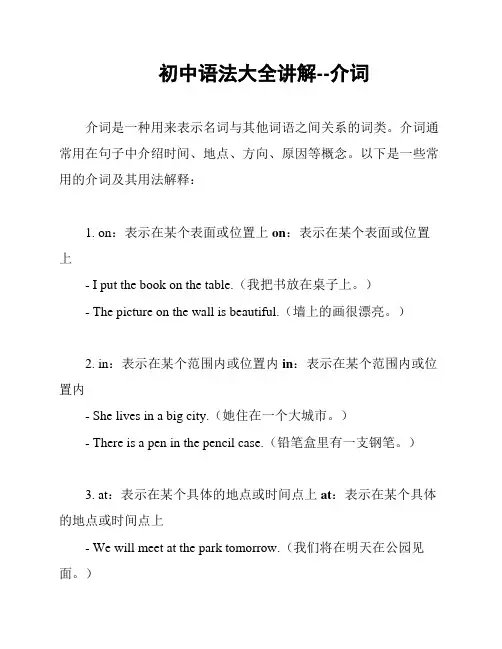
初中英语语法专题讲座——介词【复习要点】一、介词短语的形式:介词是一种虚词,不能独立存在。
它必须和随后的补足成分(又称“介词宾语”)一起构成介词短语,才能用于句中。
介词宾语可以是名词、代词、数词、动名词、wh-短语、从句等。
现分别举例如下:⑴介词+名词,例如:(go) by bus 乘公共汽车(去)(play) in the park 在公园里(玩)(come) on Sunday 星期天(来)⑵介词+代词,例如:(talk) to oneself 对自己(说),自言自语(a letter) for you 给你的(信)(not…) at all 一点也(不)⑶介词+数词,例如:(cut sth) in two (把……切)成两半⑷介词+动名词,例如:(a way) of doing that 做那件事的(方式)be good at drawing pictures善于画画⑸介词+wh-短语,例如:(talk) about what to do next(谈论)下一步该做什么⑹介词+从句,例如:Please think of what I said. 请你考虑我说的话。
二、介词短语的基本用法:⑴介词短语用作表语,例如:The post office is just across the street. 邮局就在街对面。
She looks so much like her mother. 她长得非常像她的母亲。
⑵介词短语用作宾语补足语,例如:I was surprised to find him on the bus. 发现他在公共汽车上,我很吃惊。
Please make yourself at home. 请随便一点,不要拘束。
⑶介词短语用作后置定语,例如:The girl in the hat is my sister. 那个头戴帽子的女孩是我的妹妹。
Do you like the jacket on the left? 你喜欢左边的那件短上衣吗?Did you see the house with many trees around it? 你看到那座周围长满树的房子了吗?⑷介词短语用作状语,例如:What are you going to do on Christmas? 在圣诞节你打算做什么?A policeman is standing next to him. 一位警察站在他的旁边。
By the way, what time is it now? 顺便问一下,现在几点了?Miss Zhao came in with a big smile on her face. 赵老师满面笑容地走了进来。
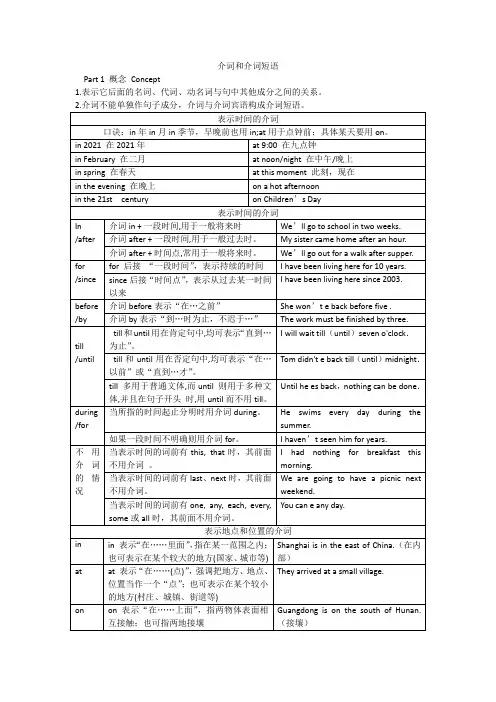
三、几组介词的用法比较:1. in, at, on:这三个介词都可以表示时间,但在使用上有区别。
⑴in表示时间段,即在较长的一段时间内。
例如:in the morning / afternoon / evening 在早晨/下午/晚上in the daytime / night 在白天/夜里in a day / week / month / year 在一天/一周/一个月/一年内in August 在八月in spring / summer / autumn / winter 在春天/夏天/秋天/冬天in (the year) 2004 在2004年3月19日星期五in the winter holiday(s) 在寒假in one’s life在(某人)一生中He is in his twenties. 他二十几岁了。
⑵一般认为,at表示时间点,即钟点、(做某事的)时刻等。
例如:at six o’clock在六点钟at noon (= at 12:00 in the daytime) 在中午at that time 在那时候;当时at the moment (= now) 现在;此刻at the end of the holiday 在假期结束时但是,在以下的时间短语中,at却表示时间段:at dinner time 在(吃)晚饭时at night 在夜间at weekends / the weekend 在周末at Christmas 在圣诞期间at this time of (the) year 在一年的这个时节⑶on表示特定的日子。
例如:①表示日期:on March 20, 2004 在2004年3月20日②表示星期几:on Saturday 在星期六on weekdays 在平时;从周一到周五(或周六)③表示某日的时辰:on Sunday morning 在星期日早晨on a Monday afternoon 在一个星期一的下午on the night of August 10 在8月10 日的夜里④表示节日、纪念日:on New Year’s Day在元旦on my birthday 在我生日那天on that day 在那天⑤表示特别的日子:on the following day (在)第二天on a cold winter morning 在一个寒冬的早晨on a sunny day in October 在10月的一个晴朗的日子2. during, in:两者用作介词时均与表示一般时间的名词连用,意为“在…期间”,一般情况下能相互换用。
但是,在实际运用中应注意下面几点:①.若谓语动词着重于动作或状态的延续性时,习惯用during ;若表示某一行为发生在一段时间中的某一点时间时,习惯用in。
例如:Ilearned a lot during my stay in the countryside .我呆在农村的那段日子里学了很多东西。
She was born in 1997 .她出生于1997年。
②. 当表示对比或强调时,多用in,而不用during。
例如:Mr. Black visited China in 1980 , not in 1970 .布莱克生先是1980年访问中国的,不是1970年。
③.表示一段时间的名词holiday , childhood , stay等词前,习惯上用during ,而不用in。
例如:I think that maybe his Chinese teacher will give Jim some work to do during the holiday .我想这段假期或许吉姆的汉语老师会给他一些作业做。
3. for, since:for和since引导的时间状语都有延续之意,但着眼点不同,用法也有所不同。
⑴“for+时间段”表示“(延续)……之久”,其着眼点是现在,即表示延续到现在的一段时间(与现在完成时连用),或表示一段已经终结了的时间(与过去时连用),或表示将要延续的一段时间(与将来时连用)。
例如:They have lived in China for two years. 他们在中国已经住了两年。
(现在还在中国)They lived in China for two years. 他们在中国住过两年。
They will stay here for a few weeks. 他们将在这里住上几个星期。
⑵“since+时间点”表示“自从(过去某时)以来”,其着眼点是过去某时,即表示自过去某时延续至今的一段时间,常与现在完成时连用。
例如:She has worked here since 1999. 自1999年以来,她就在这里工作。
I haven’t written home since Christmas. 自圣诞节以来,我就没有给家里写过信。
We haven’t seen each other since three years ago. 自三年前以来,我们彼此就未见过面。
since还可以用作从属连词,引导时间状语从句(通常用一般过去式)。
例如:It has been raining since I got up this morning. 今天早晨我起床以来,天一直在下雨。
It is just a week since we arrived here. 我们到这里以来只有一星期的时间。
4. on, above, over:这三个介词都可以表示地点,意思是“在……上”,但具体含义有所不同。
⑴on是指与物体表面接触而不是在其上方。
例如:They are sitting on the grass. 他们坐在草地上。
Do you live on the second floor? [美国英语]你住在二楼吗?/[英国英语]你住在三楼吗?He jumped on the horse. 他跳上了马。
⑵above是指离开物体表面而在其上方,其反义词为below。
例如:The plane flew above the clouds.飞机在云层之上飞行。
The mountain is about 2,000 metres above the sea. 那座山约海拔2,000米高。
⑶over是指在物体的正上方,有时还有“覆盖;越过”之意,其反义词为under。
例如:A lamp was hanging over the table.一盏灯高挂在餐桌上方。
I saw a stone bridge over the river. 我看见一座石桥横跨河上。
5. by, before, until:这三个介词都可以表示时间。
用法区别如下:⑴by和before的比较:by表示“不迟于某时”(= not later than),包括某时在内;before则表示“在某时之前”(= earlier than),不包括某时在内。
请比较:by Friday.(不迟于星期五)I will finish itbefore Friday.(早于星期五)⑵by和until的比较:by表示一个动作在不迟于某时的任何时候发生,动词常用瞬时性动词;until(用于肯定句时)表示一个动作一直延续到某时,动词常用延续性动词。
请比较:We must leave by five o’clock.(5点或5点以前离开)We must wait until five o’clock.(一直等到5点)6. between, among:①.between 多指两者之间。
如:What's the difference between the two words? among指三者或三者以上的同类事物之间,在或笼统的一群人或一些物之中,表示“在……中间,在……之中”。
如:The young people lived and worked among the workers.注意:我们可以说between you and me,但不能说between you and I,因为between是介词。