
人教版九年级英语上册作业课件:Unit 4 Section A
- 格式:pptx
- 大小:222.87 KB
- 文档页数:11

Common Progress Please Criticize
金戈铁骑制作
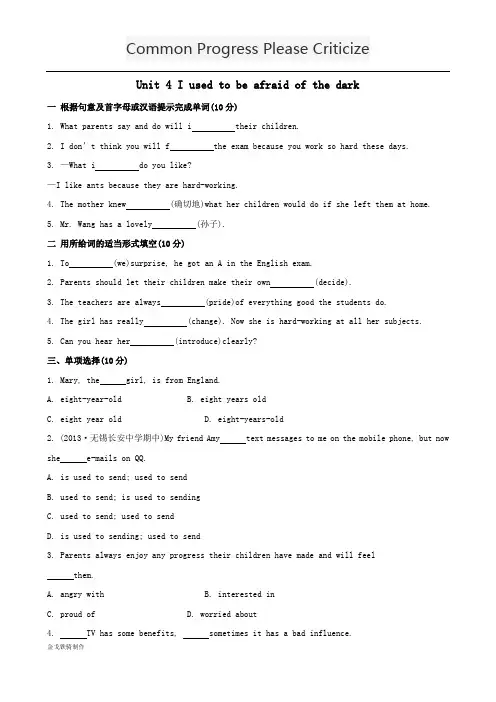
Unit 4 I used to be afraid of the dark
一 根据句意及首字母或汉语提示完成单词(10分)
1. What parents say and do will i their children.
2. I don’t think you will f the exam because you work so hard these days.
3. —What i do you like?
—I like ants because they are hard-working.
4. The mother knew (确切地)what her children would do if she left them at home.
5. Mr. Wang has a lovely
(孙子).
二 用所给词的适当形式填空(10分)
1. To
(we)surprise, he got an A in the English exam.
2. Parents should let their children make their own (decide).
3. The teachers are always (pride)of everything good the students do.
4. The girl has really (change). Now she is hard-working at all her subjects.
5. Can you hear her (introduce)clearly?
三、单项选择(10分)
1. Mary, the girl, is from England.

Unit 4 Section A 课文精彩回顾
1. (P25, 1a) Mario, you used to be short, didn't you? 马里奥,你过去很矮,对吗?
2. (P26, 2d) It's been three years since we last saw our primary school
classmates. 自从上次小学同学见面以来已经有三年的时间了。
3. (P27, 3a) Candy told me that she used to be really shy and took up
singing to deal with her shyness. 坎迪告诉我她过去非常害羞, 于是开始唱歌来对付她的羞怯。
4. (P27, 3a) As she got better, she dared to sing in front of her class,
and then for the whole school. 当她变得更好一点时, 她敢与在全班同学面前唱歌, 然后为全校 唱歌。
5. (P27, 3a) Only a very small number of people make it to the top. 只有很少一部分人做到最好。
典型题例
1. Zhang Lin used to ___ in the daytime, but now he is used to at
night.
A. read, read B. reading, read C. read, reading D. reading, reading
2. — Only a small number of students ___ able to pass the exam.
— Yes. The number _______ no more than 20.

Unit4 SectionA
知识讲解
1. Mario, you used to be short, didn’t you? 马里奥,你过去很矮,是吗?
(1)used to意为"过去常常",后接动词原形,表示过去经常发生的动作或存在的状态(暗含现在已经不复存在)。
(2) 本句是一个反意疑问句,反意疑问句的特点是"前肯后否"或"前否后肯"。
2. see sb. doing sth. 看见某人正在做某事
此结构中doing sth.作宾语补足语,强调动作正在进行。而see sb. do sth. 看见某人做了某事,强调看见动作发生的全过程或看到动作经常发生。
3. deal with 应对;处理
(1) deal with与do with两者都可以用来表示"处理",前者侧重于方式、方法,后者侧重于对象。在句中,deal with与how连用,do with则与what连用。
(2)deal with 还意为"应付;涉及;论及"。
4. too much太多
too much, much too 与too many的用法区别
too much, much too, 用法区别看后头。
much后跟不可数,too后只跟形或副。
too many要记住,后面名词必复数。
5. helpful /’ helpfl/ adj. 有用的;有帮助的
helpful的相关短语:
be helpful to sb. 对某人有帮助
6. such /sʌtʃ/ adj.如此的;这样的
such用作形容词,修饰名词。主要用法有:
(1)such+a(an)+adj.+单数可数名词+that从句。
(2)such+adj.+不可数名词+that从句。
(3)such+adj.+名词复数+that从句。
专题练习
一、单项选择
1.A _________ number of people took part in this activity, but only a _________ number of

人教版英语九年级全册Unit4SectionA1a~2d说课稿
一、教材分析
(一)内容概述
本节课为人教版英语九年级全册Unit 4的Section A部分,该部分在整个课程体系中具有重要地位。本单元主题为“自然災害”,通过学习本节课的内容,学生能够了解自然灾害的种类、危害以及预防措施。本节课的主要知识点包括:1. 新词汇:如earthquake, survivor,
destruction, victim等;2. 一般过去时的用法;3. 描述自然灾害的经历;4. 学会关心他人,提高防灾减灾意识。
本节课的内容旨在帮助学生提高英语听说能力,通过听力练习和口语交流,让学生在实际情境中运用所学知识,为后续学习打下坚实基础。
(二)教学目标
1. 知识与技能:
(1)掌握本节课的新词汇和短语,并能正确运用;
(2)掌握一般过去时的用法,能够用它来描述过去发生的事情;
(3)能够听懂并参与关于自然灾害经历的讨论。
2. 过程与方法:
(1)通过听力练习,提高学生的英语听力水平;
(2)通过口语交流,培养学生的英语表达能力;
(3)通过小组讨论,提高学生的合作能力。
3. 情感态度与价值观:
(1)关注自然灾害,提高防灾减灾意识;
(2)学会关爱他人,培养助人为乐的品质;
(3)增强对英语学习的兴趣,树立自信心。
(三)教学重难点
根据对学生的了解和教学内容的分析,本节课的教学重点和难点如下:
1. 教学重点:
(1)新词汇和短语的掌握;
(2)一般过去时的用法;
(3)听力技巧的培养。
2. 教学难点:
(1)正确运用一般过去时描述过去发生的事情;
(2)听力材料中的一些细节信息,如时间、地点、人物等;
(3)口语表达中的流畅性和准确性。
在教学过程中,教师应注重启发式教学,引导学生主动参与课堂,提高学生的英语听说能力,同时关注学生的情感态度和价值观的培养。通过本节课的学习,使学生能够更好地应对自然灾害,提高自我保护意识。