冀教版六年级英语上册知识点总结
- 格式:pdf
- 大小:132.26 KB
- 文档页数:6
冀教版六年级英语上册知识点总结
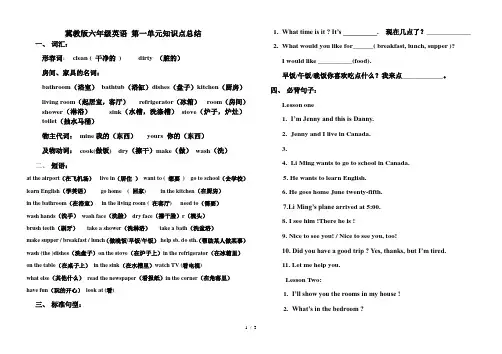
⼀单元
⼀、 单词: live(单三)lives, want(单三)wants, half kitchen house toilet bedroom, living room bathroom study (复数studies) fridge dish(复数dishes)
反义词:dry-wet, dirty-clean, come(现在分词) coming make(现在分词)making cook(现在分词)-cooking
watch(现在分词)-watching sit(现在分词)-sitting read(现在分词)-reading,
write(现在分词)-writing do(现在分词)-doing play(现在分词)---playing,
⼆、 课⽂重难点:1. at+较⼩的地点 如at school 、at home in+⼤地点 in China in Beijing
2. This is “这是….”⽤来介绍他⼈。This is my friend, Li Ming.
3. want 想要 want to do …想⼲….. 如:I want to fly kites.我想放风筝。
4.Li Ming’s plane will arrive at five o’clock. ⼏点⼏分⽤at
5. What time is it now? It’s half past five.现在⼏点了?现在5:30.
6. Did you have a good trip? Yes, thanks. but I’m tired你旅⾏愉快吗?是的,谢谢。但是我有些累。 7. Let’s go home./ Let me help you.让我们回家。让我帮助你。
8. learn English/Chinese 学英语/汉语
9. This is / That is / These are/ Here is/ Here are
10.I will show you the rooms in my house.我将领你们参观房⼦的各个房间。
11.on the first/second floor 在⼀/⼆楼(在⼏楼要⽤序数词和on)
12.I make lunch in the kitchen 我在厨房做午饭
13.I do my homework in the study.我在书房做作业
14. Time for breakfast.= It’s time for breakfast.早餐时间到了。
15. It’s time for sth./ It’s time to do sth .是做什么的时间了。
It is time for dinner=it is time to have dinner.
16. Would like sth./ Would like to do sth.想要什么。想要做什么。
17. What would you like for breakfast / lunch/dinner? (三餐前⾯要⽤for)
I would like…for breakfast / lunch/dinner?(通常would like 问would like答)
18. Breakfast is ready. wash dishes make breakfast/lunch/dinner
19. mum is cooking eggs in the kitchen 妈妈正在厨房煎鸡蛋。
20.Let’s put some dishes on the table.让我们把盘⼦放到桌⼦上。
21.I only ate an apple for lunch.午饭我只吃了⼀个苹果。
22. What’s for supper?晚餐有什么?23. What are you doing? / We are washing hands. 你正在做什么?我们正在洗⼿。
What are they doing? (通常doing 问 ing答)
24. Now the dishes are clean and dry.现在盘⼦洁净⼲爽。
25. I wash the dirty dishes.我洗脏盘⼦。
26. May I help you? Sure.我可以帮你吗?当然。
27.watch TV / read the newspaper/write a letter
28. Do you like this show? Yes,I do/No,I don’t.(通常do问 do 答)
29. I am sitting at a small table.我正坐在⼩桌⼦旁边
⼆单元
⼀、单词:always often sometimes never bus stop bus driver school bus subject class math science art PE music temperature,
(反义词)hot---cold, ill-----healthy健康的
名词复数规则1.⼀般情况下,直接加-s,如:book-books, bag-bags, cat-cats, bed-beds
2.以s. x. sh. ch结尾,加-es,如:bus-buses, box-boxes, brush-brushes, watch-watches
3.以“辅⾳字母+y”结尾,变y为i, 再加-es,如:family-families, city - cities
4.以“f或fe”结尾,变f或fe为v, 再加-es,如:leaf-leaves
degree(复数)degrees box—boxes bus—buses
tomato –tomatoes potato---potatoes photo-----photos (⼟⾖,西红柿+es,其余+s)
man(复数)---men, woman(复数)---women, child(复数)---children foot(复数)---feet
2. 频率副词⽤法:⼀般都放在动词前,am/ is/ are的后⾯。
如:He never wears dresses./ he is always late.
⼆、 课⽂重难点:1.I always have my umbrella on a rainy day.我总是在下⾬时打伞。
2.Here comes the school bus.校车来了
3. I live too far from my school 我住的离学校很远。 on the school bus.在校车上
4. Do you go to school by …? 你……去上学?
5. Jenny often goes to school by bus.詹妮经常坐公交车去上学
Sometimes she rides her bike. she never walks.有时她骑⾃⾏车。她从不步⾏去上学。
⼀般现在时当主语为第三⼈称单数(he, she, it)时,要⽤动词的第三⼈称单数,主语为复数时,要⽤动词原型。如:Mary likes Chinese. We like cat。
动词+s的变化规则:1)⼀般情况下,直接加-s,如:cook-cooks, bring--brings
2)以s. x. sh. ch. o结尾,加-es,如:guess-guesses, wash-washes, watch-watches, go-goes
3)以“辅⾳字母+y”结尾,变y为i, 再加-es,如:study-studies
6. Where are you from? I am from China/ Bao Ding来⾃中国保定。7、What subjects do you have in your school?你在学校有哪些科⽬?
8、How many classes do you have each school day? 每天你在学校有多少节课?
Three classes in the morning and two in the afternoon.上午三节,下午两节。
9. How’s the weather today? It’s rainy.今天天⽓怎样?多⾬。
10. What’s the temperature? It’s ten degrees.⽓温多少度?⼗度。
What’s the chicken’s temperature?鸡的体温温是多少?
11.The temperature of a healthy chicken is always 41.5degrees.健康的鸡的体温总是41.5度。
12. This/That is a/an/one…+单个名词
These/ Those are (some/many) …+名词复数
13. These men /These women/ These children are young /singing/playing.
14. Do you always…? / Does he often…
15. walk to school / help his mother / ride my bike / do your homework
16. Let’s put…for… Let’s put an A/O/S/N for always/often/sometimes/never.
三单元
单词: spring, summer, autumn, winter, scarf, ice, winter clothesput(现在分词)putting、skate滑冰 think, teach,fall down fun, favourite
leaf(复数)---leaves, snowman(复数) snowmen,,
反义词put on ---take off up---down teach----learn rain(形容词) rainy, wind (形容词) windy, sun (形容词)sunny,
snow(形容词) snowy cloud (形容词) cloudy
⼆、课⽂重难点:1. There are four seasons in a year.⼀年有四季
There is ice and snow in winter.冬天有冰和雪。
2.The summer sun is hot.夏⽇的骄阳似⽕。
3.The leaves turn red and yellow in autumn.叶⼦在秋天变成红⾊和黄⾊
4. What a hot, sunny day!多么热、晴朗的天啊!
5. Jenny and Li Ming are going out to play with Danny.詹妮和李明要出去和丹尼玩。
6. What do you like to do in winter?你冬天喜欢做什么?
7. I like to skate on the ice. 我喜欢在冰上滑冰。
8. Can you skate? / Can you teach me? Yes I can. /No I can;t
9. I want to go outside to play in the snow.
10. Why? Because it’s cold outside.
11.What a cold snowy day!多么寒冷多雪的天⽓啊!
12.Let’s make a snowman.让我们堆⼀个雪⼈。make snowmen / make a snowman