六年级【一般过去时的用法】
- 格式:doc
- 大小:100.00 KB
- 文档页数:9
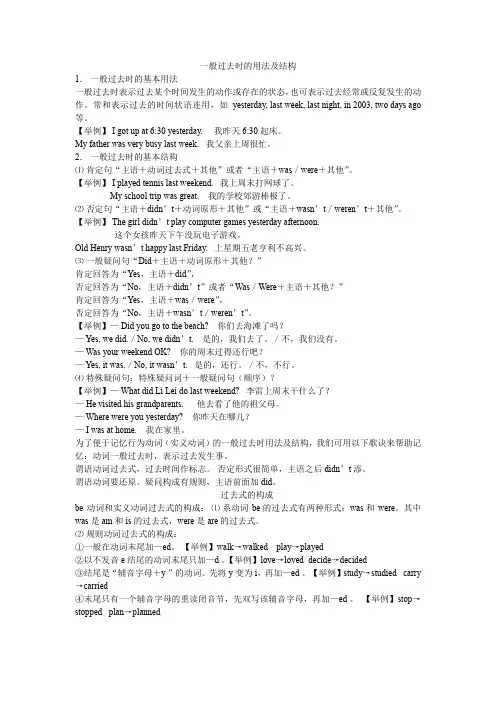
一般过去时的用法一、概念表示在的过去某个时间里所发生的动作或存在的状态。
通常在句子里找到表示过去时间的词或词组。
如:yesterday,yesterday morning,yesterday afternoon,yesterday evening,the day before yesterday(前天),last night,last week,last month,last year,a moment ago(刚才),just now (刚才),two days ago,a week ago,in 1990等。
如:I went to bed at eleven last night. 昨晚我11:00睡觉。
一般过去时四种用法;例如:I went to school at 7:00 yesterday morning.我昨天早晨七点去上学。
②表示在过去某个时间存在的状态。
例如:She was not at home last night.她昨晚八点没在家。
③表示在过去经常或反复发生的动作,常和often(经常)、always(总是)、sometimes (有时)等表示频率的时间状语连用。
例如:He often had lunch at school last month.他上个月经常在学校吃午饭。
④表示已故的人所做的事情或情况。
例如:Ba Jin wrote a lot of novels for us.巴金写了很多部小说。
二、动词过去式的构成规律(一)规则动词的过去式1.一般情况下,在动词原形后面加-ed;look→looked play→played start→started visit→visited2.以不发音e结尾的动词,在词尾直接加-d;live→lived use→used3.以“辅音字母+ y”结尾的动词,先将y 改为i ,再加–ed;study→studied, tr y→tried fly→flied4.以重读闭音节(即辅音+元音+辅音)或r音节结尾,末尾只有一个辅音字母的动词,要先双写这个辅音字母后,再加–ed。
stop→stopped plan→planned, prefer→preferred(二)不规则动词的过去式1.改变动词中的元音;begin→began drink→drank come→came eat→ate grow→grew run→ran know→knew win→won speak→spoke take→took write→wrote get→got2.变词尾的–d 为–t ;build→built lend→lent send→sent spend→spent bend→bent3.与动词原形一样;cut→cut put→put cost→cost hurt→hurt shut→shut4.变-ay 为-aid (少数动词);say→said pay→paid lay→laid5.采用不同词根;sell→sold teach→taught buy→bought6.其他。
am/is→was are→were have/has→had do→did三、加“-ed”后的读音方法1.ed加在清辅音后面读/t/。
finished /-t/ help /-t/ asked /-t/2.ed加在浊辅音或元音结尾的,读/d/。
played /-d/ lived /-d/ enjoyed /-d/3.ed加在/t/或/d/后面,读/id/。
wanted /-tid/ needed /-did/ visited /-tid/四、句式变化(一)一般过去时的一般疑问句1.把was, were放在句首,其余位置不变。
由Was…?引导的一般疑问句,肯定答为:Yes,…was. 否定回答为:No,…. wasn’t. 由Were…?引导的一般疑问句,肯定回答为:Yes,… were. 否定回答为:No,… weren’t.如:(1)I was born in Shanghai. →Were you born in Shanghai?→Yes, I was. (肯定回答) →No, I wasn’t. (否定回答)(2)They were in Li Yan’s home last night. →Were they in Li Yan’s home last night?→Yes, they were. (肯定回答) →No, they weren’t. (否定回答)2.在行为动词的句子中,要用助动词词did来引导,其余的语序不变。
要注意的是,要把行为动词的过去式改为原形。
肯定回答为:Yes, …did. 否定回答:No, …didn’t.如:John played computer games last night.→Did John play computer games last night?→Yes, he did. (肯定回答) →No, he didn’t. (否定回答)(二)一般过去时的否定句1.在表示过去存在的状态的句子中,相接在was, were的后面加上not。
如:(1)He was in the park the day before yesterday.→He was not in the park the day before yesterday.(2)We were busy last week.→We were not busy last week.2.在表示过去的时间发生的动作的句子中,要在行为动词的前面加助动词didn’t.然后把过去式的行为动词改为动词原形。
即:didn’t + 动词原形。
如:(1)She played the violin last night.→She didn’t play the violin last night.(2)They swam in the lake yesterday.→They didn’t swim in the lake yesterday.(三)一般过去式的特殊疑问句1.What did …?(主要是询问过去发生了什么事情,注意要把过去式改为动词原形。
)We ate Chinese food last night.→What did we eat last night?2.Where did ?( 主要是询问过去事情发生的地方。
)They sang and dance in the music room yesterday morning.→Where did they sing and dance yesterday morning?3.Who + 动词过去式…?( 主要是询问过去事情发生的人物。
)Mike and Tom climbed mountains last weekend.→Who climbed mountains last weekend?二、句子结构1.在表示某个时间里存在的状态的句子,系动词用过式was,were构成。
如:(1)I was at home yesterday.昨天我在家。
(2)We were in the gym just now. 刚才我们在体育馆。
2.在表示过去某个时间里发生的动作,用动词的过去式构成。
如:I visited my uncle yesterday. 昨天我拜访了我的叔叔。
3.各种句式(1)一般过去时的肯定陈述句:主语+动词过去式+宾语或表语。
He worked in Shanghai ten years ago.(2)一般过去时的否定句:a.主语+didn’t +动词原形+宾语。
(did + not = didn't)He didn't do morning exercises yesterday.b.主语+wasn’t/weren’t +表语。
(was + not = wasn't were + not = weren't)He wasn't an English teacher ten years ago.(3)一般过去时的一般疑问句:a.Did +主语+动词原形+宾语?Did you study English in 1990 ?b.Was/Were + 主语+表语?Was he a pupil five years ago ?(4)一般过去时的特殊疑问句:a.特殊疑问词+did + 主语+动词原形+宾语?Where did your parents live five years ago?What did you do last Sunday?b.特殊疑问词+were/was +表语?Who was at the zoo yesterday?过去时练习:写出下列动词的过去式is\am_________ fly_______ plant________ are ________ drink_________play_______ go________ make ________ does_________ dance________ worry________ ask _____ taste_________ eat__________ draw________put ______ throw________ kick_________ pass_______ do ________专项练习:一.用所给动词的适当形式填空。
1. We ______ (live) in Japan last year.2. Susan_______ (stop) the car on the street yesterday.3. My mother_______ (clean) my room and ______(study) for the English test last Sunday.4. What ______ you ______(do) last night?5. On Saturday morning I _____(play) football.二.用括号内所给动词的适当形式填空。
(1) May__________ (finish) her homework very late yesterday evening.(2) Han Mei __________ (bring) her pet to the park that day.(3) His father __________ (buy) a new computer for him last week.(4) Miss Du__________ (walk) to work every day last term.(5) We __________ (move) to Shenyang 8 years ago.(6) __________ you __________ (have) bread for breakfast this morning?(7) She __________ (give) me a nice present last night.(8) The police __________ (stop) the car and __________ (catch) the thief (小偷) just now.(9) Tom __________ (carry) water for the old man last Saturday.(10)Uncle Wang _____________ ( come )into the room and __________ ( find ) something to eat.(11).Lily ______________ ( study ) in the classroom for two hours and then _________ ( leave ).(12).Jimmy __________ ( do ) a lot today. He _________ ( go ) shopping and ________ ( cook ) supper.(13).We _________ ( go ) to the cinema last night. The film ___________ ( be ) very good.(14).What time _________ you __________ ( get ) to school this morning?改错题1. How is Jane yesterday?2. He go to school by bus last week.3. He often goes home at 6:00 last month.4. I can fly kites seven years ago.5. Did you saw him just now.6. Tom wasn’t watch TV last night.7. I didn’t my homework yesterday.8. He wait for you three hours ago.9. Who find it just now ?10. What did he last week?用所给动词的适当形式填空1.Tom and Mary ___________ (come) to China last month.2.Mike ____________(not go) to bed until 12 o’clock last night. So I _____(get ) up late.3.Mary __________ (read) English yesterday morning.4.There _________ (be) no one here a moment ago.5.I ___________ (call) Mike this morning.6.I listened but ___________ (hear) nothing.7.Tom ___________ (begin) to learn Chinese last year.st week we _________ (pick) many apples on the farm.9.My mother ________________ (not do) housework yesterday.10.She watches TV every evening. But she _______________ (not watch) TV last night.11.________ your father ________ ( go ) to work every day last year?12. —What time _______ you _______ (get) to Beijing yesterday?—We __________ (get) to Beijing at 9:00 in the evening.13.What __________ (make) him cry (哭) just now?st year the teacher ___________ (tell) us that the earth moves around the sun.15.There ____________ a telephone call for you just now. (be)16.There __________ not enough people to pick apples that day. ( be)17.There ____________any hospitals (医院) in my hometown (家乡) in 1940. ( be not)18.There ____________ enough milk at home last week, wasn’t there?19.Eli ____________ to Japan last week. ( move)20. –When _______ you _________ (come) to China? - Last year.21.Did she ________ (have) supper at home?22.Jack ____________ (not clean) the room just now.23._________ (be) it cold in your city yesterday?24.How many people ________ (be) there in your class last term?25.It ________ (be) hot yesterday and most children _______ (be) outside.26. There ________ (be) a football match on TV yesterday evening, but I _________ (have) no time to watch it.27. He ate some bread and _________ (drink) some milk.28. ________ he __________ (finish) his homework last night?29. I__________(be) tired yesterday.30. I ___________(gain ) Arts degree last year.31. What _________ you ___________ (do) last night?32. My grandfather _________ (leave) Hong Kong for New York in 1998.33. What _______ he ________ (do) yesterday?34. Last week I _______ (buy) a new bike.35. He ________ (be) here just now.36. He __________ (not find ) his key last night.37. My father __________ (drink) a lot of wine yesterday.38. ________ you ________ (finish) your homework yesterday?39. I ________ (eat) some eggs and bread this morning.40. Her mother __________ (not give) the girl any present.用括号内动词的正确形式填空(A)Last year Mr. Smith _____ (go ) to China and Japan. He _____ (have) a wonderfultime. He _____ (do) a lot of different things and _____ (talk) to a great number of different people. He _____ (eat) Chinese and Japanese food and _____ (visit) a lot of interesting places. When he _____ (go) back to England, he _____ (be) very tired.(B)A week ago, Kitty and Ben _________ (be) in the countryside. At first, the wind _________ (blow) lightly. The leaves ___________ (blow) slightly in the wind. They ________ (fly) their kite happily in the gentle breeze. Suddenly, the wind ________ (become) stronger. The clouds in the sky _______ (move) quickly. Leaves ________ (fall) from trees. The string on Ben’s kite _________ (break). The sky became dark. Kitty and Ben ________ (go ) home immediately. Kitty and Ben ________ (stay) at home. They __________ (watch) TV. The wind became much stronger. It _________ (blow) fiercely. It became a typhoon. Trees_____ (fall) down. Ships and boats __________ (sink) in the big waves. The typhoon _______ (pass) quickly. The wind became gentler. The big clean-up ________ (begin) immediately. Kitty and Ben went outside again.一般过去时练习题一、句型转换1. The children had a good time in the park.否定句:__________________________________________一般疑问句:________________________________________对划线部分提问:____________________________________2. There were about nine hundred people at the concert.否定句:__________________________________________一般疑问句:________________________________________对划线部分提问:____________________________________3. Ann did her homework yesterday evening.否定句:__________________________________________一般疑问句:________________________________________对划线部分提问:____________________________________4. Last week I read an English book.否定句:__________________________________________一般疑问句:________________________________________肯定/否定回答:____________________________________对划线部分提问:____________________________________5. My brother was in the park just now.否定句:__________________________________________一般疑问句:________________________________________对划线部分提问:____________________________________二、写出下列动词的第三人称单数形式、过去式形式go _______ _______ enjoy _______ _______buy _______ _______ eat _______ _______get _______ _______ walk _______ _______take _______ _______ dance _______ _______write _______ _______ run _______ _______swim _______ _______ find _______ _______begin _______ _______ eat _______ _______play _______ _______ study _______ _______三、用所给词的适当形式填空。