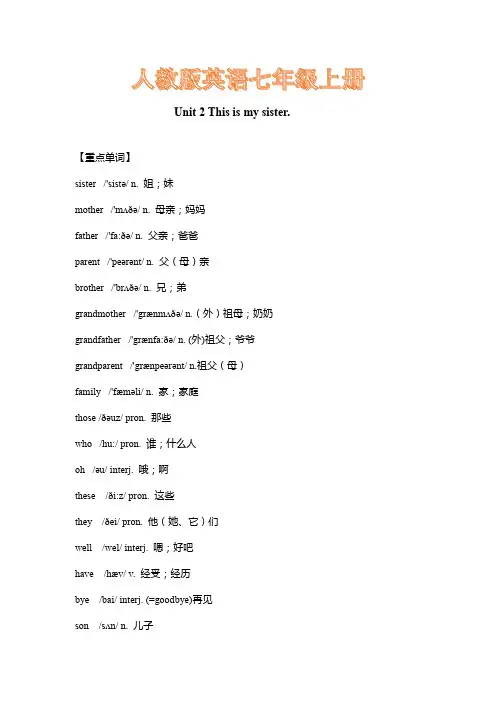
人教版初中英语七年级上册Unit2基础知识评析
- 格式:doc
- 大小:72.00 KB
- 文档页数:3
人教版初中英语七年级上册Unit2基础知识评析
Unit2 This is my sister.
1.parents父母(P.7)
释:parents,名词,意为“父母”,为复数形式,parents=mother and father,其单数形式是parent,意为“父亲或母亲”,即parent=mother or father。
例如:Jim and Linda are my parents.吉姆和琳达是我的父母。
【典型例题】Tom’s parents from England(英国).
A.is
B.am
C.be
D.are
2.grandmother祖母,外祖母(P.7)
释:grandmother名词,意为“(外)祖母;奶奶;外婆;姥姥”,在口语中常用grandma,对应词为grandfather,意为“(外)祖父;爷爷;外公;姥爷”。
Grandmother是由grand和mother组成的合成词。
grand形容词,意为“重大的,伟大的;豪华的”。
此处grand是一个前缀,与father,mother,parents,son和daughter等合成新词,表示亲属关系中的“(外)祖……”或“(外)孙……”之意。
例如:grand+son→grandson孙子,外孙grand+father→grandfather孙女,外孙女grand+parents=grandparents祖父母,外祖父母。
3.That’s my family.那是我的家庭。
(P.7)
释:family名词,意为“家,家庭”。
Family若指家庭这个整体,谓语动词ongoing 单数;若指一个家庭里的全体成员,谓语动词用复数。
例如:Jim’s family is small.Her family are all here.
【助记】family=f(father)+a(and)+m(mother)+i(I)+l(like)+y(you)
4.Those are my parents.那是我的父母。
(P.7)
释:those指示代词,意为“那些”,是指示代词that的复数形式。
This的复数形式是these,意为“这些”。
this,that与单数名词连用;these,those与复数名词连用。
“Those are her books. These are my classmates.
5.Who’s she? (P.7)
释:who疑问代词,意为“谁“。
Who is/are…?是对人物进行提问的句型,回答时,如果主语为单数,根据人物的性别选用he或she;如果主语为复数,应用代词they。
例如:1)——Who is she?——She is Mary.2)——Who are they?——They are my parents.3)——Who are you?——I’m David.
【拓展】who的宾格是whom,在句中作宾语时二者在口语中可互换,意为“谁”;who的所有格是whose,意为“谁的”。
例如:1)Who/Whom do you meet?I meet
my brothers.2)Whose sister is she?
6.——Are those your parents?那是你们的父母吗?——Yes,they are.是的,他们是。
(P.8)
释:Are these/those…?意为“这些/那些是……吗?”,是These/Those are…的一般疑问句形式。
其肯定回答用“Yes ,they are.”,否定回答用”No,they aren’t.”。
【拓展】Is this/that…?是Are these/those…?的单数形式,其肯定回答用“Yes,it is.”,否定回答用“No,it isn’t.”。
例如:——Is this your brother?——Yes,it is.
7.Well,have a good day!好吧,祝你们玩得愉快!(P.8)
释:①well此处用作感叹词,意为“好吧;喂;噢”,用在句子开头,其后加逗号,用于重新开始说话时。
例如:Well,thank you。
好吧,谢谢你。
②have此处用作及物动词,意为“经受,经历”。
例如:Have a good time on weekends.祝你周末过得愉快!
③have a good day用于表达祝愿,祝愿对方一天里有好的心情和运气。
该句中day还可以用morning,evening等词语替代。
其答语应为Thank you/Thanks.表示谢意。
例如:Have a good morning!祝你(们)上午玩得愉快!Have a good day,Tom!汤姆,祝你过得愉快!
【拓展】类似的表达还有:Have a good time!祝你(们)玩得愉快!Have a good dream!祝你(们)做个好梦!Have good luck!祝你(们)好运!Have a good trip!祝你(们)旅途愉快!
8.You ,too.也祝你玩得愉快。
(P.8)
释:You,too.是英语中较常见的一句答语,通常表示把同样的祝愿送给对方,相当于汉语中的“你(们)也一样!”
例如:——Have a good time!祝你玩得高兴!
——Thank you!You,too.谢谢你!你也是。
9.These are my parents and this is my grandma.这是我的父母,这是我的祖母。
(P.10)
释:and并列连词,意为“和”。
它可以连接两个单词、短语或句子,用来表示:①并列关系。
例如:Jenny and Alice are my good friends.
②强调反复、连续。
例如:They talked andtalked。
他们谈了又谈。
③承接关系。
例如:This is a book,and that’s a pencil.
10.Here are two nice photos of my family.这儿有两张我家人的漂亮照片。
(P.11)
释:①here副词,意为“这儿,这里”。
放在句子开头,构成倒装句,用以引起注意或加强语气。
其正常语序是:Two nice photos of my family are here.类似的词还有there。
当句子以here,there等词开头时,要用倒装语序,即“Here/There+谓语动词+主语(名词).”其中,谓语动词的形式要视后面的主语而定。
例如:Here is the news.There comes the bus!
【拓展】Here’s/Here are…还可以表示“这儿有……;这是……”,后面跟人或物。
例如:Here’s your cake.这是你的蛋糕。
Here is my mother.这是我母亲。
Here are some apples.这儿有些苹果。
其中,谓语动词的形式要视后面的主语而定。
②photo可数名词,意为“照片”,相当于“picture”。
其复数形式是直接在词尾加-s,即photos。
例如:It is a nice photo这是一张好看的照片。
Do you like these photos?你喜欢这些照片吗?
③of介词,意为“……的”。
在英语中表示无生命的东西的所有格时,一般用
of短语来表示所属关系。
例如:This is a photo of his family.这是他的一张全家福。
That’s a map of China.那是一张中国地图。
11.My grandfather and grandmother are in the first photo.第一张照片中有我的(外)祖父和(外)祖母。
(P.11)
释:in the first photo意为“在第一张照片中”。
其中first为序数词,意为“第一”,“第二”为second,“第三”为third。
例如:My sister is in the first photo.我姐姐(妹妹)在第一张照片中。
12.In the next picture are my brothers,Bob and Eric.在接下来的一张照片里,有我的兄弟们,鲍勃和埃里克。
(P.11)
释:①next此处用作形容词,意为“下一个的,接下来的”。
例如:Read the next page,please.请读下一页。
We’ll go swimming next week.下周我们将去游泳。
②picture可数名词,此处意为“照片”,与photo同义。
例如:This is a picture of my family.这是我的一张全家福。