雅思写作范文环球雅思
- 格式:docx
- 大小:36.99 KB
- 文档页数:2
雅思写作范文环球雅思
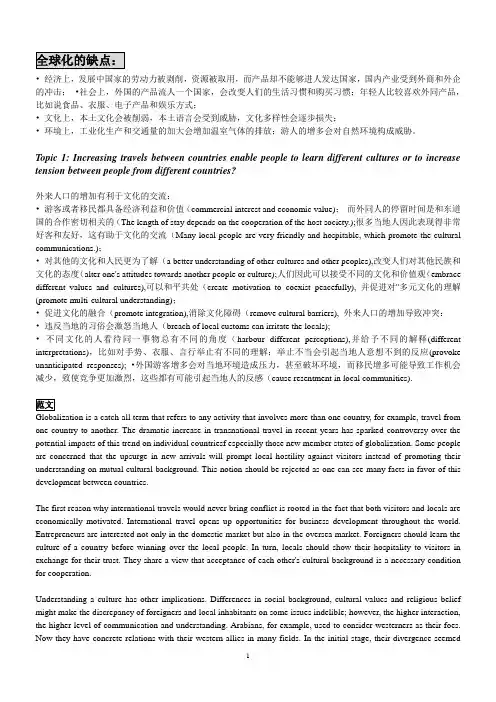
Global IELTS Writing Sample
The world today is more interconnected than ever before. With the
rapid advancement of technology, people from different countries
can easily communicate, trade, and travel across borders. This
increased global interconnectivity has both positive and negative
impacts on people's daily lives.
On the positive side, the global interconnectivity allows
individuals to access an unprecedented amount of information. The
internet has made it possible for people to learn about different
cultures, languages, and perspectives simply by searching online.
This knowledge broadens people's horizons and fosters cultural
understanding and tolerance. It also enables individuals to connect
with like-minded people from around the world, forming virtual
communities and exchanging ideas. This global exchange of ideas
can lead to innovation and progress in various fields.
In addition to knowledge sharing, global interconnectivity has also
revolutionized trade and commerce. Companies can now market
their products and services to a global audience using online
platforms. This allows businesses to reach consumers in different
countries, leading to economic growth and job creation. Moreover,
global supply chains enable the efficient production and
distribution of goods, benefiting both producers and consumers.
This interconnectedness also encourages international
collaboration and cooperation, fostering a sense of unity among
nations.
However, there are also negative aspects of global
interconnectivity. One significant concern is the increased
vulnerability to cyber threats and scams. As more personal and
financial information is shared online, individuals are at a higher
risk of identity theft and fraud. Moreover, global interconnectivity
has resulted in the spread of misinformation and fake news,
making it challenging for people to distinguish between accurate
and false information.
Furthermore, the global interconnectivity has created a digital
divide between developed and developing countries. Not everyone
has access to the internet or the necessary skills to navigate the
digital world. This digital divide exacerbates existing social and
economic inequalities, limiting the opportunities available to those
in developing nations.
In conclusion, global interconnectivity has both positive and
negative impacts on people's daily lives. While it provides access
to a vast amount of information and facilitates trade and
cooperation, it also poses various challenges such as cyber threats
and the digital divide. It is crucial for individuals and governments
to manage these challenges effectively to maximize the benefits of
global interconnectivity.