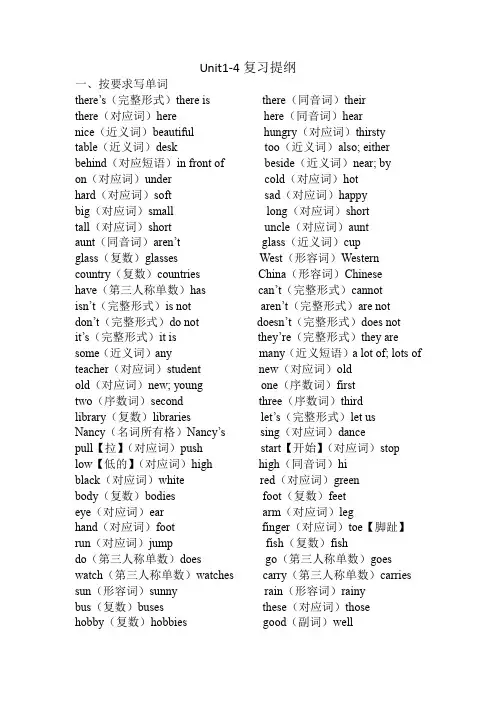
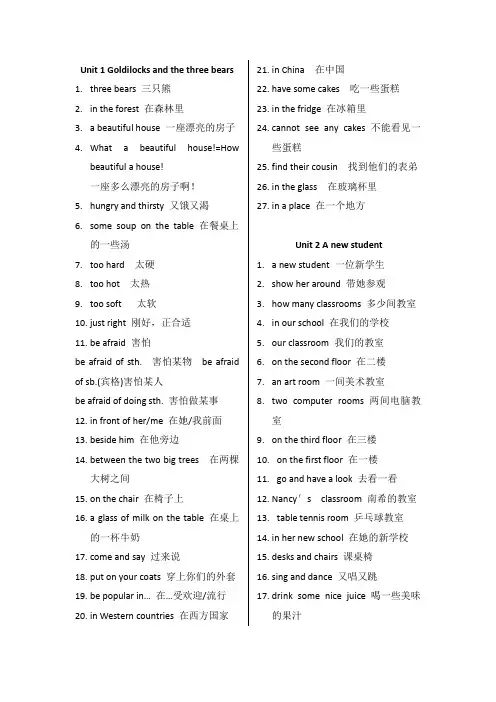
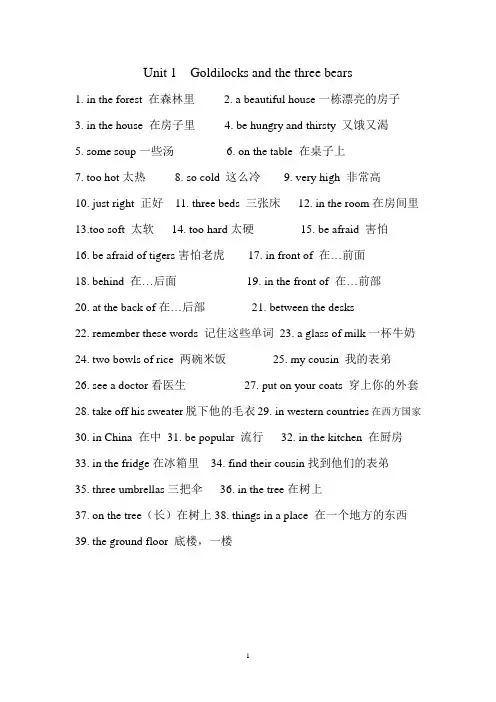
Unit1-4复习提纲一、按要求写单词there’s(完整形式)there is there(同音词)theirthere(对应词)here here(同音词)hearnice(近义词)beautiful hungry(对应词)thirstytable(近义词)desk too(近义词)also; either behind(对应短语)in front of beside(近义词)near; byon(对应词)under cold(对应词)hothard(对应词)soft sad(对应词)happybig(对应词)small long(对应词)shorttall(对应词)short uncle(对应词)auntaunt(同音词)aren’t glass(近义词)cupglass(复数)glasses West(形容词)Western country(复数)countries China(形容词)Chinesehave(第三人称单数)has can’t(完整形式)cannotisn’t(完整形式)is not aren’t(完整形式)are not don’t(完整形式)do not doesn’t(完整形式)does not it’s(完整形式)it is they’re(完整形式)they are some(近义词)any many(近义短语)a lot of; lots of teacher(对应词)student new(对应词)oldold(对应词)new; young one(序数词)firsttwo(序数词)second three(序数词)thirdlibrary(复数)libraries let’s(完整形式)let usNancy(名词所有格)Nancy’s sing(对应词)dancepull【拉】(对应词)push start【开始】(对应词)stop low【低的】(对应词)high high(同音词)hiblack(对应词)white red(对应词)greenbody(复数)bodies foot(复数)feeteye(对应词)ear arm(对应词)leghand(对应词)foot finger(对应词)toe【脚趾】run(对应词)jump fish(复数)fishdo(第三人称单数)does go(第三人称单数)goes watch(第三人称单数)watches carry(第三人称单数)carries sun(形容词)sunny rain(形容词)rainybus(复数)buses these(对应词)thosehobby(复数)hobbies good(副词)wellstory(复数)stories all(近义词)bothdance(动名词)dancing skate(动名词)skatingmake(动名词)making live(动名词)livingcome(动名词)coming give(动名词)givingtake(动名词)taking have(动名词)havingclose(动名词)closingswim(动名词)swimmingrun(动名词)running sit(动名词)sittingget(动名词)getting put(动名词)puttingstop(动名词)stopping*eat(动名词)eating *meet(动名词)meeting*jump(动名词)jumping *sleep(动名词)sleeping winter(对应词)summer spring(对应词)autumndry【干的】(对应词)wet主格I you he she it we you they 宾格me you him her it us you them 物主my your his her its our your their二、知识点1.There is加可数名词单数或者不可数名词,如:There is a house in the forest.There is some soup on the table.2.There are加可数名词复数,如:There are a lot of trees in the school.3.There is/are句中如果有量词的就看量词的单复数,如:There is a cup of coffee on the table.There are two glasses of milk on the table.4.There is/are句型有“就近原则”,如:There is a rubber and two pencils on the desk.There are two pencils and a rubber on the desk.5.too表示“太”,so表示“如此,这么,那么”,very表示“很,非常”,如:too soft 太软so hard 如此硬very hot 非常热6.介词的用法:(1)介词加the或者物主代词,再加名词,如:beside the window under my desk(2)介词直接加人称代词宾格,如:behind him in front of me7.put on表示“穿上”,wear表示“穿着”,如:put on your coat 穿上你的外套wear a pair of yellow shoes 穿着一双黄鞋子8.can的否定形式是can’t或者cannot, 如:(1)can’t see表示“看不见”: Bobby cannot see any cakes in the fridge.(2)can’t hear表示“听不见”:I can’t hear the teacher.(3)can’t find表示“找不到”:Bobby and Tina can’t find their cousin.(4)can’t fly表示“不会飞”:The rabbit can’t fly....9.动词加人称代词宾格的用法,如:show me/you/him/her/us/them around 带我/你/他/她/我们/他们参观show me your new skirt 给我看你的新短裙give him a cake 给他一个蛋糕teach us English 教我们英语10.基数词与序数词的用法,如:two computer rooms 两间电脑室on the second floor 在二楼the first lesson 第一节课my second pen 我的第二支钢笔11.a与an的用法,如:an ice cream a nice ice creaman idea a good/great idea12.some与any的用法,如:(1)Are there any cakes in the fridge?No, there aren’t any cakes in the fridge.But there are some pies in it.(2)Is there any milk in the glass?No, there isn’t any milk in the glass.But there is some juice in it.13.“去某处”的表达,如:go to the cinema 去电影院go to the park 去公园go to the zoo 去动物园go to the library 去图书馆go to the playground 去操场14.in与on在都表示“在......上”时的用法,如:(1) in the playground 在操场上in the picture 在图片上;在照片上a bird in the tree 在树上的一只鸟a hole in the ice 在冰上的一个洞a hole in the dress 在连衣裙上的一个洞(2) on the chair 在椅子上on the wall 在墙上the pears on the tree 在树上的梨play on the swing 在秋千上玩;荡秋千skate on the ice 在冰上溜冰15.time加for再加名词,time加to再加动词,如:time for breakfast/lunch/dinner time to have breakfast/lunch/dinner 吃早饭/午饭/晚饭的时间time for Art/Music time to have an Art/a Music lesson上美术课/音乐课的时间time for school/bed time to go to school/bed上学/睡觉的时间time for football/basketball time to play football/basketball踢足球/打篮球的时间16.one ... the other ... 的用法,如:Nancy has two fish. One is red, the other is black./One is red and the other is black.I have two pencils. One is long, the other is short./One is long and the other is short.There are two computer rooms in our school. One is on the second floor, the other is on the third floor./ One is on the second floor and the other is on the third floor.17.too与also都表示“也”,但用法不同,如:It has a big body too. / It also has a big body.I like drawing too. / I also like drawing.She is my friend too. / She is also my friend.I can skate very well too. / I can also skate very well.18.both与all都表示“都”,但是both表示“(两者)都”,all表示“(三者及以上)都”,如:Su Hai and Su Yang both like swimming.Mike, Wang Bing and I all like running.19.be good at加名词或者动名词,如:be good at football / be good at playing footballbe good at dancing/skating/jumping/...20.and与or的用法,如:在肯定句中用and:I can sing and dance.在否定句和疑问句中用or:I can’t swim or skate.21.too与either的用法,如:在肯定句中用too, 如:I like making friends too.在否定句中用either, 如:I don’t like dancing either.22.“给某人某物”的两种表达:give某人某物;give某物to某人,如:give me a cake / give a cake to megive them some sweets / give some sweets to them23.very与very much, very well的用法,如:(1)very直接修饰形容词或者副词,如:very nice/good/small(2)very much与like搭配使用,表示“非常喜欢......”,如:like climbing very much 非常喜欢爬山like Maths very much 非常喜欢数学(3)very well与动词搭配使用,表示“......非常好”,如:skate very well 溜冰溜得非常好play basketball very well 打篮球打得非常好draw very well 画画画得非常好24.talk about的用法,如:talk about their hobbies 谈论他们的爱好talk about animals 谈论动物talk about toys 谈论玩具25.时间前介词的用法,如:(1)“在几点”用at:at six at three thirty(2)“在上午/下午/晚上”用in:in the morning/afternoon/evening注:in the evening(同义短语)at night(3)“在星期几”用on:on Saturday on Sunday(4)“在星期几的上午/下午/晚上”用on:on Monday morning(5)this, every, tomorrow加时间,不用介词:this afternoonevery Tuesday tomorrow evening26.How many ...?句型的几种句式及回答:(1)How many toy cars do you have? I have two (toy cars).(2)How many toy cars can you see? I can see three (toy cars).(3)How many toy cars are there in the living room?There is one (toy car).(4)How many toy cars would you like? I’d like four (toy cars).27.在一般疑问句中,some不变的几种句式及回答:(1)Would you like some milk? Yes, please./ No, thank you.(2)Do you want some milk? Yes, I do./ No, I don’t.(3)What about some milk? Yes, please./ No, thanks.(4)Can I have some milk? Sure.28.感叹句的两种表达方式:(1)What加名词,如:What a nice skirt!(2)How加形容词,如:How nice the skirt is!29.play直接加球类单词,如:play football/basketball/table tennisplay加the再加乐器类单词,如:play the piano/guitar/violin三、用所给单词的适当形式填空的常用语法规则1.一般现在时句子中,三单人称动词用-s形式,非三单人称动词用原形。