
2.Features of Academic Writing
- 格式:ppt
- 大小:173.50 KB
- 文档页数:11
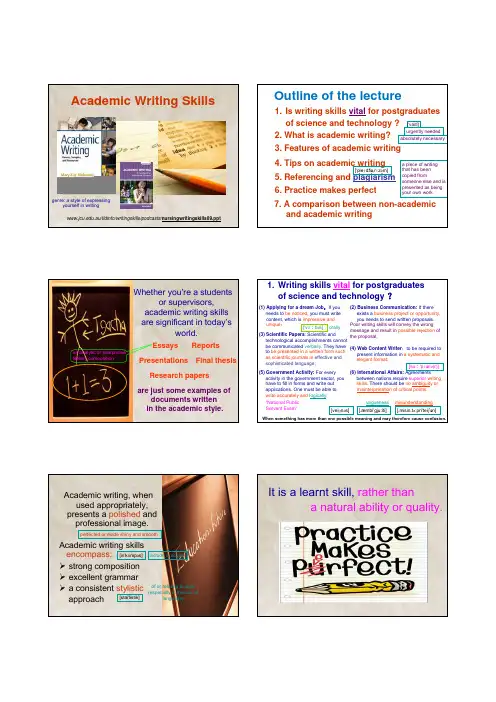
Academic Writing Skills
.au/tldinfo/writingskills/podcasts/nursingwritingskills09.pptgenre: a style of expressing yourself in writing Outline of the lecture
2. What is academic writing?
3. Features of academic writing1.Is writing skills vitalfor postgraduates
of science and technology ?
5. Referencing and plagiarism4. Tips on academic writing[‘pleɪdʒə,rɪzəm] ['vaitl]
a piece of writing that has been copied from someone else and is presented as being your own work urgently needed absolutely necessary
7. A comparison between non-academic
and academic writing6. Practice makes perfect
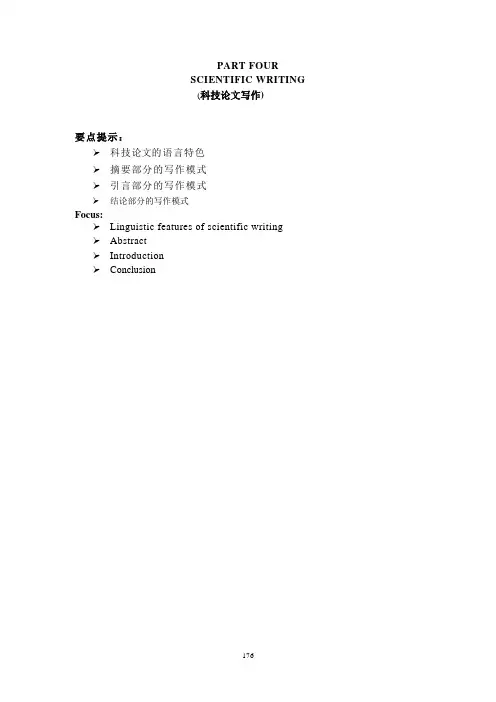
Whether you’re a students
or supervisors,
academic writing skills
are significantin today’s
world.
EssaysReports
Presentations
Research papersFinal thesis
are just some examples of documents written in the academic style.an analytic or interpretive literary composition 1.Writing skills vitalfor postgraduates
176 PART FOUR
SCIENTIFIC WRITING
(科技论文写作)
要点提示:
科技论文的语言特色
摘要部分的写作模式
引言部分的写作模式
结论部分的写作模式
Focus:
Linguistic features of scientific writing
Abstract
Introduction
Conclusion
177
Chapter 23
Linguistic Features of Scientific Writing
(科技文章的语言特征)
要点提示:
词汇特征
避免口语化
动词名词化
非人格化
词汇专业化
句法特征
较多使用陈述句
较多使用祈使句
较多使用复杂句
较多使用“It +be+adj. /participle+that clause…”句式
时态特点
时态的某些使用习惯
一些例外情况
Focus:
Lexical features
Avoidance of colloquialism
Nominalization
Depersonalization
Professionalized terms
Syntactic structure
Indicative sentences
Imperative sentences
Complex sentences
“It +be+adj. /participle+that clause…”
Tense
Some conventional uses of tense
Some exceptions
178 23.1 Lexical features(词汇特征)
23.1.1 Avoidance of colloquialism(避免口语化)
1 English Academic
Writing
and Speech Presentation
In accordance with tradition, academic papers can be divided into
research papers and reports. Research papers can be further
divided into argument, refutation, review, verification, and explanatory
papers. Of the above four types of academic papers, descriptive
papers are most widely used in natural sciences but are also
common in social sciences and thus are the most typical academic
paper type.
Structure of an academic paper: Papers can be divided into:
1. Library Research Papers
2. Experimental Research Papers, or
3. Case Studies
Library Research Papers consist of:
1. A Title Page
2. An Outline
3. An Abstract
4. Key Words
5. The Main Body, 2 6. Appendix and
7. References
Experimental Research Papers are made up of:
1. A Title
2. An Abstract
![3.2AcademicWritingStyle[1]](https://imgs-1438308264.cos.ap-hongkong.myqcloud.com/63282505e87101f69e319575.webp)
© Academic Skills Centre 2010 Page 1 1.20 Academic writing style There's no great mystique about an "academic writing style". The most important thing is to keep your writing clear and concise and make sure that you get your ideas over in a comprehensible form. It's clear expression of these ideas that will impress your tutor, not a string of long, inappropriate words found in your dictionary. A wide range of vocabulary is of course important, but you must use the right word, and shorter ones are often better than longer ones. The most important thing to remember is generally to try to avoid every day, informal language, especially colloquial expressions and slang. Also, spoken language is naturally full of hesitations, repetitions, grammatical errors and unfinished ideas. In your writing, however, structure is much more important: sentences should be complete and ideas arranged into paragraphs or sections, and you should aim for perfection in your grammar and spelling. However, especially if English is not your first language, don't become too obsessed with this, to the point perhaps of copying word for word from your sources. What‟s important is that you clearly show your understanding of the subject and your ability to manipulate information to answer a specific question or complete a specific task, and as long as any grammar errors you make don‟t impede this, then it shouldn‟t be a problem. Here are a few general points to remember when you are writing your assignments. As well as using appropriate language and aiming for 100% accuracy in your grammar and vocabulary, you should also remember that you're writing for someone else, and hence the importance of punctuation, sentences, paragraphs and overall structure, all of which help the reader. AVOID SOME ASPECTS OF INFORMAL ENGLISH Don't (do not!) use contractions (e.g. it's, he'll, it'd etc): always use the full form (it is/has, he will, it would/had). Don't use colloquial language or slang (e.g. kid, a lot of/lots of, cool) Always write as concisely as you can, with no irrelevant material or “waffle”. Generally avoid "phrasal verbs" (e.g. get off, get away with, put in, etc.): instead, use one word equivalents. Avoid common but vague words and phrases such as get, nice, thing. Your writing needs to be more precise. Avoid overuse of brackets; don‟t use exclamation marks or dashes; avoid direct questions; don‟t use “etc”. Always use capital letters appropriately and never use the type of language used in texting! See the practice exercises at the end of the guide. STRUCTURE YOUR WRITING CAREFULLY Make sure you write in complete sentences (see Guide 1.34). Divide your writing up into paragraphs (see Guide 1.35). Use connecting words and phrases to make your writing explicit and easy to follow (see Guide 1.39). Check your grammar and spelling carefully (see Guide 1.42). MAKE YOUR WRITING FORMAL AND IMPERSONAL Avoid too much personal language (I, my, we etc). Some tutors prefer you to avoid it completely. Never use emotive language; be objective rather than subjective. (See Guide 1.22). Avoid being too dogmatic and making sweeping generalisations. It is usually best to use some sort of “hedging” language (see below) and to qualify statements that you make. You should consistently use evidence from your source reading to back up what you are saying and reference this correctly. Avoid sexist language, such as chairman, mankind. Don‟t refer to “the doctor” as he; instead, make the subject plural and refer to them as they. Avoid he/she, herself/himself etc. Use nominalisation; that is, try to write noun-based phrases rather that verb-based ones. © Academic Skills Centre 2010 Page 2 For example, instead of: Crime was increasing rapidly and the police were becoming concerned. Write: The rapid increase in crime was causing concern among the police. In general, academic writing tends to be fairly dense, with relatively long sentences and wide use of subordinate clauses. Remember, however, that your main aim is clarity, so don‟t be too ambitious, particularly when you‟re starting to write. HEDGING/AVOIDING COMMITMENT In order to put some distance between what you‟re writing and yourself as writer, to be cautious rather than assertive, you should: Avoid overuse of first person pronouns (I, we, my, our) Use impersonal subjects instead (It is believed that ..., it can be argued that ...) Use passive verbs to avoid stating the „doer‟ (Tests have been conducted) Use verbs (often with it as subject) such as imagine, suggest, claim, suppose Use „attitudinal signals‟ such as apparently, arguably, ideally, strangely, unexpectedly. These words allow you to hint at your attitude to something without using personal language. Use verbs such as would, could, may, might which „soften‟ what you‟re saying. Use qualifying adverbs such as some, several, a minority of, a few, many to avoid making overgeneralisations. Exercises Exercise 1 Replace the phrasal verbs in the sentences with a more appropriate verb from the list below. Don't forget to keep the same tense. fluctuate investigate eliminate raise reduce propose intervene establish 1. Researchers have been looking into the problem for 15 years. ______________________ 2. This issue was brought up during the seminar. __________________________ 3. It is assumed that the management knows what is happening and will therefore step in if there is a problem. _________________________ 4. Schools cannot altogether get rid of the problem of truancy. _________________________ 5. The number of staff has been cut down recently. _____________________ 6. It was very difficult to find out exactly what happened. _______________________ 7. House prices have a tendency to go up and down. _______________________ 8. A potential solution was put forward two years ago. ______________________ Exercise 2 Replace the following phrasal verbs with a more formal single word. 1. The locals could not put up with the visitors from the city. ___________________________ 2. The decline was brought about by cheap imports. _________________________________ 3. The university is thinking about installing CCTV. __________________________________ 4. Sales are likely to drop off in the third quarter. ____________________________________ 5. He went on speaking for over an hour. __________________________________________ 6. The meeting was put off until December. ________________________________________ 7. The cinema was pulled down ten years ago. _____________________________________ 8. People have cut down on their consumption of beef. _______________________________