
will people have robots公开课课件
- 格式:ppt
- 大小:3.35 MB
- 文档页数:20
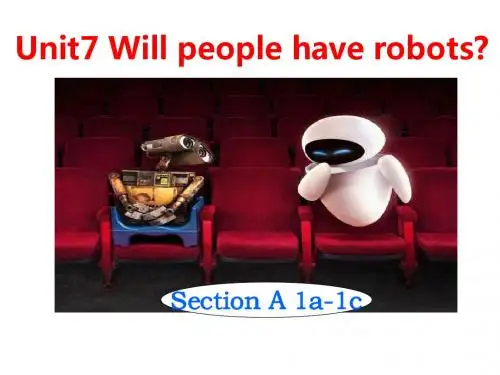
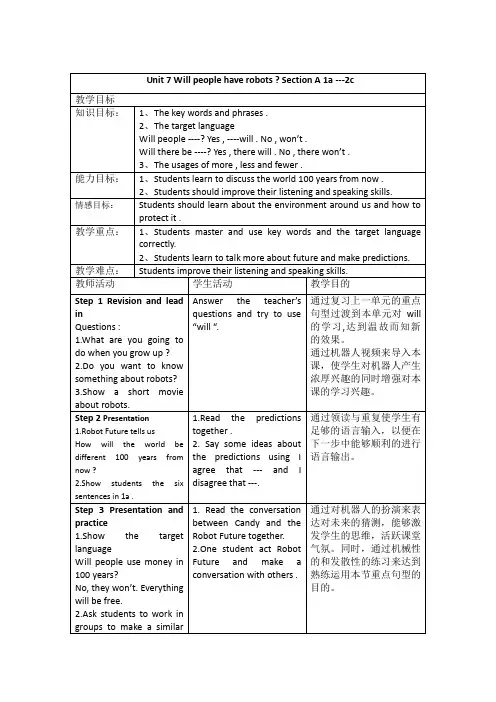
Unit 7 Will people have robots ? Section A 1a ---2c
教学目标
知识目标: 1、The key words and phrases .
2、The target language
Will people ----? Yes , ----will . No , won’t .
Will there be ----? Yes , there will . No , there won’t .
3、The usages of more , less and fewer .
能力目标: 1、Students learn to discuss the world 100 years from now .
2、Students should improve their listening and speaking skills.
情感目标: Students should learn about the environment around us and how to
protect it .
教学重点: 1、Students master and use key words and the target language
correctly.
2、Students learn to talk more about future and make predictions.
教学难点: Students improve their listening and speaking skills.
教师活动 学生活动 教学目的
Step 1 Revision and lead
in
Questions :
1.What are you going to
do when you grow up ?
2.Do you want to know
something about robots?
教学设计:
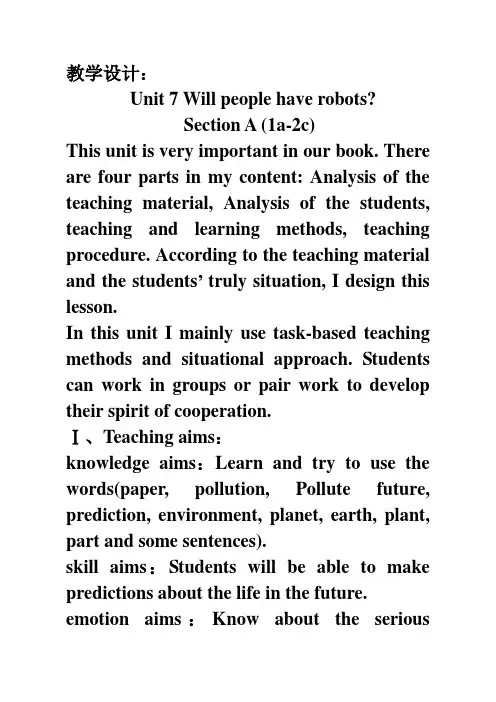
Unit 7 Will people have robots?
Section A (1a-2c)
This unit is very important in our book. There
are four parts in my content: Analysis of the
teaching material, Analysis of the students,
teaching and learning methods, teaching
procedure. According to the teaching material
and the students’ truly situation, I design this
lesson.
In this unit I mainly use task-based teaching
methods and situational approach. Students
can work in groups or pair work to develop
their spirit of cooperation.
Ⅰ、Teaching aims:
knowledge aims:Learn and try to use the
words(paper, pollution, Pollute future,
prediction, environment, planet, earth, plant,
part and some sentences).
skill aims:Students will be able to make
predictions about the life in the future.
emotion aims:Know about the serious environment problem; play a part in saving
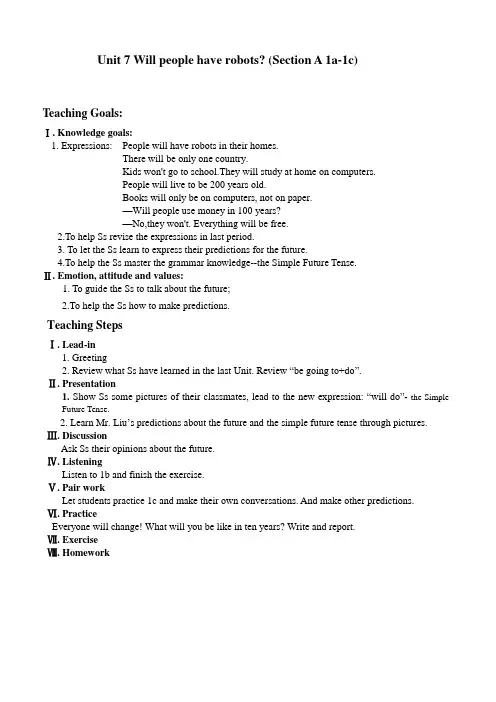
Unit 7 Will people have robots? (Section A 1a-1c)
2.To help the Ss how to make predictions.
Teaching Steps
Ⅰ. Lead-in
1. Greeting
2. Review what Ss have learned in the last Unit. Review “be going to+do”.
Ⅱ. Presentation
1. Show Ss some pictures of their classmates, lead to the new expression: “will do”- the Simple
Future Tense.
2. Learn Mr. Liu’s predictions about the future and the simple future tense through pictures.
Ⅲ. Discussion
Ask Ss their opinions about the future.
Ⅳ. Listening
Listen to 1b and finish the exercise.
Ⅴ. Pair work
Let students practice 1c and make their own conversations. And make other predictions.
Ⅵ. Practice
Everyone will change! What will you be like in ten years? Write and report.
Ⅶ. Exercise
Ⅷ. Homework
Teaching Goals:
Ⅰ. Knowledge goals:
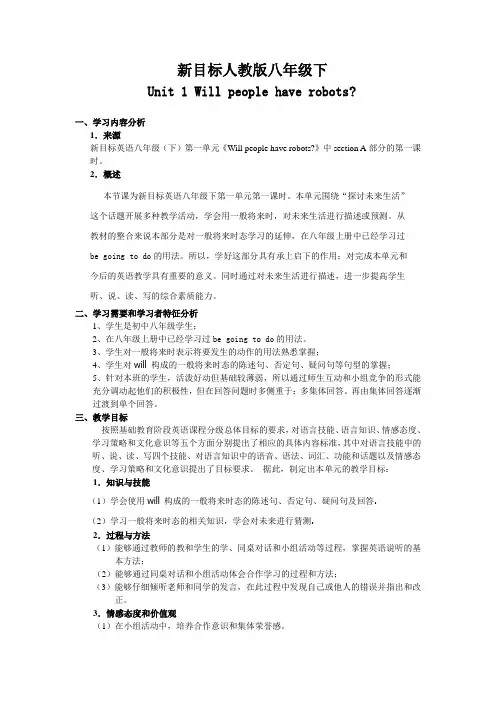
新目标人教版八年级下
Unit 1 Will people have robots?
一、学习内容分析
1.来源
新目标英语八年级(下)第一单元《Will people have robots?》中section A部分的第一课时。
2.概述
本节课为新目标英语八年级下第一单元第一课时。本单元围绕“探讨未来生活”这个话题开展多种教学活动,学会用一般将来时,对未来生活进行描述或预测。从教材的整合来说本部分是对一般将来时态学习的延伸,在八年级上册中已经学习过be going to do的用法。所以,学好这部分具有承上启下的作用;对完成本单元和今后的英语教学具有重要的意义。同时通过对未来生活进行描述,进一步提高学生听、说、读、写的综合素质能力。
二、学习需要和学习者特征分析
1、学生是初中八年级学生;
2、在八年级上册中已经学习过be going to do的用法。
3、学生对一般将来时表示将要发生的动作的用法熟悉掌握;
4、学生对will 构成的一般将来时态的陈述句、否定句、疑问句等句型的掌握;
5、针对本班的学生,活泼好动但基础较薄弱,所以通过师生互动和小组竞争的形式能充分调动起他们的积极性,但在回答问题时多侧重于:多集体回答。再由集体回答逐渐过渡到单个回答。
三、教学目标
按照基础教育阶段英语课程分级总体目标的要求,对语言技能、语言知识、情感态度、学习策略和文化意识等五个方面分别提出了相应的具体内容标准,其中对语言技能中的听、说、读、写四个技能、对语言知识中的语音、语法、词汇、功能和话题以及情感态度、学习策略和文化意识提出了目标要求。 据此,制定出本单元的教学目标:
1.知识与技能
(1)学会使用will 构成的一般将来时态的陈述句、否定句、疑问句及回答.
(2)学习一般将来时态的相关知识,学会对未来进行猜测.
2.过程与方法
(1)能够通过教师的教和学生的学、同桌对话和小组活动等过程,掌握英语说听的基本方法;