
Basic Scientific and Technical Translation1
- 格式:ppt
- 大小:330.00 KB
- 文档页数:31


笔译(一)第一讲翻译概论Some suggestions1. Students are expected to keep on improving language competence both in their English and Chinese so that they can be fit for the work of translation;2. Students are expected to cultivate a sense of bi-culture involved in translation and observe similarities and difference between two languages in lexicology, syntax, discourse.3. Students are expected to read and study translation works by well-known translators, and to have a lot of exposure to both SL (源语) and TL(目的语).4. Students are expected to do ample translation practice to improve translation ability and try to apply translation theory to practice.5. Students are expected to read extensively after class to get ample knowledge in different fields. General knowledge is of vital importance.6. Discuss with your classmates and teachers.7. Summarize and make a frequent reflection.8. Be patient and careful.The Story of Babel 巴别塔的故事那时,诺亚的后代都使用同一种语言。
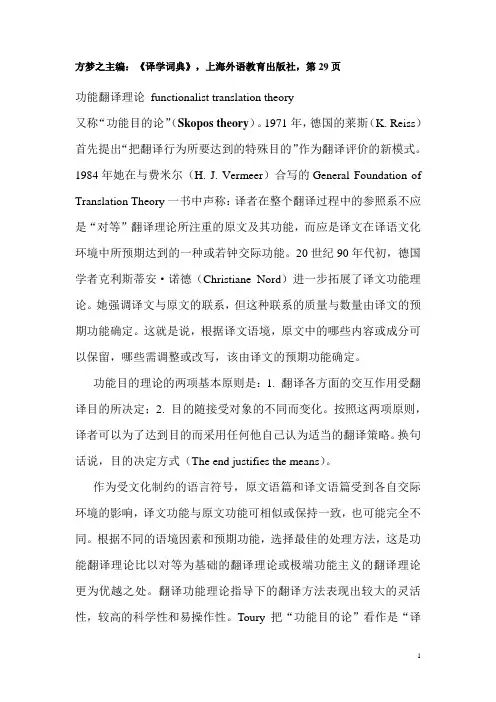
方梦之主编:《译学词典》,上海外语教育出版社,第29页功能翻译理论functionalist translation theory又称“功能目的论”(Skopos theory)。
1971年,德国的莱斯(K. Reiss)首先提出“把翻译行为所要达到的特殊目的”作为翻译评价的新模式。
1984年她在与费米尔(H. J. Vermeer)合写的General Foundation of Translation Theory一书中声称:译者在整个翻译过程中的参照系不应是“对等”翻译理论所注重的原文及其功能,而应是译文在译语文化环境中所预期达到的一种或若钟交际功能。
20世纪90年代初,德国学者克利斯蒂安·诺德(Christiane Nord)进一步拓展了译文功能理论。
她强调译文与原文的联系,但这种联系的质量与数量由译文的预期功能确定。
这就是说,根据译文语境,原文中的哪些内容或成分可以保留,哪些需调整或改写,该由译文的预期功能确定。
功能目的理论的两项基本原则是:1. 翻译各方面的交互作用受翻译目的所决定;2. 目的随接受对象的不同而变化。
按照这两项原则,译者可以为了达到目的而采用任何他自己认为适当的翻译策略。
换句话说,目的决定方式(The end justifies the means)。
作为受文化制约的语言符号,原文语篇和译文语篇受到各自交际环境的影响,译文功能与原文功能可相似或保持一致,也可能完全不同。
根据不同的语境因素和预期功能,选择最佳的处理方法,这是功能翻译理论比以对等为基础的翻译理论或极端功能主义的翻译理论更为优越之处。
翻译功能理论指导下的翻译方法表现出较大的灵活性,较高的科学性和易操作性。
Toury 把“功能目的论”看作是“译文文本中心论”的翻版。
Skopos theory (plural Skopos theories)1.(translation studies) The idea that translating and interpretingshould primarily take into account the function of both the sourceand target text.o1995, Paul Kussmaul, Training The Translator, JohnBenjamins Publishing Co, p. 149:The functional approach has a great affinity with Skopos theory.The function of a translation is dependent on the knowledge,expectations, values and norms of the target readers, who are again influenced by the situation they are in and by the culture. Thesefactors determine whether the function of the source text orpassages in the source text can be preserved or have to be modified or even changed.Introduction to the Skopos TheoryThe Skopos theory is an approach to translation which was put forward by Hans Vemeer and developed in Germany in the late 1970s and whichoriented a more functionally and socioculturally concept of translation. Translation is considered not as a process of translation, but as a specific form of human action. In our mind, translation has a purpose, and the word “Skopos” was from Greek. It’s used as the technical term for the purpose of the translation.翻译目的论,"skopos"是希腊语“目的”的意思。

I,所有title部分1 科技英语文体的特征、功能和语境:1.1 科技英语文体1.2 专用科技文体1.2.1 专用科技文体语义特征1.2.1.1 语义结构显性化1.2.1.2 非人称化1) 少用代词,偶见人称代词we2) 多用被动(近二三十年多用主动)1.2.1.3 名词化(Nominalization)1 科技英语文体的特征、功能和语境1.2.2 专用科技文体用词正式1.2.3专用科技文体结构严密1.2.4 专用科技文体程式化1.3 普通科技文体(包括科普文章和技术文本)1.3.1 普通科技文体用词平易1.3.1.1 用常用词代替专业术语1.3.1.2 用动词代替抽象名词1.3.1.3 多用代词1.3.2 普通科技文体句法简单1.3.2.1 使用短句1.3.2.2 避免使用形式主语it和引导词there1.3.2.3 多用主动态1.3.3 普通科技文体多用修辞格1.3.3.1 明喻(simile)1.3.3.2 暗喻(metaphor)1.3.3.3 拟人(personification)1.3.3.4 排比(parallelism)1.3.3.5 押韵(rhyme)1.3.3.6 借代(metonymy)1.3.3.6 借代(metonymy)1.3.3.8 低调陈述(understatement)1.4 专用科技文体和普通科技文体的区别1.4.1 在专用科技英语中,常用拉丁语派生词来代替同义的盎格鲁-撒克逊语单词1.4.2 在专用科技英语中常用规范的书面语动词来代替普通语中的短语动词或动词词组1.5 科技英语文体的功能1.5.1 彼得∙纽马克(Peter Newmark)1) 信息功能(informative function)2) 表情功能(expressive function)3) 祈使功能(vocative function)4) 美感功能(aesthetic function)5) 交际功能(phatic function)6) 元语言功能(metalingual function)1.5.2 科技英语文体的功能是信息功能传递和交流信息1.6 科技英语文体翻译的语境言外语境:情景语境,社会文化语境言内语境2 科技英语文体翻译的语境选择2.1 科技英语文体翻译应顺应目的语的语境3 科技英语文体翻译的标准3.1翻译标准3.1.1 忠实准确(faithful and accurate)3.1.2 通顺流畅(smooth and fluent)3.1.3 规范专业(standard and professional)3.2 科技英语文体翻译的步骤3.2.1理解3.2.2诠释3.2.3重现3.2.4表达第二章1 科技英语词汇的来源、分类及特征1.1 科技英语词汇的来源和分类1.1.1 英语中的普通词汇即语言的共核部分,但被赋予了新义。