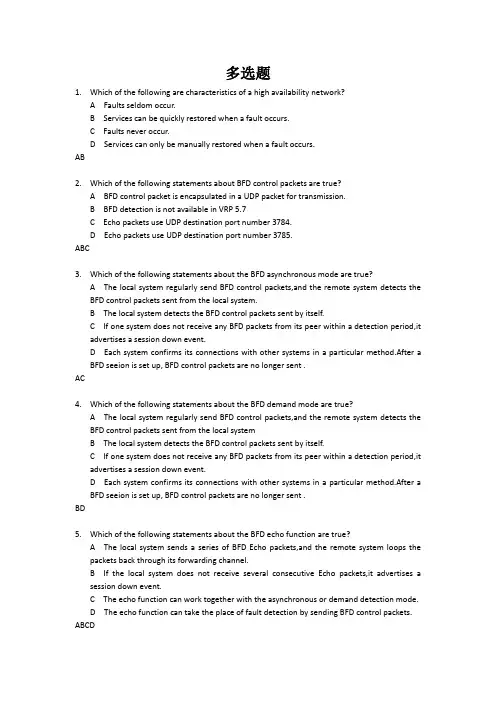
多选题1.Which of the following are characteristics of a high availability network?A Faults seldom occur.B Services can be quickly restored when a fault occurs.C Faults never occur.D Services can only be manually restored when a fault occurs.AB2.Which of the following statements about BFD control packets are true?A BFD control packet is encapsulated in a UDP packet for transmission.B BFD detection is not available in VRP 5.7C Echo packets use UDP destination port number 3784.D Echo packets use UDP destination port number 3785.ABC3.Which of the following statements about the BFD asynchronous mode are true?A The local system regularly send BFD control packets,and the remote system detects theBFD control packets sent from the local system.B The local system detects the BFD control packets sent by itself.C If one system does not receive any BFD packets from its peer within a detection period,itadvertises a session down event.D Each system confirms its connections with other systems in a particular method.After aBFD seeion is set up, BFD control packets are no longer sent .AC4.Which of the following statements about the BFD demand mode are true?A The local system regularly send BFD control packets,and the remote system detects theBFD control packets sent from the local systemB The local system detects the BFD control packets sent by itself.C If one system does not receive any BFD packets from its peer within a detection period,itadvertises a session down event.D Each system confirms its connections with other systems in a particular method.After aBFD seeion is set up, BFD control packets are no longer sent .BD5.Which of the following statements about the BFD echo function are true?A The local system sends a series of BFD Echo packets,and the remote system loops thepackets back through its forwarding channel.B If the local system does not receive several consecutive Echo packets,it advertises asession down event.C The echo function can work together with the asynchronous or demand detection mode.D The echo function can take the place of fault detection by sending BFD control packets. ABCD6.Which of the following statements about a smart link group are true?A Smart link group consists of a maximum of two interfaces,where there are twointerfaces,one is an active interface,and the other a standby interface.B Of the two interface in a smart link group,one is active,and the other is standby.C when an active interface goes down,the Smart link group automatically blocks it andchanges the status of the standby interface to active.D when an active interface recovers,the standby interface is blocked and traffic is switchedback to the active interface.ABC7.Which of the following statements about Flush packets in a smart link group are true?A A smart link group sends flush packets to instruct other devices to update the addresstable.B Flush packets use IEEE 802.3 encapsulation.C The destination MAC address of Fulsh packets is an unknown unicast address,which isused to distinguish protocols.D The destination MAC address of flush packets is a special multicast address,which is usedto distinguish protocols.ABC8.When links are switched in a smart link group, which of the following mechanisms can beused to refresh MAC and ARP entries?A MAC and ARP entries are refreshed automatically with respect to traffic.B The smart link group uses a new link to send flush packets.C MAC entries are refreshed after the aging time expires.D ARP entries are refreshed after the aging time expires.ABC9.Which of the following statements about link aggregation are true?A link aggregation binds a group of physical interfaces together as a logical interface toincrease the bandwidth and reliability.B Link aggregation complies with IEEE 802.3ah.C The logical link formed by bundling multiple physical links together is called a linkaggregation group (LAG) or a trunk.D Active and inactive interfaces exist in link aggregation,Active interfaces forward data,whereas inactive interfaces do not.ABCD10.Which of the following statements about link aggregation are true?A Link aggregation can be performed in manual load balancing or LACP mode.in manualloading balancing mode,LACP is disabled:in LACP mode,LACP is enabled.B In manual load balancing mode,all active member interfaces forward data and performload balancing.C In static LACP mode,the creation of the Eth-Trunk and the addition of member interfacesto the Eth-Trunk are perfaormed pared with link aggregation in manual load balancing mode,active interfaces in static LACP mode are seleted by sending LACP data units(LACPDUs).D Indynamic LACP mode,the creation of the Eth-Trunk,the addition of memberinterfaces,and the selection of active interfaces are performed based on LACP negotiation. ABCD11.Which of the following statements about LACP are true?A It complies with IEEE 802.3ad.B A device enabled with LACP exchanges link Aggregation Control protocol data Units(LACPDUs) with its peer.C Devices at both ends determine the active interface according to the interface priority ofthe active device.ABC12.Which of the following reliability designs are related to routers?A Reliability design of the system and hardwareB Reliability design of the softwareC Reliability test authenticationD Reliability design of the IP networkABCD13.Which of the following can speed up OSPF fast convergence?A Configuring dynamic BFD for OSPFB Adjusting the interval at which OSPF calculation is performedC Configuring the interval at which an LSA are retransmittedD Configuring the maximum number of external LSAs in the LSDBAB14.When the GR restarter performs the active/standby switchover, the neighbor performs whichof the following perations when detecting that a TCP disconnection?A Keeping the routing tables of various address families advertised by the GR Restarterduring negotiation,marking entries in these tables with stale tags,and starting a stale timer.B Starting a restart timer.C Clearing all routing entries and forwarding entries related to the GR restarter if the GRrestarter fails to re-establish the BGP connection with the neighbor after the restart timer expires.D Remaining the neighbor relationship unchanged.15.Which of the following statements about the reliability requirement level are true?A Faults seldom occur in the system software or hardware.B System functions are not affected by faults.C System functions are affected by faults but can rapidly recover.D System functions can be ensured by using redundancy design,switchover policy,and highsuccess rate in switchover.ABCD16.Which of the following are end-to-end link protection modes?A 1:1B M:NC N:1D 1+1ABD17.On a BGP/MPLS IPv4 VPN,OSPF,LDP,and static routes are configured.which of the followingprotocols need to be enabled with GR to achieve NSF on PEs?A OSPFB MPLS LDPC BGPD Static routesABC18.Which of the following statements about BFD are true?A It cannot be used to detect MPLS networks.B It provides low-load and short-duration detection for paths between adjacent forwardingengines.C It provides a unified mechanism for detecting all types of media and BFD-supportingprotocols.D It is a bidirectional detection mechanism.BCD19.Which of the following statements about the setup of a BFD session are true?A A BFD session can be set up in either static or dynamic mode.B A static BFD session is set up by manually configuring BFD session parameters anddelivering requests for setting up a BFD session. BFD session parameters include the local and remote discriminators.C A dynamic BFD session is set up by dynamically allocating local discriminators.D Static and dynamic BFD session are not differentiated.ABC20.Which of the following statements are correct regarding OSPF Router LSA?A Every router running OSPF must generate Router LSA.B In broadcast and NBMA network,only DROther generates Router LSA.C Router LSA describes link states of the router in area.D Router LSA is flooded in the whole AS.AC21.Which of the following statements are correct regarding Network LSA in OSPF network?A Network LSA is generated by ABR.B only the router which connects NBMA or Broadcast Network may generate network LSA.C DR uses network LSA to describe routers that have established adjacency relation with itin the network.D Network LSA is flooded in the whole AS.BC22.Which type of LSA is only used to calculate external route?A Type 1B Type 2C Type 3D Type 4E Type 5DE23.Which of the following are OSPF packet type?A LSAB LS requestC LSPD LS UpdateE LS ackBDE24.Which of the following elements together uniquely identify a LSA?A LS typeB Link state IDC Advertising RouterD LS Sequence numberABC25.Which of the following statements are correct regarding how OSPF detects old and duplicateLSAs?A The smaller the sequence number,the more recent the LSA,B The smaller the LS age,the more recent the LSA.C When router generates a new LSA at the first time,it will use 0x80000001 as thesequence number.D An LSA can be flushed from routing domain by setting its LSA age to Maxage.BCD26.Which of the following statements are correct regarding intra-area route calculation of OSPF?A Every OSPF router only uses one Router LSA to describe local active link state for onearea.B Every OSPF uses more than one Router LSA to describe local active link state for one area.C One Router LSA Only describes one linkD One Router LSA describes more than one linkAD27.In OSPF protocol,which of the following elements are used to describe one link?A Link IDB DataC TypeD MetricABCD28.In OSPF protocol,which of the following elements are used by network LSA to describebroadcast network segment or NBMA network segment?A LINK IDB Net maskC Attached Router listD MetricABC29.Which of the connection types that Router LSA can describe?A Point-to-pointB StubC transitD Virtual linkABCD30.In OSPF, which of the following statements are incorrect regarding Router LSA generated byRouter A?A In point-to-point link type, Data is set to the interface IP address of RouterA.B In TransNet link type,Data is set to the interface IP address of RouterA.C In StubNet link type,Data is set to the interface IP address of RouterA.D In Virtual link type,Data is set to the Router ID of RouterA.CD31.In OSPF protocol,which of the following elements are used by network LSA to describebroadcast network segment or NBMA network segment?A Link IDB Net maskC Attached Router listD MetricABC32.Which of the connection types that Router LSA can describe?A Point-to-pointB StubC TransitD Virtual linkABCD33.In OSPF area,RTA and RTB interconnect through FE interface.which of the followingcommands can be used to configure the link cost between RTA and RTB as 10?A Use commed ospf cost 10 on two routersB Use commed ospf cost 5 on two routersC Use commed bandwidth-reference 500 on two routers to change bandwidth-referencevalueD use command bandwidth-reference 1000 on two routers to change bandwidth-reference AD34.In OSPF protocol,which of the following statements are incorrect regarding link ID of RouterLSA?A in point-to-point link type,link ID is the neighbor’s interface IP address.B In TransNet link type,link ID is the network address of TransNet network segment.C In StubNet link type,link ID is the network address of Stub network.D In virtual link typemlink ID is the neighbor’s Router ID of virtual link.AB35.Which of the following statements are correct regarding how OSPF detects old and duplicateLSAs?A The smaller the sequence number,the more recent the LSA.B The smaller the LS age,the more recent the LSA.C When router generates a new LSA at the first time.it will use 0x80000001 as thesequence number.D An LSA can be flushed from routing domain by setting its LSA age to Maxage.BCD36.OSPF uses SPF algorithm to calculate SPF tree according to topology.which of the followingstatements are correct regarding SPF tree node?A The node on SPF tree indicates router and port.B There are two types of SPF tree node; Transit node and Stub node.C The router node on SPF tree is one type of Stub nodes.D The router node on SPF tree is one type of Transit nodes.BD37.What kind of the BGP attributes does AS-Path attribute belong to ?A MandatoryB TransitiveC OptionalD Non-transitiveAB38.Which of the following statements are correct regarding BGP attribute?A Till now,there are 16 BGP attributesB BGP attribute can be extended to 256 typesC Well-know discretionary attribute may not be included in each BGP update message,suchas Origin attributeD AS_PATH is an Optional Transitive attributeAB39.Which of the following statements belong to BGP COMMUNTY attribute?A NO_EXPORTB NO_ADVIERTISEC LOCAL_EXPORT_SUBCONFEDD NO_BROADCASTABC40.Which of the BGP attributes are Well-known mandatory attributes?A ORIGINB AS_PATHC NEXT_HOPD MEDE LOCAL_PREFF COMMUNITYABC41.Which of the attributes must exist in the BGP Update messages?A LOCAL_PREFB NEXT-HOPC ORIGIND AS_PATHBCD42.Which of the attributes may affect BGP Route Selection?A NEXT_HOPB AS_PATHC LOCAL_PREFD CLUSTER_IDABCD43.Which of the following can be used for BGP route selection?A ACLB IP-PREFIXC AS-PATH-FILTERD COMMUNITY-FILTERABCD44.Which of the following statements about comparison between ACL and IP-PREFIX are true?A Both ACL and IP-PREFIX can be used for route filteringB Both ACL and IP-PREFIX can be used for data packet filteringC ACL can be used for data packet filtering and route filtering,but IP-PREFIX can only beused for route filteringD IP-PREFIX can be used for data packet filtering and route filtering,but ACL can only beused for route filteringAC45.Which of the following statements about ACL type are true?A ACL consists of basic ACL,advanced ACL and interface-based ACLB ACL ranging from 2000 to 2999 belongs to advanced ACLC ACL ranging from 3000 to 3999 belongs to advanced ACLD Advanced ACL can be used to match either destination address or source addressACD46.Which of the following can only be used for BGP route selection?A ACLB IP-PREFIXC AS-PATH-FILTERD COMMUNITY-FILTERCD47.Which of the following statements about VLSM characteristics are true?A VLSM supports both IPv4 and IPv6B VLSM supports overlapped address ranges.C VLSM provides more proper route summarization information in the routing table.D VLSM allows a subnet to be divided into smaller subnets.CD48.Which of the following IP address are network addresses?A 64.104.3.7/28B 192.168.12.64/26C 192.135.12.191/26D 198.18.12.16/28BD49.What are the advantages of subnet division?A Isolating broadcast trafficB Improving network QosC Increasing the IP address usageD Improving network reliabilityAC50.Assume that the subnet mask is 255.255.255.248,which of the following addresses are validhost addresses?A 192.168.200.87B 196.123.142.190C 223.168.210.100D 220.100.100.154BCD51.Which of the following addresses can be used on a public network?A 172.30.0.1/16B 127.254.11.15/16C 172.15.12.7/16D 193.168.10.4/16CD52.Which of the following rules should a network administrator obey when the networkadministrator uses the VLSM technology to plan subnets?A A subnet is composed of all summarized routes.B A subnet can address a host or be further subnetted.C The update message of a routing protocol in use must carry subnet mask information.D The summarized networks must have the same high-order bit.BCD53.Which of the following statements about OSPF authentication are false?A Entering a password in cipher text is allowedB The ospf authentication-mode md5 1 huawei command and the ospfauthentication-mode md5 1 plain Huawei command have the same function.C If passwords are configured for both an area and an interface,the password configuredfor the area is used.D The ospf authentication-mode simple Huawei command and the ospfauthentication-mode simple plain Huawei command have the same function.BC54.Which of the following statements about route summary are true?A advertise is the default parameter of the abr-summary comman,IF neither advertise nornot-advertise is specified in the abr-summary command,advertise is used.B not-advertise is the default parameter of the abr-summary command,If neither advertisenor not-advertise is specified in the abr-summary command,not-advertise is used.C The abr-summary command is run in the OSPF viewD The asbr-summary command is run in the OSPF view.AD55.What are the OSPF message types?A HelloB Database DescriptionC Link state RequestD Link state UpdateE Link state AckABCDE56.What are possible causes for a failure in the establishment of an OSPF neighbor relationship?A Router IDs conflictB Area IDs are mismatchedC Network masks are inconsistentD Authentication types and authentication passwords are inconsistentABCD57.Which statements about OSPF packets are true?A Hello packets can be sent after OSPF is enabled on an interface.B LS Request packets are sent only after an adjacency is established.C LS Update packets contain detailed LSA information for LSDB synchronization.D LS Update packets are sent only after an adjacency is established.ABC58.Which of the following statements about state transition are true?A The neighbor state machine transitions from the loading state to the full state if aloadingdone event occursB The neighbor state machine transitions from the Exstart state to the Full state if aNegotiationdone event occursC The neighbor state machine transitions from the Exchange state to the full state if anExchangedone event occursD The neighbor state machine transitions from the Exchange state to the loading state if anExchangedone event occurs.ACD59.Which of the following statements are true?A The neighbor state machine can transition from the Down state to the attempt stateB The neighbor state machine can transition from the Down state to the init stateC The neighbor state machine can transition from the init state to the Exstart stateD The neighbor state machine can transition from the init state to the 2-way stateABCD60.Which of the following LSAs are flooded within a single area?A Router LSAB Network LSAC Summary LSAD AS External LSAABC61.Which of the following statements about an AS-External-LSA are true?A The Link State ID field specifies the network segment address for an advertiseddestination.B The Advertising Router field specifies the Router ID of an ASBR.C The Net mask field specifies the network mask of an advertised.D The link state ID and Advertising Router fields are used together to uniquely identify anAS-External-LSA.ABC62.Which of the following statements are true?A An LSDB uses a directed graph to show a network topology.The graph contains threeelements:routers,Stub networks,and transit network.B A broadcast network or an NBMA network,each having two or more routers,is a Transitnetwork.C The default value of bandwidth-reference is 10M.D The cost of the route from a Transit network to an attached router is 0.ABD63.Which of the following statements are false?A An ASBR-Summary-LSA describes the route to an ASBR and is flooded within an AS.B An ASE-LSA describes the route to an external AS and is flooded to an external ASC An AS-External-LSA does not belong to any specific area.D The metric of a Type-1 external route is the AS external metric only.ABD64.Which parameters are optional for configuring a BGP peer?A IP addressB DescriptionC PasswordD AS-numberBC65.Which types of packets are supported by BGP?A HelloB NotificationC UpdateD Route-refreshBCD66.Which methods can be used to import local routes to BGP?A Run the network commandB Receive routes from peersC Run the summary automatic commandD Run the import command.AD67.BGP is an inter-AS routing protocol,which statements about BGP are true?A BGP adopts a reliable transmission protocol.B BGP supports automatic peer discovery.C BGP supports incremental route update.D BGP supports various routing policies.ACD68.Which statements about prerequisites to establishing a BGP peer relationship are true?A BGP peers have been manually configured.B A TCP connection has been established between two neighboring routers.C BGP peers have exchanged routing information.D MD5 authentication has been configured on BGP peers.AB69.Which statements about BGP route advertisement are true?A ALL BGP routes learned from BGP peers are advertised to other BGP peers.B Only the routes learned from an IGP are advertised to other BGP peers.C By default,the routes learned from IBGP peers are not advertised to other IBGP peers.D Only the optimal routes are advertised to other BGP peers.CD70.Which of the following conditions must be met for importing routes to BGP by using thenetwork command?A The routes are optimal in the ip routing table.B The routes do not need to match the specified mask length.C The routes match the specified mask lengthD The routes are IGP routes.AC71.Which statements about the AS number range are true?A If 2-byte AS numbers are supported,a private AS number ranges from 32768 to 65535.B IF 2-byte AS numbers are supported,a private AS number ranges from 64512 to 65535.C IF 2-byte AS numbers are supported,an AS number ranges from 1 to 65535.D If 4-byte AS numbers are supported.a 4-byte AS number is in the X.Y format.Here”X”and“y” are integers ranging from 1 to 65535 and 0 to 65535 respectively.BCD72.A notification message with Error Code 2 indicates an error OPEN message.which of thefollowing error sub-codes can be contained in this OPEN message?A 1: indicates that the version number is not supported.B 2: indicates that the AS of the peer is incorrect.C 3: indicates that the BGP identifier is incorrect.D 4: indicates that the Optional parameters filed is not supported.ABCD73.Which parameters are carried in a BGP Open message?A Local AS numberB BGP IDC Keepalive timerD Holder timerE Current peer statusABD74.Which commands are relevant to a BGP route reflector?A peer reflect-clientB reflect between-clientsC reflector cluster-idD rr-filterABCD75.Which statements about the process of establishing a BGP peer relationship are true?A There may by two TCP connections during the establishment of the BGP peerrelationship.B IF two TCP connections are established between BGP peers,one connection functions asthe primary connection,and the other as the backup connection.C IF two TCP connections are established between BGP peers,one TCP connection is torndown.D IF there are multiple TCP connections between BGP peers,BGP keeps the TCP connectioninitiated by the peer with a greater BGP router ID.ACD76.Which statements about BGP route reflection are true?A IBGP peers must be fully connected in absence of a route reflector(RR),The BGP routereflection mechanism is introduced to lower the requirement.B After learning routes from a non-client,a route reflector(RR) advertises these routes to allclients.C After learning routes from a client,an RR advertises these routes to all clients andnon-clients.D After learning routes from an EBGP peer,an RR advertises these routes to all clients andnon-clients.ABCD77.In a route-policy,which BGP attributes can be invoked by if-match clauses?A Local-PreferenceB AS-PathC MEDD CommunityBCD78.In a route-policy,which BGP attributes can be used to define apply clauses?A Local-PreferenceB TagC OriginD AS-PathACD79.Which BGP attributes are optional in a BGP update packet?A OriginB NexthopC Local-PreferenceD MEDCD80.Which statements about BGP well-known mandatory attributes are true?A Well-known mandatory attributes must be identified by all BGP routers.B Well-known mandatory attributes must be transmitted between BGP peers.C Well-known mandatory attributes are optional in an Update packet,and can be carried inan Update packet as needed.D Well-known mandatory attributes must be carried in an Update packet.ABD81.in OSPF,which of the following statements are incorrect regarding Router LSA generated byRouter A?A In point-to-point link type,data is set to the interface IP address of RouterA.B In transNet link type, data is set to the interface IP address of RouterA.C In StubNet link type,data is set to the interface IP address of RouterA.D In Virtual link type, data is set to the Router ID of RouterA.CD82.which attributes are well-known community attributes?A NO_EXPORT (0xFFFFFF01)B NO_ADVERTISE(0xFFFFFF02)C NO_EXPORT_SUBCONFEDD AS(2Byte):Number(2Byte)ABC83.which statements about BGP route selection rules are true?A BGP first ignores routes with unreachable next hops.B A summarized route takes precedence over a non-summarized route.C EBGP routes take precedence over IBGP routes.D IF other conditions of routes are the same,the route with the shortest cluster_list ispreferred.ABCD84.which BGP attributes can be used to prevent routing loops?A originator_IDB AggregatorC Cluster_listD AS-PathACD85.which of the following BGP routing policies can be used to filter routes?A ip-prefixB route-policyC as-path-filerD community-filterABCD86.which attributes meet the following two conditions:(1)A BGP router (Router A)can choosewhether to carry this attribute in an update packet.(2) If a receiving router(Router B )cannot identify this attribute,this router can advertise this attribute to another BGP router (RouterC).Router C may be able to identify and use this attribute.A AggregatorB Local_prefC multi_exit_discD CommunityAD87.which of the following route selection tools can be used only in BGP?A Route-policyB IP-prefixC AS-path-filterD Community-filterCD88.which of the following routing protocols support import-route?A OSPFB RIPC BGPABC89.which of the following routes match this ACL filter? Acl number 2001 rule 0 permit source1.1.1.0 0.0.254.255A 1.1.1.1/32B 1.1.2.1/32C 1.1.3.1/32D 1.1.4.1/32AC90.which of the following route prefixes match this IP-prefix-filter? IP ip-prefix test index 10permit 10.0.0.0 16 greater-equal 24 less-equal 28A 10.0.1.0/23B 10.0.1.0/24C 10.0.1.0/25D 10.0.1.0/28BCD91.one route selection tool may have several Items defined,to which of following tools will thesystem automatically add a deny-any item following all the configured items?A ACLB IP-prefixC AS-path-filterD community-filterABCD92.which of the following as-path attributes does not match this AS-path-filter? IpAS-path-filter 1 permit 100(_100)*(_400)*$A 100B 100 200 400C 100 400D 100 400 400 400B93.which of the following methods are supported by OSPF for delivering default routes?A Delivery by an ABRB Delivery by an ASBRC Forcible deliveryD Non-forcible deliveryABCD94.which of the following scenarios can an AS-path-filter be used for?A Filtering the routes received from a BGP peer based on the as-path attributes of theroutes,for example,peer X.X.X.X as-path-filter importB Filtering the routes sent to a BGP peer based on the as-path attributes of the routes,forexample,peer X.X.X.X as-path-filter exportC Apply clauses in a route-policyD IF-match clauses in a route-policyABD95.which of the following protocols support default route advertisement by using commands?A RIPB OSPFC BGP。