
Gram satin test
- 格式:ppt
- 大小:277.00 KB
- 文档页数:13

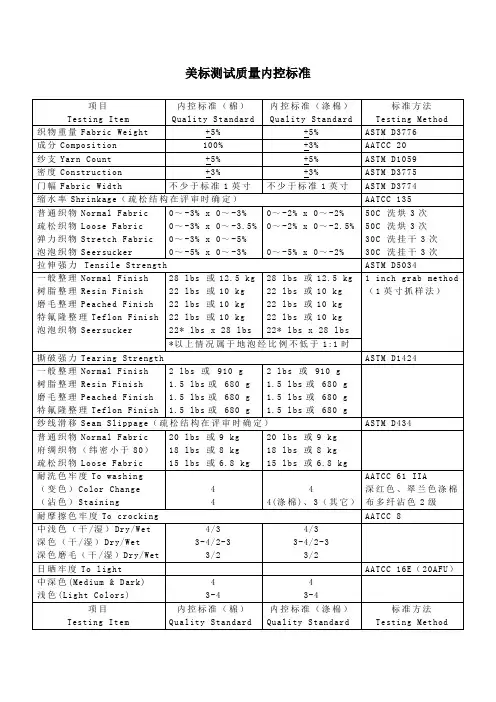

纺织品物性检测常用的检测项目介绍一、检测项目分为两大类二、各国检测方法之简介三、各项检测方法说明一、检测项目分为两大类:(一)牢度部分:1.水洗色牢度2.耐水色牢度3.摩擦色牢度4.耐汗渍色牢度5.耐海水色牢度6.日光色牢度7.色泣(二)物性部分1.克重2.幅宽3.拨水度4.超拨水5.YOULON拨水6.耐水压7.撕裂强度8.断裂强度9.滑脱抵抗力10.水洗缩率11.胶条剥离强度12.游离甲醛的含量二、各国检测方法之简介1.AATCC:American Association of Textile Chemists&Colorists美国纺织化学协会2.JIS:Japanese Industrial Standards日本工业规格协会3.ISO:International Standards Oganizatio国际标准组织4.DS:DECATHLON Standards迪卡侬标准5.其它:如ASTM,渤扬,美津侬等三、各项检测方法说明:(一)色牢度部分1.水洗色牢度(1)目的:模拟纺织品在洗涤状态下的污染情形。
(2)条件:将试样与附布缝合,连同配制好的溶液一同放入钢杯中,置于耐洗色牢度试验机内,依所需条件进行测试,测试完成后,利用分光仪或灰色标来判定变褪色及污染等级。
2.耐水色牢度(1)目的:模拟纺织品在湿润状态下的污染情形。
(2)条件:将试样及附布4×10cm缝合,以清水浸湿后,置于压克力板之间放置于汗渍牢度仪中,施加一定荷重后,依所需条件放置一定时间,测试完成后,利用分光仪或灰色标来判定变褪色及污染等级。
2.摩擦色牢度(1)目的:模拟纺织品在运动或接触摩擦时的褪色程度。
(2)条件:将试样固定于摩擦仪上,摩擦附布5×5cm固定于摩擦头上,附布在试样上来回摩擦10次,历时10秒,测试结束后利用分光仪或灰色标来判定变褪色及污染等级,分为干摩擦色牢度和湿摩擦色牢度。
3.耐汗渍色牢度(1)目的:模拟纺织品碰触人体汗液时,是否会产生褪色现象。
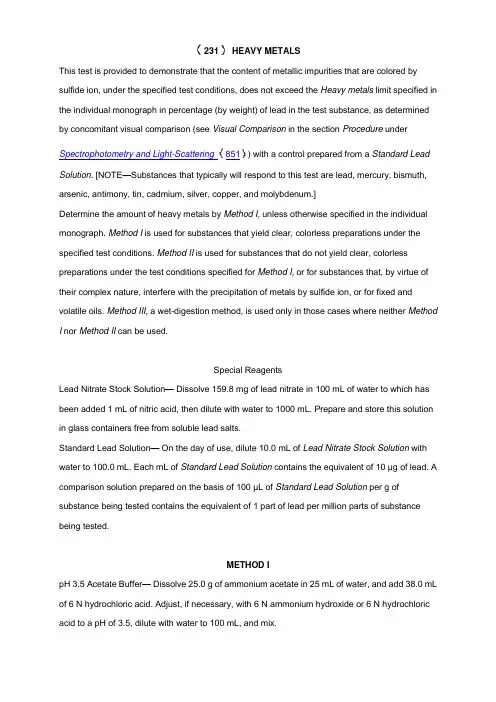
231HEAVY METALSThis test is provided to demonstrate that the content of metallic impurities that are colored by sulfide ion, under the specified test conditions, does not exceed the Heavy metals limit specified in the individual monograph in percentage (by weight) of lead in the test substance, as determined by concomitant visual comparison (see Visual Comparison in the section Procedure underSpectrophotometry and Light-Scattering 851) with a control prepared from a Standard Lead Solution. [NOTE—Substances that typically will respond to this test are lead, mercury, bismuth, arsenic, antimony, tin, cadmium, silver, copper, and molybdenum.]Determine the amount of heavy metals by Method I, unless otherwise specified in the individual monograph. Method I is used for substances that yield clear, colorless preparations under the specified test conditions. Method II is used for substances that do not yield clear, colorless preparations under the test conditions specified for Method I, or for substances that, by virtue of their complex nature, interfere with the precipitation of metals by sulfide ion, or for fixed and volatile oils. Method III, a wet-digestion method, is used only in those cases where neither Method I nor Method II can be used.Special ReagentsLead Nitrate Stock Solution— Dissolve 159.8 mg of lead nitrate in 100 mL of water to which has been added 1 mL of nitric acid, then dilute with water to 1000 mL. Prepare and store this solution in glass containers free from soluble lead salts.Standard Lead Solution— On the day of use, dilute 10.0 mL of Lead Nitrate Stock Solution with water to 100.0 mL. Each mL of Standard Lead Solution contains the equivalent of 10 µg of lead. A comparison solution prepared on the basis of 100 µL of Standard Lead Solution per g of substance being tested contains the equivalent of 1 part of lead per million parts of substance being tested.METHOD IpH 3.5 Acetate Buffer— Dissolve 25.0 g of ammonium acetate in 25 mL of water, and add 38.0 mL of 6 N hydrochloric acid. Adjust, if necessary, with 6 N ammonium hydroxide or 6 N hydrochloric acid to a pH of 3.5, dilute with water to 100 mL, and mix.Standard Preparation— Into a 50-mL color-comparison tube pipet 2 mL of Standard Lead Solution (20 µg of Pb), and dilute with water to 25 mL. Using a pH meter or short-range pH indicator paper as external indicator, adjust with 1 N acetic acid or 6 N ammonium hydroxide to a pH between 3.0 and 4.0, dilute with water to 40 mL, and mix.Test Preparation— Into a 50-mL color-comparison tube place 25 mL of the solution prepared for the test as directed in the individual monograph; or, using the designated volume of acid where specified in the individual monograph, dissolve in and dilute with water to 25 mL the quantity, in g, of the substance to be tested, as calculated by the formula:2.0/(1000L),in which L is the Heavy metals limit, as a percentage. Using a pH meter or short-range pH indicator paper as external indicator, adjust with 1 N acetic acid or 6 N ammonium hydroxide to a pH between 3.0 and 4.0, dilute with water to 40 mL, and mix.Monitor Preparation— Into a third 50-mL color-comparison tube place 25 mL of a solution prepared as directed for Test Preparation, and add 2.0 mL of Standard Lead Solution. Using a pH meter or short-range pH indicator paper as external indicator, adjust with 1 N acetic acid or 6 N ammonium hydroxide to a pH between 3.0 and 4.0, dilute with water to 40 mL, and mix. Procedure— To each of the three tubes containing the Standard Preparation, the Test Preparation, and the Monitor Preparation, add 2 mL of pH 3.5 Acetate Buffer, then add 1.2 mL of thioacetamide–glycerin base TS, dilute with water to 50 mL, mix, allow to stand for 2 minutes, and view downward over a white surface *: the color of the solution from the Test Preparation is not darker than that of the solution from the Standard Preparation, and the color of the solution from the Monitor Preparation is equal to or darker than that of the solution from the Standard Preparation. [NOTE—If the color of the Monitor Preparation is lighter than that of the Standard Preparation, use Method II instead of Method I for the substance being tested.]METHOD IINOTE—This method does not recover mercury.pH 3.5 Acetate Buffer— Prepare as directed under Method I.Standard Preparation— Pipet 4 mL of the Standard Lead Solution into a suitable test tube, and add 10 mL of 6 N hydrochloric acid.Test Preparation— Use a quantity, in g, of the substance to be tested as calculated by the formula:4.0/(1000L),in which L is the Heavy metals limit, as a percentage. Transfer the weighed quantity of the substance to a suitable crucible, add sufficient sulfuric acid to wet the substance, and carefully ignite at a low temperature until thoroughly charred. (The crucible may be loosely covered with a suitable lid during the charring.) Add to the carbonized mass 2 mL of nitric acid and 5 drops of sulfuric acid, and heat cautiously until white fumes no longer are evolved. Ignite, preferably in a muffle furnace, at 500to 600, until the carbon is completely burned off (no longer than 2 hours). If carbon remains, allow the residue to cool, add a few drops of sulfuric acid, evaporate, and ignite again. Cool, add 5 mL of 6 N hydrochloric acid, cover, and digest on a steam bath for 10 minutes. Cool, and quantitatively transfer the solution to a test tube. Rinse the crucible with a second 5-mL portion of 6 N hydrochloric acid, and transfer the rinsing to the test tube.Monitor Preparation— Pipet 4 mL of the Standard Lead Solution into a crucible identical to that used for the Test Preparation and containing a quantity of the substance under test that is equal to 10% of the amount required for the Test Preparation. Evaporate on a steam bath to dryness. Ignite at the same time, in the same muffle furnace, and under the same conditions used for the Test Preparation. Cool, add 5 mL of 6 N hydrochloric acid, cover, and digest on a steam bath for 10 minutes. Cool, and quantitatively transfer to a test tube. Rinse the crucible with a second 5-mL portion of 6 N hydrochloric acid, and transfer the rinsing to the test tube.Procedure— Adjust the solution in each of the tubes containing the Standard Preparation, the Test Preparation, and the Monitor Preparation with ammonium hydroxide, added cautiously and dropwise, to a pH of 9. Cool, and adjust with glacial acetic acid, added dropwise, to a pH of 8, then add 0.5 mL in excess. Using a pH meter or short-range pH indicator paper as external indicator, check the pH, and adjust, if necessary, with 1 N acetic acid or 6 N ammonium hydroxide to a pH between 3.0 and 4.0. Filter, if necessary, washing the filter with a few mL of water, into a 50-mL color-comparison tube, and then dilute with water to 40 mL. Add 2 mL of pH 3.5 Acetate Buffer, then add 1.2 mL of thioacetamide–glycerin base TS, dilute with water to 50 mL, mix, allow to stand for 2 minutes, and view downward over a white surface*: the color of the solution from the Test Preparation is not darker than that of the solution from the Standard Preparation, and the color of the solution from the Monitor Preparation is equal to or darker than that of the solution from the Standard Preparation. [NOTE—If the color of the solution from the Monitor Preparation is lighter than that of the solution from the Standard Preparation, proceed as directed for Method III for the substance being tested.]METHOD IIIpH 3.5 Acetate Buffer— Prepare as directed under Method I.Standard Preparation— Transfer a mixture of 8 mL of sulfuric acid and 10 mL of nitric acid to a clean, dry, 100-mL Kjeldahl flask, and add a further volume of nitric acid equal to the incremental volume of nitric acid added to the Test Preparation. Heat the solution to the production of dense, white fumes; cool; cautiously add 10 mL of water; and, if hydrogen peroxide was used in treating the Test Preparation, add a volume of 30 percent hydrogen peroxide equal to that used for the substance being tested. Boil gently to the production of dense, white fumes. Again cool, cautiously add 5 mL of water, mix, and boil gently to the production of dense, white fumes and to a volume of 2 to 3 mL. Cool, dilute cautiously with a few mL of water, add 2.0 mL of Standard Lead Solution (20 µg of Pb), and mix. Transfer to a 50-mL color-comparison tube, rinse the flask with water, adding the rinsing to the tube until the volume is 25 mL, and mix.Test Preparation— Unless otherwise indicated in the individual monograph, use a quantity, in g, of the substance to be tested as calculated by the formula:2.0/(1000L),in which L is the Heavy metals limit, as a percentage.If the substance is a solid— Transfer the weighed quantity of the test substance to a clean, dry, 100-mL Kjeldahl flask. [NOTE—A 300-mL flask may be used if the reaction foams excessively.] Clamp the flask at an angle of 45, and add a sufficient quantity of a mixture of 8 mL of sulfuric acid and 10 mL of nitric acid to moisten the substance thoroughly. Warm gently until the reaction commences, allow the reaction to subside, and add portions of the same acid mixture, heating after each addition, until a total of 18 mL of the acid mixture has been added. Increase the amount of heat, and boil gently until the solution darkens. Cool, add 2 mL of nitric acid, and heat again until the solution darkens. Continue the heating, followed by addition of nitric acid until no further darkening occurs, then heat strongly to the production of dense, white fumes. Cool, cautiously add 5 mL of water, boil gently to the production of dense, white fumes, and continue heating until the volume is reduced to a few mL. Cool, cautiously add 5 mL of water, and examine the color of the solution. If the color is yellow, cautiously add 1 mL of 30 percent hydrogen peroxide, and again evaporate to the production of dense, white fumes and a volume of 2 to 3 mL. If the solution is still yellow, repeat the addition of 5 mL of water and the peroxide treatment. Cool, dilute cautiously witha few mL of water, and rinse into a 50-mL color-comparison tube, taking care that the combined volume does not exceed 25 mL.If the substance is a liquid— Transfer the weighed quantity of the test substance to a clean, dry, 100-mL Kjeldahl flask. [NOTE—A 300-mL flask may be used if the reaction foams excessively.] Clamp the flask at an angle of 45, and cautiously add a few mL of a mixture of 8 mL of sulfuric acid and 10 mL of nitric acid. Warm gently until the reaction commences, allow the reaction to subside, and proceed as directed for If the substance is a solid,beginning with ―add portions of the same acid mixture.‖Monitor Preparation— Proceed with the digestion, using the same amount of sample and the same procedure as directed in the subsection If the substance is a solid in the section Test Preparation, until the step ―Cool, dilute cautiously with a few mL of water.‖ Add 2.0 mL of Lead Standard Solution (20 µg of lead), and mix. Transfer to a 50-mL color comparison tube, rinse the flask with water, adding the rinsing to the tube until the volume is 25 mL, and mix. Procedure— Treat the Test Preparation, the Standard Preparation, and the Monitor Preparation as follows. Using a pH meter or short-range pH indicator paper as external indicator, adjust the solution to a pH between 3.0 and 4.0 with ammonium hydroxide (a dilute ammonia solution may be used, if desired, as the specified range is approached), dilute with water to 40 mL, and mix.To each tube add 2 mL of pH 3.5 Acetate Buffer, then add 1.2 mL of thioacetamide–glycerin base TS, dilute with water to 50 mL, mix, allow to stand for 2 minutes, and view downward over a white surface*: the color of the Test Preparation is not darker than that of the Standard Preparation, and the color of the Monitor Preparation is equal to or darker than that of the Standard Preparation.。

纺织品验货-AATCC grey scale 灰度等级
色牢度是指纺织品的颜色对在加工和使用过程中各种作用的抵抗力。
根据试样的变色和未染色贴衬织物的沾色来评定牢度等级。
纺织品色牢度测试是纺织品内在质量测试中一项常规检测项目。
评定变色用灰色样卡由五对无光的灰色小卡片(或布片)组成,分为五个牢度等级,即5,4,321,在没两个等级中再补充半级,即4-5,3-4,231-2,合称五级九档灰卡。
每对的第一组均是中性灰色,其中仅5级的第二组成相一致,其他各对的第二组成在色泽上依次变浅,色差逐级增大。
变色评级时,将原样与试后样按同一组织结构方向并列置于同一平面上,灰色样卡也置于其旁,然后在上面放一个中性灰色遮框,使灰色样卡与试样面积相同,在规定观察条件下,以样卡色差程度与试样相近的一级作为试样牢度等级。
第三方验货公司在面料检验过程中,对于颜色评定一般要求如下:1. 卷与卷或批与批之间的色差不得低于AATCC灰度表中的四级。
2. 同卷面料内边对边、边至中的色差不得低于AATCC灰度表中的 4.5 级。
3. 布头、布尾的色差不得低于AATCC灰度表中的四级。
4. 工厂所分的缸差(LOT色)与头缸样(确认样)不得低于AATCC 灰度表中的四级一般用到的灰卡如下图。