
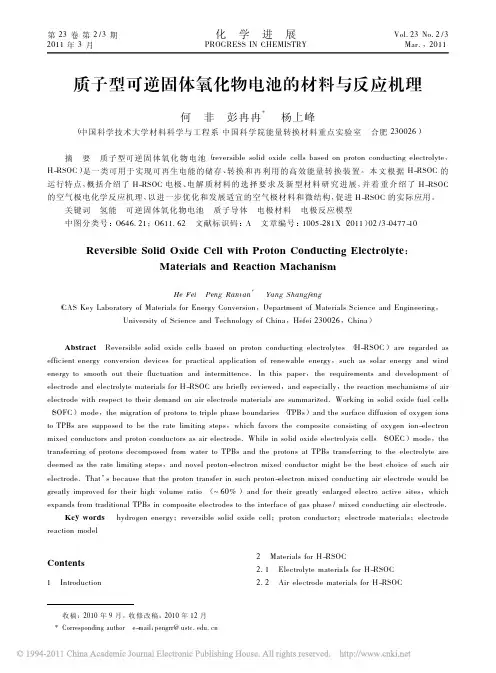
质子型可逆固体氧化物电池的材料与反应机理_何非
- 格式:pdf
- 大小:1.02 MB
- 文档页数:10

质子交换膜燃料电池机理模型哎呀,说到质子交换膜燃料电池(PEMFC),这玩意儿可真是个技术活儿。
咱们今天就来聊聊这个听起来高大上,实际上跟咱们生活息息相关的玩意儿。
首先,得说说这玩意儿是干嘛的。
简单来说,质子交换膜燃料电池就是一种能把氢气和氧气转换成电能的装置。
你可能会问,这跟咱们有啥关系?嘿,这关系可大了去了。
你想啊,如果这玩意儿能大规模应用,那咱们的汽车就不用烧油了,直接用氢气,既环保又节能,多好!好了,咱们来聊聊这玩意儿的机理模型。
首先,你得知道,质子交换膜燃料电池主要由三部分组成:阳极(氢气入口)、阴极(氧气入口)和中间的质子交换膜。
这膜可不是一般的膜,它得能导电,还得能阻止氢气和氧气直接接触,不然它们俩一见面就“嘭”的一声,那可就麻烦了。
咱们先从阳极说起。
氢气从阳极进入,然后在催化剂的作用下,氢分子被拆分成两个质子和两个电子。
这电子呢,就被送到电路里去,产生电流。
而质子,就得穿过那层神奇的质子交换膜,跑到阴极去。
说到这质子交换膜,它得既透气又防水,这样才能让质子顺利通过,同时不让电子和气体乱跑。
这可是个技术活儿,得用特殊的材料和工艺才能做到。
然后,咱们再来看看阴极。
氧气从阴极进入,和从阳极过来的质子结合,再吸收电子,形成水。
这水就是这整个反应的副产品,既环保又无害。
整个过程中,质子交换膜燃料电池的机理模型就像是一个精密的机器,每个部分都得精确配合,才能保证电能的高效转换。
这玩意儿虽然听起来复杂,但其实就跟咱们平时用的电池差不多,只不过它用的是氢气和氧气,而不是化学电池里的化学物质。
最后,咱们得说说这玩意儿的未来。
随着技术的发展,质子交换膜燃料电池的成本正在逐渐降低,效率也在提高。
说不定哪天,你就能开上一辆用氢气驱动的汽车,既不用担心油价上涨,也不用担心环境污染。
好了,关于质子交换膜燃料电池的机理模型,咱们就聊到这儿。
这玩意儿虽然复杂,但想想它能给咱们带来的好处,还是挺让人期待的,不是吗?。

可逆质子陶瓷电化学电池英文回答:Reversible Proton-Conducting Ceramic Electrochemical Cells for Hydrogen Production and Storage.Reversible proton-conducting ceramic electrochemical cells (PCECCs) have attracted significant attention for hydrogen production and storage due to their potential for high efficiency, fuel flexibility, and durability. PCECCs utilize proton-conducting ceramic membranes as electrolytes, which exhibit high ionic conductivity and chemicalstability under operating conditions. The ability of these membranes to transport protons enables the reversible conversion of hydrogen into electricity and vice versa.In hydrogen production mode, PCECCs operate as electrolysis cells, utilizing electricity to split waterinto hydrogen and oxygen. The proton-conducting ceramic membrane acts as a barrier between the anode and cathode,allowing protons to migrate from the anode to the cathode, where they combine with oxygen to form water. The hydrogen produced at the anode can be collected and stored for later use.Conversely, in hydrogen storage mode, PCECCs operate as fuel cells, utilizing hydrogen as a fuel to generate electricity. Hydrogen is supplied to the anode, where it reacts with the protons in the membrane to form water and release electrons. These electrons flow through an external circuit, generating electricity. The water formed at the cathode is then recycled back to the anode, completing the cycle.The key advantages of PCECCs include their high efficiency, fuel flexibility, and durability. The use of proton-conducting ceramic membranes allows for low overpotentials and high current densities, resulting in high energy conversion efficiency. Additionally, PCECCs can operate on a wide range of fuels, including natural gas, biogas, and renewable hydrogen, providing fuel flexibility. Furthermore, the ceramic materials used in PCECCs exhibitexcellent chemical and thermal stability, enabling long-term operation and durability.However, there are also challenges associated with PCECCs, including the cost and complexity of the materials and the need for high operating temperatures. Research efforts are currently focused on developing new materials and reducing the operating temperatures of PCECCs to make them more cost-effective and practical for widespread applications.中文回答:可逆质子陶瓷电化学电池,制氢储氢新途径。


固态电池的正极材料随着能源和环境问题的日益严峻,新型高效能源的研究和开发已成为各国科学家和工程师的热门话题。
固态电池作为一种新型高效能源储存装置,其正极材料的研究和开发也备受关注。
本文将从固态电池的基本原理、正极材料的分类和性能要求、目前研究进展等方面进行探讨。
一、固态电池的基本原理固态电池是指正负极材料之间没有液态电解质,而是采用固态电解质进行离子传输的电池。
其基本原理是正极材料通过氧化还原反应释放或吸收电子,从而完成电池的充放电过程。
在充电时,电池的负极材料释放出电子,正极材料吸收电子,同时离子在固态电解质中传递;在放电时,电池的正极材料释放出电子,负极材料吸收电子,同时离子在固态电解质中传递。
固态电池相比于传统电池具有以下优点:首先,由于采用固态电解质,固态电池可以避免液态电解质的泄漏和腐蚀等问题,具有更高的安全性和稳定性;其次,固态电池的能量密度更高,可以实现更长的续航里程和更高的输出功率;第三,固态电池的循环寿命更长,可以实现更长的使用寿命和更低的维护成本;第四,固态电池可以采用多种材料进行设计,具有更大的设计灵活性和适应性。
二、正极材料的分类和性能要求固态电池的正极材料主要包括氧化物、硫化物、硒化物、氮化物等,其中氧化物材料应用最为广泛。
根据氧化物材料的结构和性质,可以将其分为多种类型,如锂离子正极材料、钠离子正极材料、钙钛矿材料、锰酸盐材料等。
正极材料的性能要求主要包括以下几个方面:首先,正极材料应具有高的电化学活性,即具有较高的充放电容量和较低的充放电电位;其次,正极材料应具有良好的稳定性和循环寿命,即能够在长期充放电循环过程中保持较高的电化学性能和结构稳定性;第三,正极材料应具有高的离子传输速率和低的电阻率,即能够快速地进行离子传输和电子传导,从而实现高功率输出和高能量密度;第四,正极材料应具有低的成本和易于制备,即能够实现大规模、低成本的生产和应用。
三、目前研究进展目前,固态电池正极材料的研究进展较为迅速,已取得了许多重要进展。